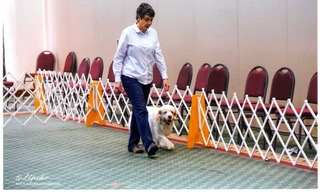

111- Gretchen Schultz: The “Queen of Slobber” – PHA Hall of Fame Inductee
Gretchen Schultz aka the “Queen of Slobber”
For a woman of such tremendously strong opinion and personality, it is remarkably difficult to find much public information about Gretchen Schultz.
I hope you guys enjoy hearing from one of my great idols and, at least distantly, mentors.
I always was slightly terrified of Gretchen even from across the Expo Center in Portland, but she was my original “stalking” victim! I watched *everything* she did. Short of growing a “rat tail,” as they were called in the day, I wanted to be JUST like Gretchen when I “grew up.”
2nd Generation – Daughter of Professional Handlers
The daughter of very famous professional handler parents, Gretchen’s father, Walt Shellenbarger, went on to judge. He scared the bejeezus out of me the few times I was in his ring! Her mother, Jo, handled the famous Traveler, Ch. Gretchenhof Columbia River to Best in Show at Westminster Kennel Club in 1974.
Jo also showed Clumber Spaniels for the one and only Bets Young of Cypress Woods kennels. My parents were very involved in the early 1980s with convincing the powers that be in the Clumber Spaniel Club of America (primarily Bets) that field work should be included in the national events. I have very vivid memories of Jo, toward the end of her career, convincing my 15 year old brother to dance with her at a social event in Bets’ home.
Gretchen and German Shorthaired Pointers
Gretchen grew up with 50 German Shorthaired Pointers, but started her junior showmanship career with an English Cocker Spaniel, because the German Shorthairs were too big for her. She credits her mother with teaching her about breeding dogs and her dedication to her parents’ memories is obvious.
Despite an attempt to break away from the allure of the dog show world, traveling the world and some wild adventures, Gretchen couldn’t stay gone for long. Her passion for the sport runs deep and wide.
How did Gretchen get the nickname Queen of Slobber?
Married for many years to Bruce Schultz, they were a powerful handling team. Gretchen became known as the “queen of slobber” for her most consistent clientele… Bloodhounds and Mastiffs. Gretchen handled the Bloodhound bitch, Ch. Ridge Runner Unforgettable, to the record as the top-winning Bloodhound of all time. Just before Westminster 2001, Gretchen had knee surgery, so Bruce showed ‘Fanny’ to her big Group First win.
Fundraiser for American Cancer Society’s Relay for Life
As a multiple cancer survivor, literally given months to live more than once, Gretchen has become a major fundraiser in the American Cancer Society’s Relay for Life. She remarried in 2013. She and her husband Phil Lawrence are avid golfers.
Gretchen is, if nothing else, forthright in her opinion… She expresses frustration with the judges’ approval process at the AKC and describes the “old days” and a system by which judges “sank or swam” based on their ability to draw an entry and their popularity with clubs and exhibitors. She currently judges 13 breeds along with junior showmanship.
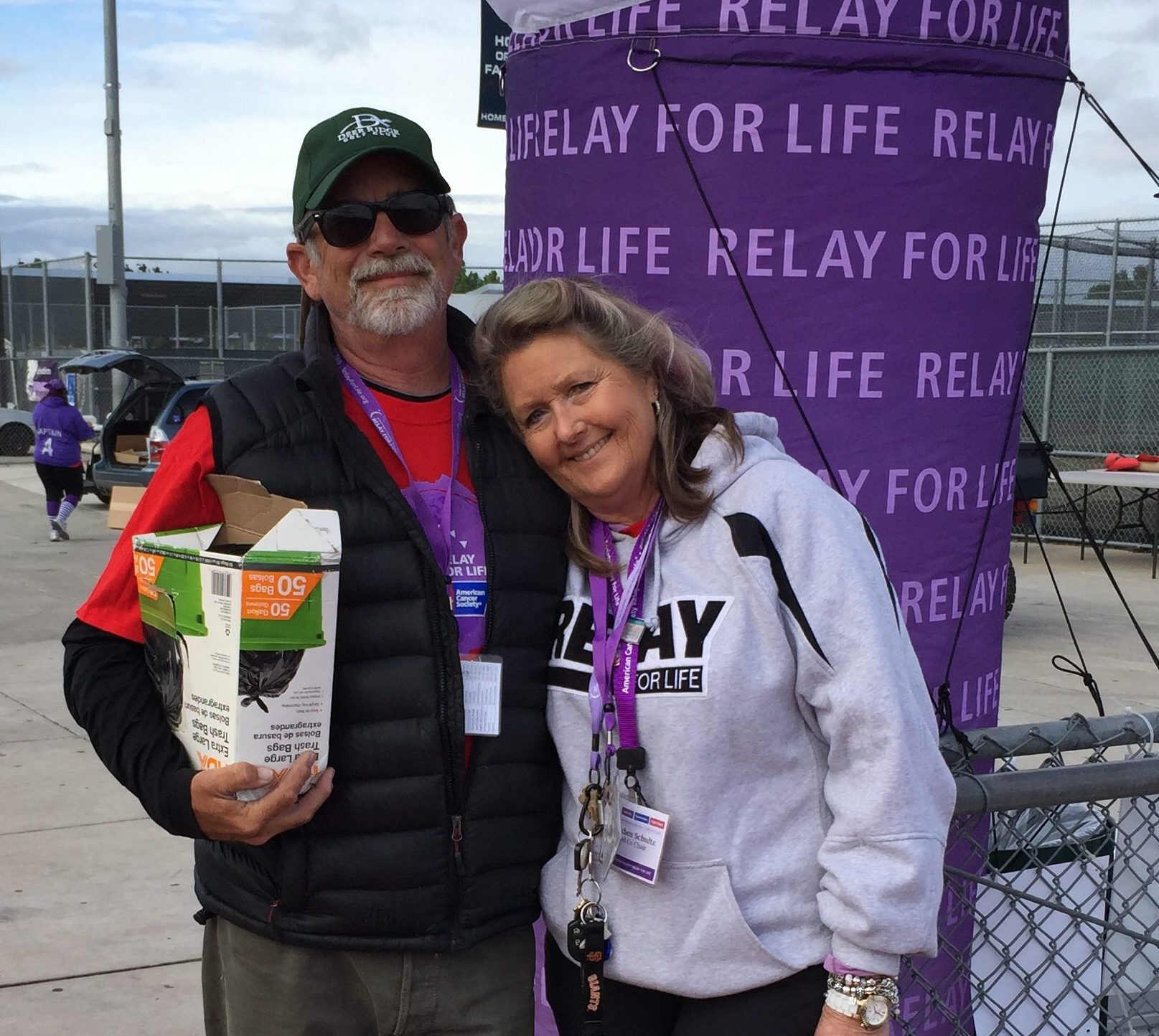
Gretchen Schultz Relay for Life
Gretchen Schultz PHA Hall of Fame Inductee
The PHA is pleased to announce establishment of the Hall of Fame intending to recognize current and past members whose individual effort over the years have made immeasurable contributions to the Association, the dog handling profession, and the sport of showing purebred dogs.
Their unselfish work, guidance, and leadership have permitted the PHA to evolve into a strong, vibrant, and honorable organization that proudly represents the interest of professional dog handlers. Without their lifelong involvement and dedication the Association, nor the fancy, would be the showcase it is today for the exhibiting of purebred dogs.
110 – Cherrie Spring: How To Talk To the Animals – English Springer Spaniels and Animal Communicator
Cherrie Spring – From English Springer Spaniels to Talking with the Animals
Handing her English Springer Spaniel to professional handler Gary Zayac at the National, vaulted Cherrie Spring into the world of dog shows. Balance in dogs, and balance with and through her skills as an animal communicator was not always easy. But just as show dogs learn to use themselves well, Cherrie has honed her communication skills to answer questions between owners and animals.
In addition to her work as an animal communicator, Cherrie Spring has a long, diverse history involved with purebred dogs. She agreed to share some of her most powerful lessons with our PureDogTalk listeners.
Enjoy this wonderful tribute to her mentors! Laura Reeves
Words of Wisdom from my Mentors
…as remembered by Cherrie Spring
Wisdom comes in as many forms as there are teachers. I will share some of the more memorable from the great teachers in my life, recognizing that in saying this I am leaving out many people.
From Debbie Ritter – Pedigrees
I learned that, in reading pedigrees, you must consider the grandparent’s influence as if you are not breeding the two you are considering, but the four behind them. If any of those four, in your estimation, should not be bred, for any reason, the breeding should not be done.
When breeding from a dominant bitch line to an outcross you should never expect to go forward in that generation alone. Only keep out of the litter what your vision is going forward. When breeding to a line-bred dog, you must always consider his stamina, drive and temperament as the foremost component of what you are trying to achieve.
You absolutely, without exception, must know the faults in make and shape and genetic abnormalities that all animals in the first three generations have to make an educated and responsible decision in a considered breeding.
She taught me how to read a pedigree like no one before her or since. She understood our breed (English Springer Spaniel) and the individuals in it that well.
From Karen Prickett Miller – English Springer Spaniels
I learned, you cannot shorten the muzzle of an English Springer Spaniel without compromising everything in head structure which makes the Springer head unique. A shoved in foreface creates a round eye and lack of correct chiseling around the eye and to include the muzzle that is specifically stated in the standard. This shortening also causes the upper lid to lose its shape and become round, another fault addressed in the standard. The loss of length of foreface also creates a lack of room for pre molars. A Springer head with these proportions and faults has no strength or stamina to carry game in its mouth correctly.
You cannot have a short headed dog and have a dog that is proportioned to the standard, as measurements starts with the length of the head. Bone on a Springer is flat. It is not round. Round bones are heavier than flat bones. Make your bones flat and wide, not round and dense. This really applies to legs and rib cage.
Teach them to go (move) on their own. They must go as they stand in profile.
Four Qualities in Breeding Animals
There are four qualities that every breeding animal should have. Strong character appropriate to their breed. Deep underjaws in breeds that are to have a scissor or level bite. Straight front legs. Breed appropriate feet. The down fall of these mark the downfall of the breed.
I have had Anne Clarke tell Gary and I the same things.
From Denis Springer I learned:
You have to be tough as nails on the outside, with hands that are trusted and gentle guided by your love of the dog and the fancy.
He would tell me, “Toughen up Red, regroup and show them what is really inside.”
You must let your hands tell you what your eye lies to you about.
No matter how great a groomer you are, the studied and schooled eye can always know your lie. You can’t hide bad structure, unless you take them apart and restitch them.
From Gary Zayac I learned:
- Many people can get the Best In Show dog in the whelping box. The trick is having the eye to pick the correct one and managing them from the whelping box to the Best In Show ring.
- Silent mouths, silent hands and an always watchful eye wins the prize.
- Teach them (dogs) to trust you and they will give you the world. Teach them to fear you and you have no dog when things get rough.
- When the dogs really trust you, then you can push them past what they fear.
- Be invisible, inside the ring and out, until it is time to not be.
- Believe in the dog on the end of the lead. And believe in the dog you take home.
- Patience is the foundation of all good work in the world.
- Good sportsmanship is the foundation of all that we do and no win is complete without the honor of your fellow exhibitors.
From Chris Terrell I learned:
Be humbled by the magnificence that surrounds you.
Find joy in every day.
Walk gently and honor the life you have.
He taught me so much about how to handle big out of control dogs that were acting out of fear and being overwhelmed. He’s a master at mind control. I learned so much from him about controlling my mind and body. He taught me to not care and let it roll off my shoulders what people thought and said about me and the dogs. Gary, by the way told me the same thing, but Chris was not the husband. (LOL)
From Brenda Albrecht
I learned how to be a really hard worker for a club and to be a part of a community who’s goal was the preservation and promotion of a breed that we all loved. She taught me how to be a selfless club member where the club came first and my needs or schedule was not a huge consideration.
Talking to the Animals – Cherrie Spring
Cherrie Spring reveals her root story of how talking to the animals began in episode #110 of Pure Dog Talk.
I would not want to detract from you listening to her tales, but well-worth your ear.
Cherrie does leave our listeners with a insightful blessing.
Be Still With Your Animals
Be quiet. Be still. Listen deeply. Ask gentle questions. Watch.
This practice of being still with your animals may help you communicate clearer and deeper.
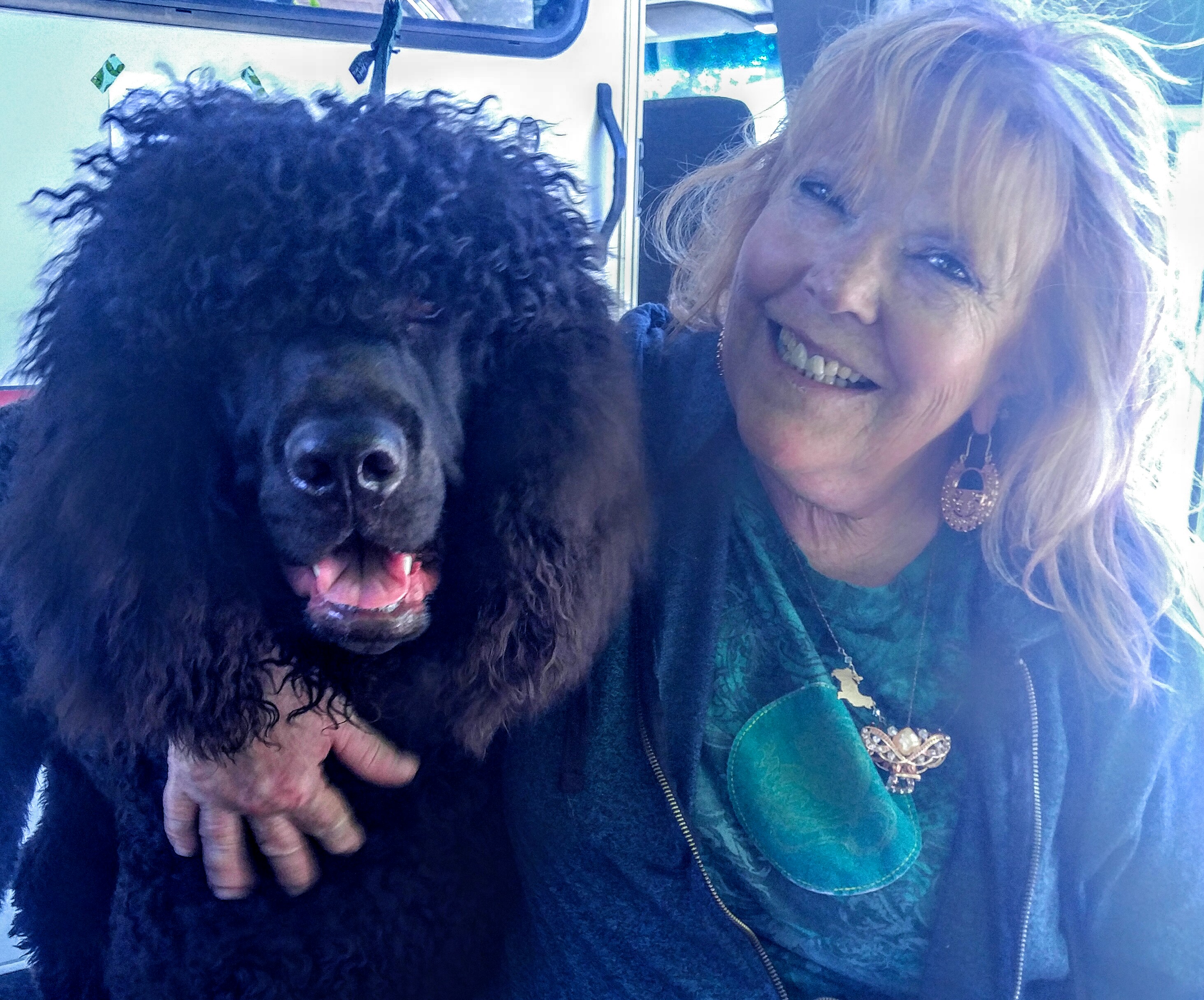
109 – Social Media Sportsmanship: Dog Show Forum and The Dog Judges Report Card with Jacqueline Zwirn
Jacqueline Zwirn: Dog Show Forum and The Dog Show Judges Report Card
Jacqueline Zwirn is 3rd generation dog shows… literally “whelped” into dogs. A successful junior handler of her mom’s Great Danes, Jacqueline continues today to show Miniature Pinschers under the Sidel Miniature Pinschers prefix. Junior Showmanship taught… SPORTSMANSHIP Sportsmanship is ethics, etiquette, manners, losing and winning with dignity and the strive and drive to improve.
Sportsmanship as Administrator of Dog Show Facebook Groups
Sportsmanship skills are a question on Facebook and social media. Why, hidden behind a keyboard, is permission granted to lose the core ethics of showmanship?
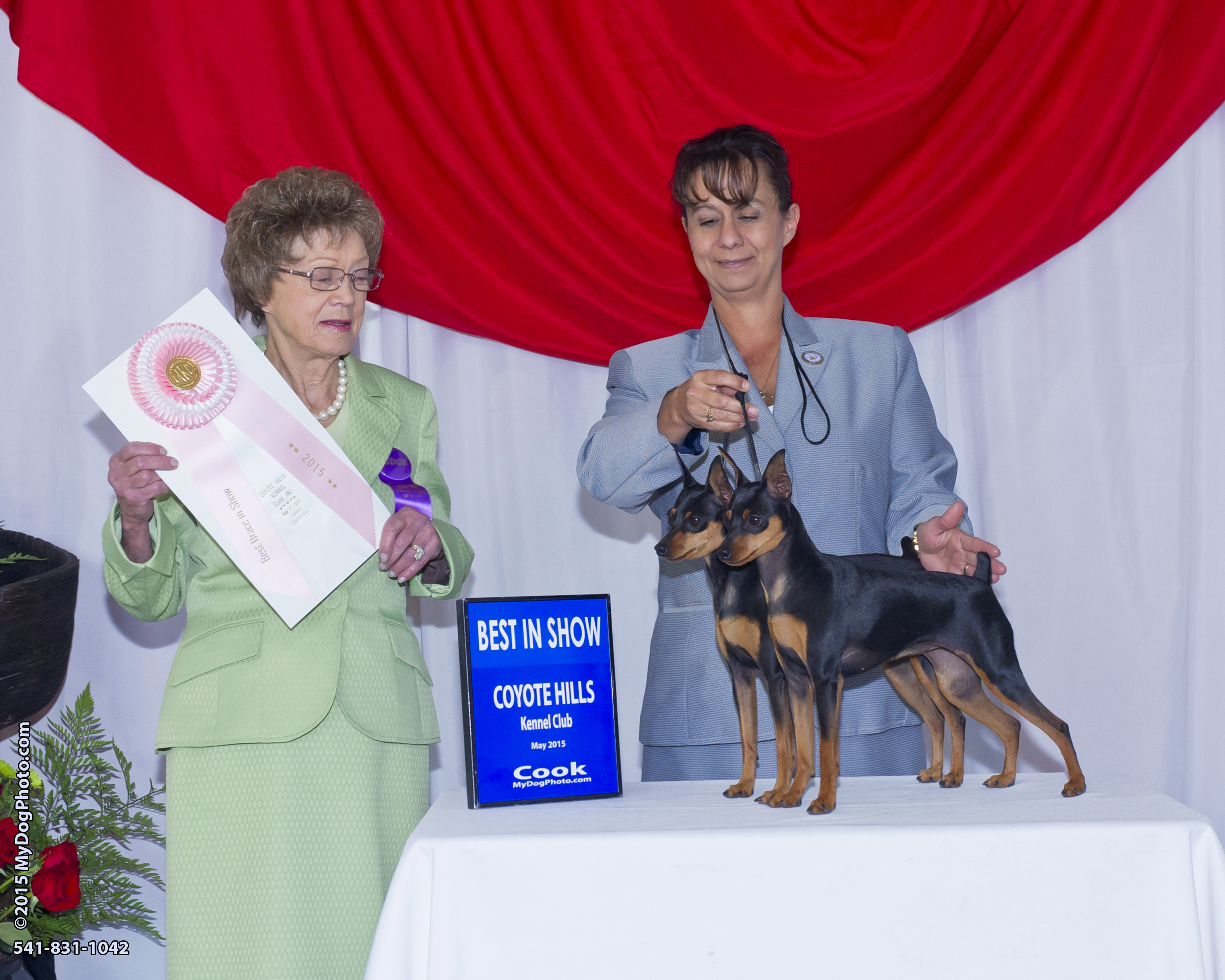
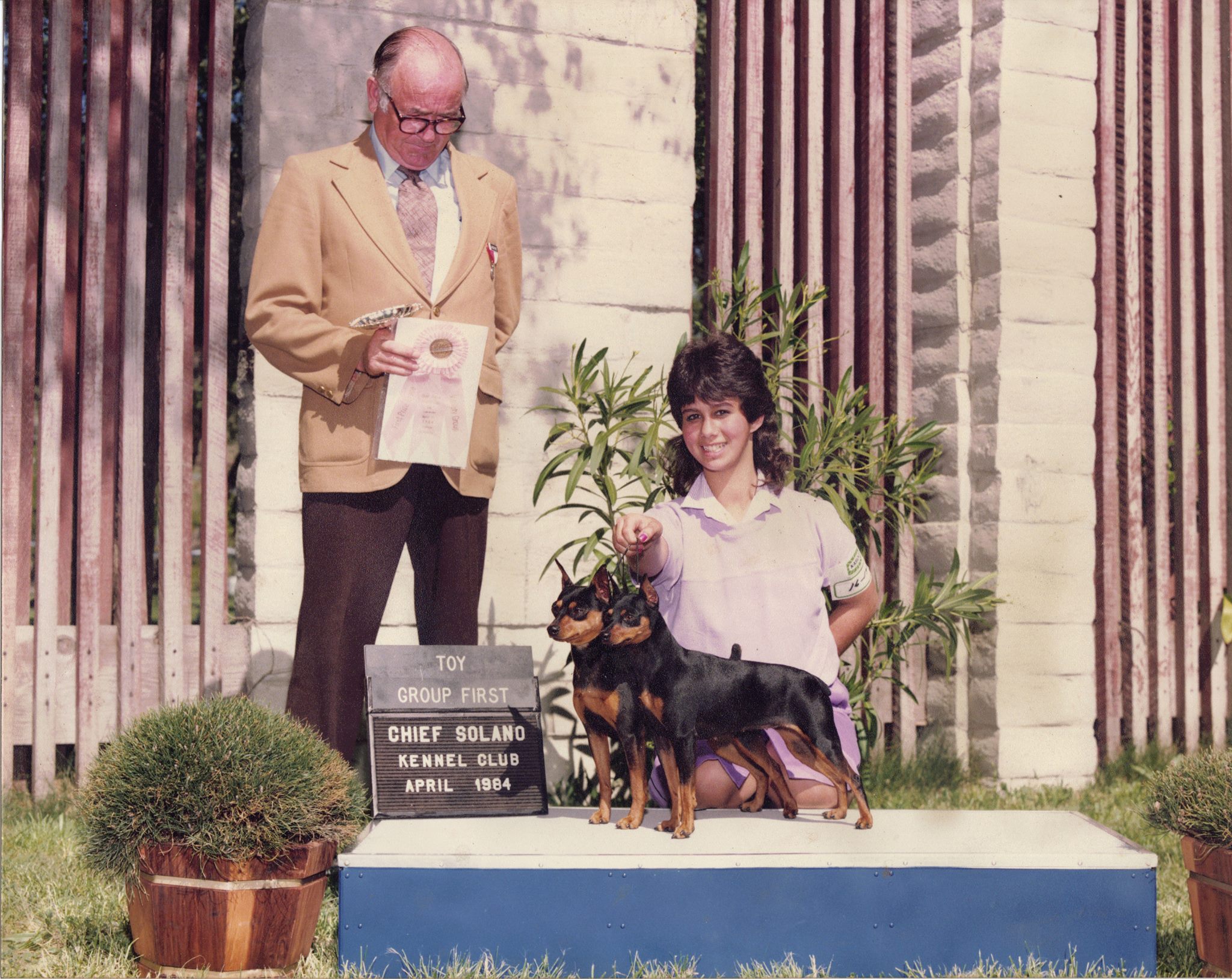
Jacqueline Zwirn winning with her Miniature Pinscher brace under Patricia V. Trotter
Listen to Episode #109 of Pure Dog Talk as Laura Reeves and Jacqueline Zwirn discuss how Facebook and social media groups could mentor exhibitors and breeders in understanding the judge’s opinions, and learn to breed better dogs.
Social Media Thoughts From Jacqueline Zwirn
Rules of Sportsmanship:
- No Slander or Attack
- Give facts of your experience, not your opinions
- Describe what or why you felt something happened
- Listen and learn
- Don’t vent because you lost
Ringside and Judges Perspectives:
- Ringside has more time to evaluate a dog than the judge
- The Judges view is not the same as the ringside view
- Judges may be looking at or for something different than you
Owners:
- Owners that have only one dog may have emotional attachment blinders on, and not be able to see what the judge sees
- Handlers are a great resource for an evaluation.
- Handlers are not emotionally attached to your dog’s critique
- Judges read, hear or talk about what is said online. Don’t kiss up or promote your dog
Dog Show Judges:
- Dog Show Judges are people too!!!
- Judges love dogs
- Judges are human and constantly learning
- Judges spend a ton of money to become judges and make VERY LITTLE!!!
Correctly Assessing a Judge’s Intentions
Even professional handler’s sometimes mistake a judge’s intention, preferences, or pet peeves. Breeder Judges may look for or be harder on something that affected their line or is a problem in the breed. Judges not as familiar with your breed may be more generic in selection.
Evaluation of what a judge might like or dislike in a dog is really hard. There is no hard and fast rule. Try not to categorize them as a head hunter, or a movement judge without systematically analyzing if that is true. Oftentimes the “current opinion” is just gossip and not grounded in fact.
- As a judge learns, their opinions may change
- Different dogs are in the ring, every show is different
- Your “belief” that your dog is perfect, colors your opinion
Boring News… Go Back To Your Breed Standard
Sorry… but maybe if it is said enough times? Go back to your breed standard. Understand your breed standard. Question what it means? Does your dog excel in every part of the standard? If so, get a second opinion!
108 – Bill Ellis and Junior Showmanship: How Junior Showmanship Prepares You For Life Outside the Ring
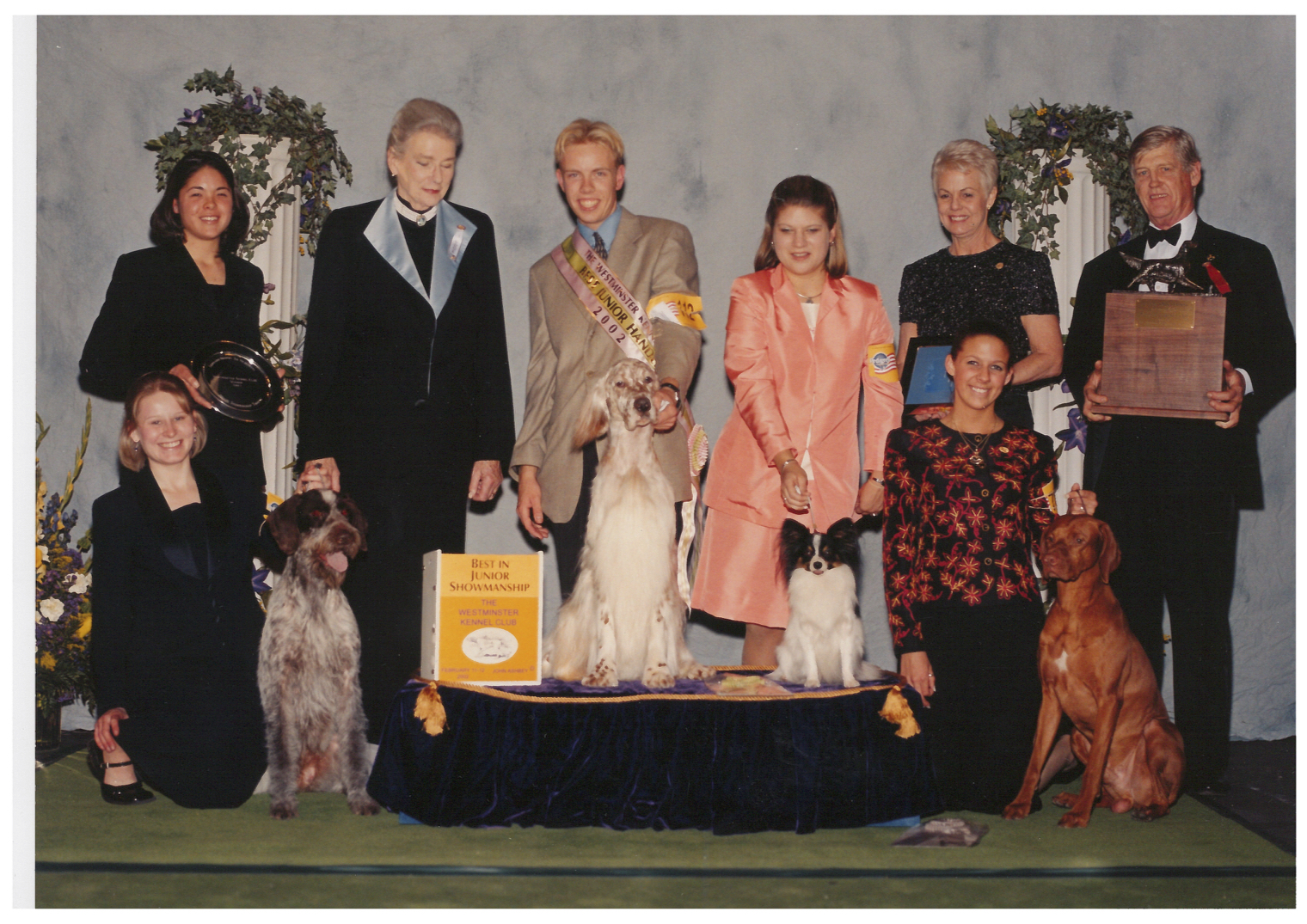
Bill Ellis, once a former junior showmanship competitor, is currently Communications Coordinator for the American Kennel Club.
Bill talks with Laura Reeves of fond memories and how what he learned through Junior Showmanship prepared him for life outside the ring.
Laura Reeves
I have always believed that Junior Showmanship and a childhood spent raised in and around the sport of purebred dogs is invaluable in many diverse ways.
After all, Mom enrolled me in dog care 4-H in fourth grade because I was “shy and retiring and lacked people skills”… Forty years later, who I am is due, in large part, to what I learned there and by continuing on into the sport of purebred dogs. Literally, my best friend in third grade was the school librarian. I was the only eight year old kid who knew the entire Dewey Decimal system by heart since I spent most every recess and lunchtime shelving books with Mrs. Young.
While I’m still the head bookworm at heart, I learned how to cope, how to get along, how to lead as well as follow, how to manage time, take responsibility, have a thick skin for criticism (a *definite* requirement in journalism and the dog show world), how to make friends, etc ad nauseam. I have an expensive college degree that broadened my exposure to the outside world, but I would never have survived it without the years spent with dogs learning how to be “human.”
Bill Ellis and other former Junior Handler’s skills
When I interviewed Bill Ellis on this topic, it struck me that all of these “transportable skills” as the human resources people like to call them, are not unique to me. So I reached out to the fancy for their thoughts on the topic. Turns out, as usual, I didn’t even know the half of it!
From special education teachers to emergency managers, from researchers to factory workers, from lawyers to stay at home moms, the uniting theme is the work ethic, compassion, confidence, grace under pressure, skillful multitasking and so much more that young people acquire in this sport.
Thanks to former juniors and assistants
Tremendous thanks to the dozens of former juniors and assistants who responded to my inquiry. I’m including a great many of their stories, comments and observations here. Mostly because so many of them were so intense, specific and concrete.
Meanwhile, for all of you out there who think Junior Showmanship is nothing more than a training ground for future professional handlers, think again. This part of the dog fancy is busy training up an entire miniature work force of individuals with determination, punctuality and perseverance that are sadly lacking in too many youngsters outside our world.
Former Junior Handlers and/or Assistants: Where Are They Now?
Heather Hale:
My introduction to the sport came via none other than Cie Harris and her giant Irish Wolfhounds in the mid 90’s. I wish I could say what drew me into the sport beyond being a preteen girl who didn’t have the first clue as to how to dress to impress boys and virtually no real social life, so naturally going to dog shows and engrossing myself could do nothing to further ruin my already stellar reputation right?
Somewhere along the way, I convinced my parents to let me tag along and “help” Cie at a dog show. From the first instant I was hooked. I loved this exciting and crazy world, the smell, the odd way people dressed and ran, but most of all I loved the dogs. I loved the sizes and shapes and their natural ability to love and want to please their masters. I didn’t have the first clue that I would be entering what has become a mild obsession for me my entire life.
Then I met you, Laura Reeves, a professional handler and quite possibly the scariest and nicest woman I had ever met. You didn’t need anyone, a man, children, or close friends to sit and have coffee with and gossip about other friends. I was all at once stunned and intrigued, certainly if you could have that kind of confidence and push around a 150 lb Irish Wolfhound, then there was something to be learned from you.
My fear was matched equally by my respect for you and you began to teach me about everything that is dog shows; waking up at 6 am to walk and bathe dogs, schlepping crates that were bigger than me “the proper way”, how to properly strip a coat, how to load a Dodge van (something out of Tetris), how to not get a run in my panty hose (because we were down to the last pair), the importance of good flat shoes and pockets in your show clothes, and how to set up x-pens, grooming tables, mats, and every other sort of equipment (and do it quickly), but the most important thing I learned was that the dogs’ safety and comfort were paramount. These dogs not only trusted us to do the right thing, but they loved us and counted on us every minute. They performed for us, and played with us when it was over. I learned that it was the most thankless job I would ever have, but also the most rewarding one.
I am not sure I will ever match the feeling I had when Ric Byrd gave me Best Junior from the Open Junior class, beating Candace with the Dalmatian, or having a crush on Jorge who showed a Beagle in juniors.
So many lessons learned. I am now in wine sales, (which is arguably the best career in existence) but to be in any sales one must possess a certain level of confidence, certainly hard work, and the innate ability to connect to people you barely know. I am certain that my early years in dog shows gave me these qualities. I am married, I have 2 wonderful children, but I also know that I am capable of handling a 150 lb dog.
I have a love for dog shows that will never go away. When I was going through a somewhat messy divorce I did what any dog show enthusiast would do; I flew to Texas, bought a Beagle puppy, brought him home, bought a motorhome and spent a year showing him. It was the time of my life. He became a champion in less than 6 months, and the two times a judge put him BOB from the 12-18 month class we took back to back G4s. If I hadn’t met my husband and if Jake had filled out and didn’t look like a Beagle bitch instead of a dog, I would have continued to show him. But alas, my life went a different wonderful way.
I still think that someday I will find myself back in the ring, hopefully this time it will be with my husband after our kids have grown and we are doing it for fun because that is what dog shows have always been to me. A source of good memories and lots of fun. I miss the “dog show world” and a part of me is always envious to see those still in the sport, but I don’t think I have seen my last show ring. Or at least I hope not.
PS I chose wine sales because I get paid to drink wine, and who the hell wouldn’t want to do that? I have a bachelors degree in Civil Engineering, but quickly found that I am not a desk person and I multi task way too well to try and fill 8 hours behind a desk. Also could be attributed to my first job as an assistant. Nothing says multi tasking better than that!
Natalie Grochowski
I came from a non dog family but showed an English Cocker in juniors, aging out in 2010. I worked for Kellie Fitzgerald and Chris Berg from 2008 and onward for several summers and occasionally through college when I could. I now work in Federal Management Consulting, particularly in program management activities for agencies within the Department of Homeland Security.
Kellie and Chris were huge mentors to me and always encouraged me to get an education outside dogs- that I could always come back to dog shows if I wanted to. Working for them has honestly shaped my life in so many ways, most notable the work ethic it takes to be successful in dogs translated to my education and now my work life. Working for them honed my attention to detail, appreciation for the amount of behind the scenes work that goes into any successful product (dog, or client presentation etc.), and most importantly to never cut corners – that if anything is worth doing, it is worth learning the right way. One of the reasons I wanted to work for them was because I always admired Kellie’s sporting dog grooming and wanted to learn how to do it well too – the importance of giving even the smallest tasks your all had always stuck with me since the first time she said it and it has helped tremendously in my job. The idea of mentorship and finding lessons out of every interaction has also brought me leaps and bounds in my work life. I learned so much by listening at dinner to so many great dog people, and the idea of being a good listener (as opposed to pretending to be an expert on Day 1) is still with me today.
I didn’t pursue a career in dogs because I wanted the flexibility to show my dogs and have my own breeding program and do shows on my own time. I was worried that if I did this as my profession, I would burn out and resent it, but if I did this as my release and hobby – I’d stay motivated and passionate about learning and being involved. If I feel frustrated with dog shows or anything, having a life outside dogs allows me to step away and then come back when I am ready (I always do!) and see things with a fresh and renewed perspective which I think has kept me excited and in love with the sport.
Coming full circle- I actually am in the process of getting my junior showmanship license and can’t wait to give back to the sport. I am getting ready to marry a non dog show person (after vetting him at the dog show of course) and he keeps me grounded while totally supporting my passion as well. I got my first show dog since college about a year ago and am excited to learn about my new breed. To be honest, there are days where I listen to your podcast on my drive to work or on my lunch break and wonder if I made the right decision- but it is also through your podcast that has inspired me to get more and more involved with dogs at different levels and opened my eyes to the different possibilities within dogs to make a difference.
Demery Paladichuk
“I spent my teenage years working as an assistant for Randy Schepper, Kevin & Diane Chestnut, and most notably Shea and Tiff (Skinner) who I still have a very close relationship with to this day (and love like family). I spent all this time with a specific plan in my head: go to college, get my degree in business (as the “back up plan” everyone talks about), and return to dog shows.
I knew I wanted to go to college, and I don’t know if Shea and Tiff, and especially Don Rogers would have been very happy with me if I hadn’t! He especially told me to go every chance he got. So I went to WWU, took some classes, hated the business ones, made friends, and started volunteering. It broke me out of the dog show bubble I had been immersed in and opened my eyes to what all else was out there.
I started doing a lot of thinking about what I wanted my life to look like 5, 10, 20, 50 years from now, and what I wanted my life to mean. As much as I loved, and still love dog shows, at the end of the day (to me), it’s running around the ring with a dog. To me, dog shows are fun, but don’t provide me with a purpose in life.
I personally couldn’t justify knowing that there are human beings suffering, dying completely preventable deaths, and with an education I could make a difference in their lives. How do you compare that to a dog show? So in a few months I’ll be a nurse practitioner, and even better, will have a reliable job with a great salary, job security, benefits, PTO, and weekends off… which are all things you don’t exactly have being a professional handler.
With that being said, dog shows will always have a place in my heart. And I have absolutely nothing against professional handlers, it’s just not how I ultimately wanted my life to look. I’m now a regular status all-breed juniors judge. I’m super excited to finally be (almost!!) done with school as it means I can get more involved in dog shows again, and I’m lucky to co-own some beautiful puppies with Kim Bullard as well as two well-known springer breeders who I’ve already learned a lot from and can’t wait to keep learning from. I will hopefully be getting my own puppy within the next year and will start my breeding program (most likely in collaboration with Kim Bullard) from then on. In terms of skills I’ve carried on from dog shows, there are so many.
Most importantly, I think that working for a professional handler teaches assistants customer service, and not in the “the customer is always right” kind of way. More of how to handle situations that aren’t always pretty, how to interact professionally, how to always treat others with respect, and taking responsibility for your actions.”
Matt Grimes
I got my first show basenji when I was 10 years old from Katie Campbell. I was brand new to the whole dog show thing and when we purchased our first basenji my Mom asked if I would show her. After about a year, showing her with Katie and Mary k, they introduced me to their friend Laura. Laura needed an extra hand one weekend and from there on forward I worked for Laura for about 6 years.
I traveled every weekend through the summer and even during the slower time of the season with Laura. I think I have been to every county fairgrounds in Washington, Oregon, and Idaho. I learned a lot of life skills from her. Laura helped me build the foundation of sportsmanship, work ethic, professionalism, and taught me the importance of building professional relationships.
Upon graduating high school, I had the honor to serve in the Marine Corps Infantry from 2004-2008. Currently, I am a supervisor at Puget Sound Naval Shipyard. The life experiences presented to me during my time showing dogs and the people I have had the opportunity to meet, has played a major impact in my successes today!
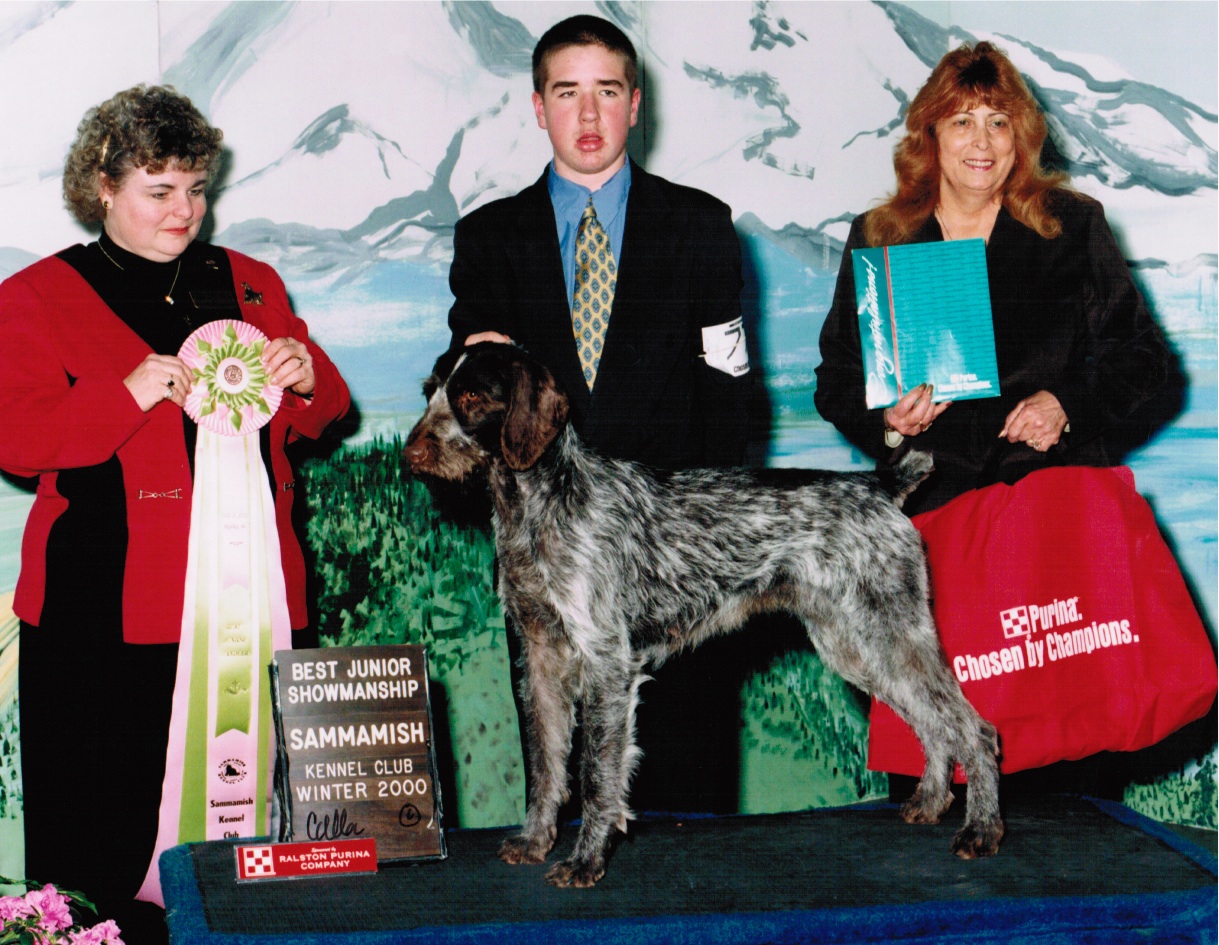
Alexia Rodriguez
“Growing up I had very low self-esteem. I was extremely shy and had a hard time interacting with other kids that were my age. As an only child, I always had difficulty connecting with my peers. Junior showmanship gave me something to connect to other kids with. It broke the ice, so to speak, so that I had something to talk about with other people. The more I learned about dogs, the more comfortable I felt talking about them.
Right now I work for a software company doing technical support and some light coding. I guess I didn’t really choose this profession but I’ve always been good with problem solving. My original profession was in Day Spa and salon management.
I am still heavily involved in dogs. I currently breed, show and compete in IPO and Rally with my Cane Corso and Lowchen. I also just received provisional judging status for Japanese Chin and Corso and am really enjoying my foray into this next chapter in the sport.
Training my dog, going to dog shows and being rewarded with a win or praise from my peers, boosted my self-confidence and gave me something to work towards. I did not grow up in a dog show home. Instead, I got involved because of a flyer at school that advertised an “AKC fun Match”. My mother supported me in my wish to try out dog shows and would cart me around to various shows. From the dog show world, I also found a profound sense of “family” which, for an only child growing up with a single mom, was instrumental to help boost my self-esteem.”
Maryke Nau
“Everything I am is because of the sport of dogs. I learned that I love teaching from 4H and handling class, so i made it my job. (Having skills at training dogs is VERY applicable to teenagers too!)
The biggest thing I learned was how to have a goal and make steps towards it. To know when to back track and try something else. To know when to change goals completely. To know what is in your power and what isn’t and accept that. I learned how to compete and be defeated. I’ve learned to constantly evolve and never settle for complacency, which has been endlessly beneficial is becoming a leader at my career.
I love dogs, and do the same whether I show every week or once in a year, but the connection with them when we go in the ring is unparalleled. If I never showed another dog I wouldn’t be sad but I would miss the people. The people I have known the longest outside of family are from dog shows. We have seen each other go through many phases of life and are always excited to see each other, mostly. I have learned to fight and make up. I learned about relationships. A lot. A lot about long and short term relationships.”
Rémy Smith-Lewis
For me dogs taught me so much respect and responsibility. The same things I use today in my role at Google and the past companies I have worked at.
Ann Foley Lindstrom
Former Junior and assistant, now a teacher.
Involvement/Why I didn’t become a handler
I started at 13 in Obedience, bought my first show dog, a lovely Belgian Tervuren, at 16. My dog was an absolutely terrible hell beast and regularly embarrassed me in the ring. I did not do well in Juniors. It’s hard to look good when your dog is kangaroo hopping. I worked my butt off with her and learned a lot. I became involved in agility and herding. I traveled a little bit with Sheltie handler, Judy Stachowski. I had a blast and enjoyed every moment of it.
I planned on being a professional handler. I had kennel plans all drawn up. I was going to teach for a few years and save my money to buy a house and build a kennel. I guess 19 year old me didn’t realize how little teachers made, but weekends and summers are off, right? Perfect for shows!
I drove 15 hours from Chicago to Atlanta for a dog show. I was walking back to the car and looked at a row of RVs with x-pens and dogs. At each RV, tarps haphazardly covered the x-pens to protect the dogs from the ongoing drizzle while handlers had dogs up on tables, fighting with the humidity and dampness. Everyone looked miserable at that moment. I stopped and thought, “What am I doing here? Is this what I want?” Showing is fun, dogs are amazing, the people are great. But hauling stuff in and out every weekend, or getting worked up over mud, or the general franticness of it all… it just hit me that this wasn’t what I wanted as a long term career.
Current involvement
I’m still involved in dogs at age 35 and I am still a teacher. I still do conformation and I’ve done varied amounts of obedience/rally, agility, and herding. I maintain the herding statistics for the ABTC. My children are beginning to do Juniors and we’re getting to a point where I can share this great hobby with them. My lovely girl Tipsy won BISS from the Veteran’s class, and the very next weekend she piloted my 3 year old son around the ring for his first time in a Pee-Wee Juniors class (UKC). Sharing our lives with dogs is what this is all about.
Current job
I am a teacher for at-risk high school students. I have no doubt that my experience with dogs has greatly impacted my success as a teacher. I primarily do intervention work to get students back on track. This is basically the equivalent of convincing a terrier to do obedience. Where many people would throw their hands up in the air, I roll up my sleeves and double down. I spend a lot of time figuring out what motivates students and slowly shaping positive behaviors.
One time I was in a meeting with several administrators, counselors, and teachers regarding a student’s poor performance. I used the phrase “back chain” to describe how I was reteaching material, and I momentarily panicked because I couldn’t remember if that term was used only for dogs. Fortunately most terms used in dog training and behavior are used in teaching humans, so I ended up looking good. My experience with dogs and training gave me tremendous insight into working with teenagers, not just the learning and teaching component, but also patience, compassion, and an appreciation of effort.
Margaret Shelley
“I worked for Doug and Mandy Carlson for 3 years in high school and Janice Hayes for 2 summers in High School and starting college. I also helped Michael Shepherd a few times as well.
I am currently working as a Corporate Sales Manager for Main Event. I choose that route because it was more money and had weekends off. I loved being an assistant and I would have stayed, but Dottie James made me go to college (I didn’t finish but I was able to land a great a job and haven’t had a need to go back yet).
The skills I learned from being an assistant is how to handle clients which I use daily, how to build relationships with clients or other professionals. Also I learned at a young age how to interact with adults which has been so beneficial as a young professional.
I’m not in dogs but it’s something I will be back in once I get a home and my social life slows down enough for me to have time for a puppy to show.
I tell people all the time that being in Juniors and working for the handlers I did taught me way more than I learned in school. It taught me social skills, how to hold yourself together if something doesn’t go your way (like losing a big juniors class), how to keep track of finances and expenses, the importance of being up to date on billing your clients (I do that all the time now), and also how to run a business.”
Moriah Hubbell
“I brought myself into the dog world at 13, when I purchased my first show puppy (Samoyed.) My parents and family had no knowledge of the sport, so I was fully guiding the train. I trained my puppy and took her to my first show at 6 months old. It was hard and we got no where at first. Juniors was impeccably challenging, having no formal training in how to handle. I learned, though, and my puppy learned. Throughout our nearly five year journey with juniors, I learned more than I could ever express.
I learned how to win graciously and loose gracefully. I learned that just because you come in behind the curve, doesn’t mean you can’t climb to the top. I learned that dogs are my passion and my dream, but that my relationship with them is more important than any win.
For a time, I worked as a handling assistant. It was temporary, but it confirmed my thoughts that professional handling wasn’t for me. I wanted some of my weekends to go hiking with my dogs, my week days to work a 9-5, and my love for showing to remain a hobby and a passion rather than a career. I wanted to show and breed my dogs, and for that to be my focus.
So, I decided to go to college for Marketing. Random choice, right? Not really. I know that my skills with dogs will benefit my marketing career and that my marketing career will benefit my endeavors with dogs. I’m happy with the decision I made and I am forever grateful of the lessons junior handling taught me, it’s something I encourage the children that I teach to take part in and it’s something I hope my own kids will take part in one day.”
Sarah Beaird
“I did Juniors and 4-H growing up. I loved being in the ring and as an adult, it was always my goal to get back there. I love animals and when I got hired at the Henry Doorly Zoo in Omaha I thought I was starting my dream job. There were many things that I loved, but I noticed that when I got home I wanted space from my own animals…. and that became unacceptable to me. Giving my energy to my own animals should come first. They are the most important.
After moving back to Oregon, I spent a few years running dog obedience classes, and once again working with animals became a chore. It wasn’t fun. However, when I took a break from it I had a group of people who had been in my classes before and had new dogs and wanted me to do a class. I suggested we just meet once a week to “work dogs”. It was still almost exactly what I had done in my formal classes, except no money was involved and we usually ended by sitting down and sharing whatever snacks and wine each of us had brought, and it was lovely.
So — that works for me. I’m always happy to take another dog into the ring as long as it doesn’t conflict with my own. I’m happy to take another dog to a show with me if I’m going, but I don’t want any money, and therefore no expectations so I don’t have to feel the stress that I’m “working”. Showing dogs is a fun hobby for me. I want it to stay fun, and when money starts to exchange hands, it becomes a chore and I would feel obligated to put the client dog above my own, and I would resent myself for that.
Also, regardless how my dog does in the ring, I always have other goals set for myself for the day/weekend that often have zero to do with ribbon color. My real job has nothing to do with animals, so I miss them during the day and can’t wait to see them and spend time with them when I’m home. For me, a life full of animals does not mean a career working with animals. I get more, and my own lovely creatures do too, if I have the balance of a job that doesn’t have anything to do with working with animals.”
Kelly Schur
2nd generation breeder owner handler, former junior handler – currently a special education teacher
I was an assistant to several professional handlers throughout junior showmanship and following aging out. I loved learning about new breeds, getting my hands on different dogs, and the camaraderie and relationships that were built. Some of my favorite memories are from experiences as an assistant.
However, after several weeks on the road where we only had a one or two-day turnaround and traversing a dozen states in less than a month, I realized that it just wasn’t a life for me. I wanted something more stable and consistent.
Time in dogs and dog shows set me up for success as a sped teacher. I learned patience, attention to detail, and how to establish, maintain, and strengthen relationships, especially with those who are not necessarily open to the relationship to begin with.
I chose it because I wanted a profession that would be a challenge but in which I felt I could make a difference. I participated in a therapy dog program with my old juniors dog and first group winning special, and I saw what a difference people could make in children with special needs. My ultimate goal is to explore animal related therapies and develop a program to work with our beloved purposefully bred dogs to improve school life for students (and staff)!
I still handle as a hobby, breed Pugs under the Brenich prefix with my mom, and have expanded to duck Tollers – field and conformation… I participate in conformation, field (hunt tests/hunting), rally, obedience, and am trying other sports (barn hunt, nose work, lure coursing, dock diving).
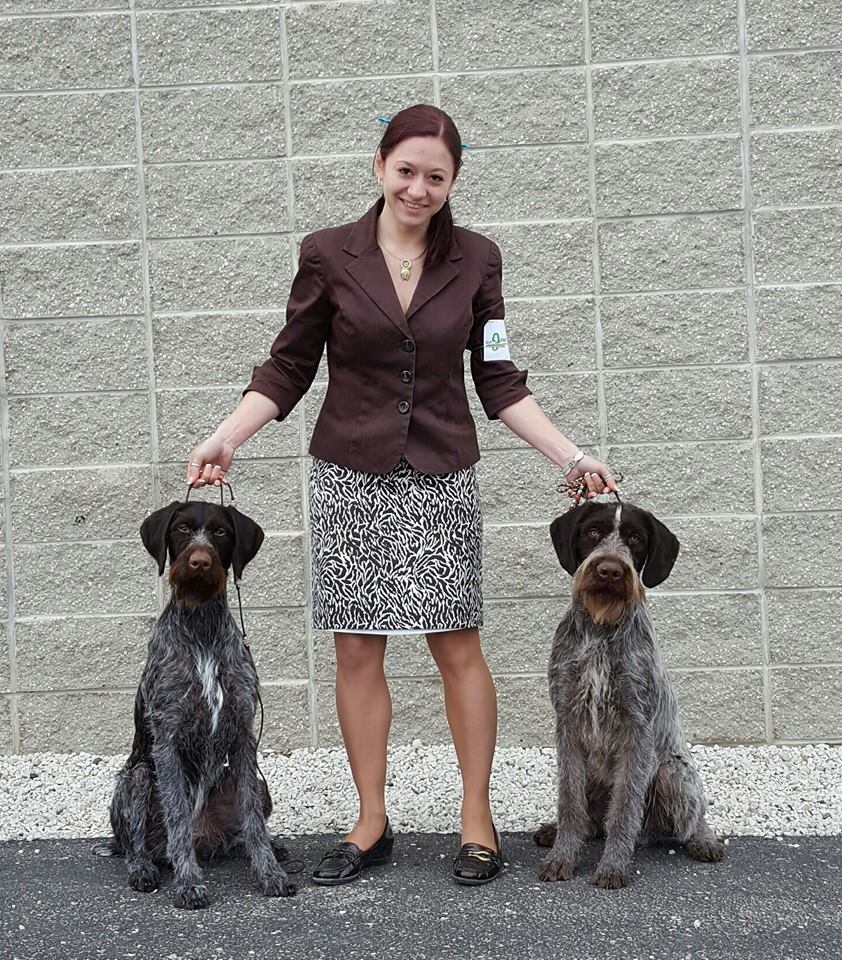
Kris Wiltse
“I learned that winning isn’t everything and when you lose you don’t really lose anything you gain knowledge of what needs to be worked on. I learn patience working with the puppies and that you just have to keep trying till you figure out what works just like with dogs, not every child is the same. I learned how to manage time. Having to be at a certain ring with a bathed and groomed dog to having to have the kid brush teeth dress for bed and in bed by a certain time or to school bus.
Teaching dogs is VERY SIMILAR to teaching children you have to praise the good and depending on child/dog either discipline or ignore the bad. I think the most important 2 things were to put the dog away and walk away when I got frustrated. And two I learned respect. I learned to respect the fact that this dog or person is alive and has feelings and doesn’t always understand why I do what I’m doing and to respect the fact that they may not want to do that right then and thats ok.”
Kim Bullard
“I started in 4-H. My 4-H leader talked my parents and I into trying Junior showmanship. I worked for a few handlers during my Juniors career then for several years following with the idea of becoming a handler.
I remember one weekend on the Montana circuit we had a family emergency and I felt helpless being so far away. I realized that traveling every weekend just wasn’t something I wanted to do any longer.
I still miss it on occasion, but also fully enjoy being able to show my dogs on the weekends I want to. I am still very much involved with AKC, breeding and showing English Springer Spaniels and co-breeding Golden retrievers with a friend whom I’ve been showing dogs with for over 10 years. I’ve mentored a few juniors and am also a member of several of my breed clubs and the Whidbey Island Kennel Club which I am on the Juniors committee and we host an event for the Junior handlers at our show every year. I was (and still am) quite a shy person and dogs helped me break out of my shell a bit being around so many likeminded people.”
Taylor Marshall
“I was a Jr from ages 12-18, also assisted for Helen (George) roughly the last three years.
While I would’ve loved to go the pro route, my parents wanted me to have a fallback option so off to college I went. During those years I moved out, met my fiancé and had to get a job to pay my bills. I lucked into the job I have now (it’s not related to my degree and I got it before I graduated).
Specifically, my time management skills and multitasking skills have carried through. I think the biggest skill set that has benefitted me the most in my job is handling things under pressure. Whether it’s numerous clients, working on several jobs at a time, meeting quick deadlines, etc. it’s still nothing compared to having numerous dogs/breeds in the ring at a single time. Being able to focus on completing a single task while not worrying (but also not forgetting) about other tasks is one of my strongest advantages in my field.
Another thing I notice that carried is confidence. I’m by no means a people person but I have confidence in my job and can talk to people in that setting. (But not at parties or anywhere else lol)”
Sarah Tulla-Marie Stenberg
“Former assistant/lifetime dog show enthusiast. I started young, literally almost born at Enumclaw dog show. First time in the ring was when I was three with a Chinese Crested.
I worked for many high end professionals, lived and breathed dog shows. Became pregnant, and that changed all of my priorities. I realized I couldn’t afford a living with a handlers wage, so I started school. The intense work ethic I learned from being an assistant was what drove me through college and now nearly finishing my bachelors.
I am currently a successful business owner, mother, and homeowner. I still think about going and doing hobby showing. I really want to show a single dog and special that dog. I currently work a bloodhound in search and rescue.”
Paul Chen
“In my early teens, as a junior handler, I really wanted to be a professional handler. Then I worked a few months for one including the old “Cal-Ore Death March”. After that I decided I wanted a real life, a decent income, some weekends off, to be able to date, to sleep in my own bed, and to breed/show my own dogs. I have been showing/breeding dogs for 53 years now, have over 60 champions and am an AKC judge for my own breeds. And have been with the same wonderful man (non-doggy) for 43 years.”
Alexzandra Erb
“I really wanted to be a handler when I was a junior but then I decided I felt more joy as a breeder/handler. I love being in the whelping box and from there going to the show ring. I also found that there is a world with a family that needs me more than the show ring weekend after weekend.
My family always appreciated me no matter what I won or came home with…when I was showing for others I didn’t like my worth being dependent on a win or a ribbon. Also I work for a vet clinic and having a job like that you can’t be off all the time.”
Hillary Arnaud
“I started out showing in 4-H in my teens. I then progressed to showing in AKC right away and after a couple years I worked for many of the nation’s top handlers on the West coast for about 5 years to learn about what it takes to show and groom. I always knew that breeding and showing my own dogs was my passion.
I graduate as an RN in one year, and until then, I will continue to focus on my studies, enjoy time with my children and put showing on the back burner. I always knew I wanted to work in healthcare, helping others. I am so pleased to have the opportunity to do that now.
I commend those who stay in it (as handlers), but I believe that without aspiring breeders, the sport would die. You need a little bit of both, and unless you commit to learning and applying for years before labeling yourself as a handler, it’s not right.
I feel that my time in dogs has helped me learn what priorities I wanted in my life since I always knew I wanted a family. I also feel that it taught me the value of hard work (and trust me, assisting is not easy by any means!) as well as dedication, being teachable, and having an open mind.”
Bridget Ratcliffe
“I started in dog shows when I was 9 with my pet papillon. I got hooked from the start since it was something fun to do with my dog! Currently I’m about to start my 2nd year at a Statistics PhD program. I don’t really participate in shows much anymore. As for specific skills I gained through dog shows, the ones that come immediately to mind are time management, the ability to talk comfortably with adults/people in charge (even from a young age), helping others in a person-specific way (I used to help teach handing classes as a junior and it really helped me learn how to talk and explain things when helping people) and also the mentality of “expect the worst, hope and try for the best”, so when things go wrong etc it doesn’t seem as big a deal.
Tammy Lewis Walker
“I started when I was 10 in 4-H and 2 years later got my first Akc show dog. A Mini poodle with an attitude and a following. I trained mainly obedience and also did showmanship. There was no rally, no agility, no pre-novice. Your first class in obedience was novice, and after your first title, you competed with all the others!
I learned to work with people in all age, education, economic, and gender preferences. I learned that a pro taking their time to help a newbie is an amazing thing. I now do mainly obedience and rally but do several other sports too. I always try to help someone who needs help with training or grooming and even in my non dog ventures, I help where I can. The value of mentoring in any aspect of any job is so important!”
Megan Ericson
“Did both junior handling and worked under a professional. My time showing taught me invaluable time management skills, working quickly and efficiently, under pressure and with a deadline, and good communication skills. It also gave me a thick skin, and taught me how to accept constructive criticism. I worked for 10 years as a cook and it gave me the tools I needed to be successful in that environment. I now work in a grooming salon, so the grooming skills have definitely given me a leg up.”
Mara Spicer
“I went into public safety working as a 911 dispatcher. I was able to use so many of my skills learned from the pros. From time management, to working under pressure, to handling yourself like a professional no matter what.”
Jess Blatt
“I started showing in juniors before I was 10 at matches. As soon as I turned 10, I was showing in juniors at shows. My mom has been breeding Shar-Pei for 25+ years, I traveled with and assisted different handlers, I showed everything and anything I could. When I turned 17 and met my husband, I decided dog shows weren’t everything. We had children, I work at a hospital, and I go to dog shows sparingly as my daughters like showing my mom’s dogs but they generally go with her and they’re more involved with showing their rabbits, livestock and horses.
I’ve learned that once you can pick out a good animal of any species, it carries through to different species and same goes for showing them (except rabbits which is a whole different ball game from showing any species!) I’m thankful for all the places I’ve traveled and people I’ve met. And I think the biggest thing I’ve gained from showing dogs, I can pack a vehicle like none other! And I have no issues working til 3AM, sleeping for 2 hours and driving 3 hours to a rabbit show with van packed full of rabbits and 4 kids. I also developed a love for coffee at a young age.”
Jordin Wallis
“I have been in dogs since 2004 when I started showing in juniors as well as at the breed level. The quote I would choose to best describe my profession now and my experience in handling dogs is “structure dictates function.”
I have always had this quote ingrained in my mind when showing and working in my current field. I am currently a Surgical TA at VCA NWVS working with an orthopedic surgeon. When looking at orthopedic patients we are looking at their gait and how their limbs work with one another.
Gait is extremely important for a dog to perform its job as well as just to be a normal dog. When I view the conformation side of movement I see the same thing. How their limbs work with one another and how that gait moves them across the ring. The form of the dog always follows its function in all aspects whether it be a working dog, show dog, or just a fantastic family pet. The dog show community should always follow this Motto to continue to improve the breeding stock of today’s generation.”
Jacqueline Zwirn
“I grew up in the RV, at the shows. As a toddler I was in the expens ringside while my mom was in the ring.
I toyed with the idea of becoming Pro–but life dictated otherwise. I love being on the road and in the ring.
What I learned from my experience as a child in the ring and on the road was candor, respect, sportsmanship and to strive for excellence.
If you aren’t going to do it right, with ethics, don’t do it at all.”
Brittany Updyke
“So I showed in juniors and in the breed rings for about 7 years. My mom and I would rather to the shows after I got home from school. I worked for Laura and Robin for 2 summers as their assistant. Showing dogs taught me so many life lessons and I am forever grateful for the experiences I was able to receive. When I moved to Texas 3 years ago, I brought my last juniors dog with me. Everyone always says, a dogs love is unconditional, but I feel that having a dog that you’ve shown in juniors is something even a little more special. You come to realize that you are a team and I truly couldn’t imagine life with my “pet”.
Along the journey, I’ve also made life long friends. In fact, I just got married in May and 2 out of my 4 bridesmaids were people I’ve met from showing dogs. I currently work as a registered nurse and I think most of my time management skills come from showing dogs. Being able to balance work life and home life is something that is so important and I contribute those lessons to being able to travel during my younger years as an assistant, in juniors, while going to school and keeping a social life outside on top of it all.”
Taylor Ault
“I didn’t grow up in dogs. I started with my first dog when I was twelve doing rally and agility then started in the conformation ring a couple years later. I worked for a couple breeders and handlers and loved it but definitely did not want to do it full time.
I got my Bachelors in Animal Science and I am now starting my Masters in Animal Reproductive Physiology. I still love handling dogs on the side when I can for some friends. When I have the time (and money!) after I finish school I want my own show dogs and eventually breed. I think dog shows are a wonderful way to teach life lessons, especially to juniors, about hard work, dedication, and responsibility. But I credit my work with dogs for getting me where I am today in school and I absolutely love it!”
Aimee Bruening
“Former junior handler AND assistant here! I chose not to go the professional handler route because in college I joined Air Force ROTC and decided to pursue that as a career instead. I absolutely loved my time as an assistant though, and it’s definitely helped me succeed in ROTC.
Time management, attention to detail, communicating clearly and precisely, working under pressure and most importantly a sense of urgency – all beneficial skills that apply to both professions! I’m still involved in the world of dogs, but it’s been put on the back burner while I finish my degree. I still help as an assistant from time to time when I can, and I’m currently planning on getting a new show prospect sometime in the spring so I’ll become more involved in the show community again.”
Riley DeVos Mars
“I decided to go to college for Elementary Education and now teach 3-4 grade Special Education. I still show dogs and have branched out to try hunt tests and rally/obedience as well. Dog shows have definitely benefited me in my current job – one of my Rottweilers is our school therapy dog. When talking to the school board, I was able to highlight her OFA health test results, her stable temperament, and her ability to handle new situations from showing.”
From Cassie Noe
“I got burnt out. I was working every weekend and it got to the point where the weekends off or weekends at home with the house dogs is what I was looking forward to more than working. I decided to move home and pursue my education and career. I found that working and helping people was a lot more rewarding and also a lot less physically exhausting.
I stayed involved with showing because I still love the companionship of the animals and the feeling of piloting a dog to some exciting wind and also seeing the happiness on the owners faces when their precious pet won a ribbon. Eventually after the loss of my mother I decided I needed a break from shows entirely to ground myself and find my happiness and focus on my growing career, house, and wedding.”
From Kat Smith
“My family had purebred poodles growing up but not show or competition dogs. I did a year in 4H and got hooked and wanted a show dog, my parents said no more dogs. I found a local dog show and convinced them that if I could find a dog to show that didn’t live here, that I could show it. Much to their surprise, I found some awesome breeders who were willing to sign me on a dog Juniors!
I worked for pros over the summer and had awesome breeder mentors. When I aged out of Juniors, people kept asking me to show their dogs, so I was an agent for a few years so I could keep showing dogs until I was out of college and really in a position to buy one. I finally did a few years ago, and am many titles and a few litters in as a hobby breeder and competitor.
Working for a handler and as an agent, I realized that I get so much more out of working with and competing with my own dogs than anyone else’s. So I enjoy my day job, working in communications & marketing, having a small-scale breeding program where I can train, groom, and show my own dogs to their maximum potential. I also get to spend my dog show days mostly enjoying time with dogs and friends than running around. Plus, boy if you bring a litter of puppies to the office they get a lot of socialization and you get a lot of bonus points!”
From Jennifer Scattini Nowell
“I am a 2nd generation breeder/owner/handler. I started training my own juniors dog at age 8, showed in the breed ring at age 9, and jrs at age 10. While I worked for a few handlers off and on, I pretty quickly decided being a pro wasn’t for me, mostly because I’m grooming inept. I also enjoy the freedom my job gives me. I have a B.S. in Ecology and Systematic Biology and I work on a commercially caught rockfish and flatfish study in CA.
I am still involved in the dog show world, albeit on the periphery now. I am a member of the local kennel club and I teach a conformation handling class. I find it rewarding to help people with their craft. I owe a lot to my personal mentors, so I try to give back where I can. I’m hoping to get back on the ring with a dog of my own eventually. Maybe my son will be interested, too.
The biggest life skills I took away from my juniors years were all about sportsmanship. Be a good loser, but always, always be a gracious winner. Help new folks find their way, and for Pete’s sake, give your dog the love he/she deserves!”
From Andrea Albin
“Three years as an assistant, four years in juniors showing Goldens and English Cockers, and over a decade in agility. Now, I’m the Digital Marketing Manager and Graphic Design Specialist at the Sports Car Club of America, the country’s largest amateur motorsports organization. Dog shows helped me develop determination and individual responsibility. I also found that participating in AKC events allowed me to observe an organization that operates within similar business models as my current employer.”
From Michelle Nolan
“I started working for professionals from 12-17 yoa. I decided I wanted to take a break from dog shows and focus on being a teenager. As fate would have it, I continued to work with dogs as I was hired to work at a doggy daycare and did so for four years. After that point, I moved to Santa Cruz and studied political science. I then worked/managed a dog walking company for 3 years.
This March, I embarked on a new adventure. I started my own dog walking/daycare/ overnight service here in Santa Cruz. I never envisioned working for myself or with dogs. I tried to push away from it many times in my short life but something kept drawing me back to it.
At this point in my life, I’m not pursuing dog shows and have no desire at this time to be apart of that realm. However, I without a doubt, would not have the dog or people sense without my experience working along dog enthusiasts and professionals. I believe the main skill set I acquired from dog shows is my understanding of different breeds. I didn’t realize that this was a skill and helps me understand my pack of dogs better. For example looking at a Husky or an Australian Shepherd and knowing what they were bred to do and how those unique qualities are reflected in their personalities and behaviors. I guess reading all of those dog breed books as a kid and spending countless hours at the side of show rings really helped me out there!”
From Erin L McClurg
“The paycheck wasn’t consistent. I had to rely on people with good dogs to hire me. For the amount of work I didn’t feel the amount of return was worth it- but most of all- I did not want showing dogs to be a “have to”. It’s a passion and love in my heart.
One mentor told me to go to college so I didn’t have to rely on dogs forever. I attended Texas A&M and did my BS in animal science production industry and my MS in animal science with an emphasis on ruminant nutrition.
I’ve taught vet tech courses at the collegiate level but for most of my career I have been in sales of dog food. I am able to share specific cases in which I may have changed food and how it worked. Experience from breeding, puppies, adults and seniors.
Yes, I am still involved. Labradors first and foremost. I have had borders and schnauzers as well.”
From Kara Lynn Gossage
“I grew up in Collies ( Rough & Smooth), my mom had been involved since she was 15. I handled in the breed ring as a child and then when I became old enough for juniors my mother bought me a miniature pinscher for easier handling. I was in juniors from 10-18.
I have a Bachelors in Biology, emphasis on animal behavior and a minor in psychology. I handled a little for close friends during college and campaigned a few specials. I started working with PetSmart in 2008 and worked my way up the corporate ladder, now overseeing the Central IL- Kentucky region of salon services teaching new groomers in academy. I took a hiatus to have children, but am currently getting back into that game and looking to expand breeds and become a junior judge. I also compete nationally on PetSmart’s Competitive Groom Team.
My experiences growing up in the dog show world and working with breeders, professional handlers, and other younger handlers have been the foundation of my success in my career. I have become well-versed in multiple breed knowledge, handling, grooming, and products. I can honestly say I love what I’ve grown up doing, it fits me well.”
107 – How To Properly Bathe and Dry Your Dog with Laura Reeves
Proper Bathing and Drying of Dogs with Laura Reeves
Our bathing dogs topic today is a thank you for Facebook Fan #2000 Joann Frisch! Joann says she owns a grooming salon, so she’s always up for grooming topics.
We covered pretty basic steps in Episode 73 and working with wire coats in Episode 88.
Importance of Bathing and Drying
But I worked pet grooming for a number of years and the one thing it teaches you is how VERY important bathing and drying are to the success of grooming any dog. Everybody starts out as a bather in pet grooming or as a professional handler’s assistant. And there is a reason for that.
A half clean, half dry dog is going to get sent back to the tub. Every time. The reasons would seem sort of self explanatory but considering the number of them I have sent back over the years and the number of client dogs who arrive clearly suffering the effects of the same malady, I’m going to hedge my bets on this.
There is no place for half way clean and dry, even for a pet dog, never mind a show dog. While your Italian Greyhound isn’t going to take as long as your Newfoundland, they all need the same level of care.
So let’s start at the top.
Nail Trim
Do it first. Get it out of the way before you have to trim feet around too long toenails. We’ve discussed nails before and I’ll just say it again briefly. Dogs feed off YOUR nerves. If you’re scared you’ll make the dog bleed, he’s going to figure there is a reason to be scared and panic and make the entire process a nightmare. Patience fearless leader, patience. Firm, fair and consistent. And always win the battle of wills. Just because your dog doesn’t *want* his toenails trimmed is NO reason not to do it.
Anal Glands
ONLY if needed. And if you don’t know how, learn the proper method! We’ve included a video link on the website to a veterinarian demonstrating the proper procedure. Most large breed active dogs will not need this procedure. Smaller breeds and less active animals or those that are overweight can experience more difficulty. For obvious reasons, do this *before* the bath!
Ears
Clean, pluck if needed. If you need to pull hair from the ear canal, be sure to clean it thoroughly afterward to prevent bacterial or fungal infection. Chlorhexadine ear cleaner is absolutely fabulous for preventing and clearing up ear problems.
Teeth
Do they need scaling?? Now is a good time to do it. Don’t have a tooth scaler? I was taught years ago how to use the thin edge of dime to achieve the same goal in a safe manner for dogs and humans. Use your tool to *gently* get to the gum line and pull down (or up) and away from the gums. I generally focus on the canines and any nasty buildup on the molars. Chlorhex makes a *fabulous* pre-soaked gauze pad for more regular cleaning of teeth.
BRUSH
As noted in previous shows, don’t wash a matted dog. Get the dog fully brushed to the skin, all over his body. Testicle mats, toe mats, belly mats, armpit mats…. Get them out BEFORE you bathe. Use a comb, use brushing spray, use Cowboy Magic, use a mat splitter if you have to, but make sure every part of the dog’s body is thoroughly brushed *to the skin*! You should be able to pull the dog’s hair back and see skin, not clumpy hair, on even the most densely coated dogs.
After nails, ears, anal glands, teeth and brushout, THEN you can get the bath started.
Bathing
Alrighty, on to the actual bathing part. Make sure ALL of the dog is wet (assuming you’re doing a full bath). And wet to the skin. For some coat types, this takes some effort, using a good spray attachment on the hose and really working the water in the coat. Use lukewarm water as a general rule. If you want to hold coat use cold water, if you want to accelerate the process of a dog that’s dumping coat, use warmer water. Apply your shampoo in a dilution according to the directions or guidance from a mentor. Dumping a big blob of shampoo on top of Fluffy’s back is not going to be the best use of your products or your time. Use your hands or one of those rubber squeegee brushes to distribute your product over the dog’s entire body and down to the skin. You want to be sure that ALL of the hair is getting washed, not just the top part.
Shampoos and Products
We could spend the bulk of an entire show just on the topic of different products. Every single person has their own favorite brands, combinations, rituals and magic potions. I have different products and preferred brands for different coat types, colors, condition … like that. In general, I love the PurePaws products and #1 All systems. But I use specific products from nearly every brand line for something.
Stain Removal
Stain removal is *always* a hot topic. For beards and feet I’ve found a mixture of 50/50 water and 6% hydrogen peroxide (some vendors carry it at the show or you can find at a Sally’s Beauty Supply type store) in a solid container spray bottle (it breaks down in light) to be most effective and not expensive. It’s critically important to remember that if you strip the coat with something like peroxide (#1 all systems whitening gel is also very good for the task) that you have to condition it heavily. You’ve opened up the hair shaft and the first bit of spit, urine, red clay, whatever your staining issue will just suck right in and you’ll be worse off than when you started. Since you’ll need to use heat from a hot dryer to achieve best results from any of the “whitening” type products, it just exacerbates the crunchy, stripped, dull coat problem. Conditioner is your friend!
Keep Problem Areas Clean for Prevention
In fact, most of the “hair” masters will tell you to keep the problem areas clean and conditioned on a daily basis. Keep the dog on a quality food. Keep him clean and dry (yep, it’s a lot of work in the winter if you have, say, a Clumber Spaniel dripping in coat….) Even just a quick foot and belly bath with wash tubs will work wonders. In other words, an ounce of prevention is worth a pound of cure! For more words of wisdom from the true artists, visit the link in the show notes to an interview with top drop coat specialists.
Table Baths
On the topic of table baths. This is sort of a dying art that more folks would do well to perfect. At the show, at home, wherever. Get two dish pan sized tubs. Fill both half full of tepid water. Add a teaspoon of your favorite shampoo to one and conditioner to the other. Using big sponges (one for each tub) you squeeze water through the beard, legs, belly, pants — whatever hair needs to be gently and quickly cleaned. I have a ritual that I can blow through in half an hour if I have to at the show. Wash tub goes in front of the dog. Sponge water into the beard and the front legs, holding them over the tub so as to not make such a mess. Tub moves under the dog’s body, I do the same for the belly coat. Tub moves to the back of the dog and I do both back legs, pants if needed, etc. Swap wash tub for rinse tub (containing diluted conditioner) and repeat the process in the same order. At the show this gives the dog a fresh appearance without having go through an entire bath. At home, it helps prevent staining that’s a common result of food, saliva, urine and so on in the coat.
No Hotel Baths
For the love of all that is holy, DO NOT wash your dogs in the hotel bathtub! Do we have any question why there are fewer and fewer hotels that allow dogs?! Come on people. And yes, I am talking to YOU! Don’t do it!
Sun Bleach
Another issue we run in to is sun bleach on black or liver colored dogs. That rust/orange/yellow tint isn’t pretty! Wash the dog with your regular shampoo, rewash with a lightly diluted “black” shampoo like Chris Christensen’s black on black, (More information on this particular product is linked on the website.) follow the directions for letting the product sit in the coat and then rinse and condition with a product that suits the dog’s coat type. In other words, the conditioner I use on the Tibetan Terrier’s coat is going to be far to “heavy” for the Newfoundland, weighing the coat down instead of allowing it to stand off the body.
Conditioner
A bit more on conditioner… USE it!  Even wire coated breeds need it at least in the furnishings so they don’t break off. The proper light weight conditioner even for a double coated breed will add shine. The extra polish that top dogs exhibit is in large part due to daily maintenance and the proper use of conditioners to keep the hair coat in its best condition. If in doubt as to the correct product for your breed, ask questions! Ask your breeder, your mentor, a successful professional in the breed. Use the world wide web, in all its glory, for good, and make contact with the people who have knowledge. And here’s another important point. Randomly throwing out a question to one of the proliferation of online forums will bring you a wide variety of information. Some of it might be useful, the rest may well be from keyboard warriors. Learn to value the knowledge that comes from successful experience.
Rinse
OK, so we’ve sudsed, rinsed, conditioned and now it’s time to rinse again. I’ll tell you the same thing I tell my assistants. Rinse. Then rinse again. Then rinse again. THEN feel through the *entire* coat to make sure you don’t encounter residue or stickiness that indicates remaining product in the coat. Then rinse one more time for good measure. I’m *two weeks* in to fighting a nasty hotspot on a pug dog who wasn’t sufficiently rinsed. Finally, use your hands like a squeegee to pull off the bulk of the water. I train my dogs to shake on command (yes, it really does work) so that a) I don’t get drenched while bathing and b) they can do part of my work for me.
If you’re using a leave in conditioner product of some kind, I prefer to get the dog out of the tub and on the table, use a towel to squeeze the hair (not scrub it around), then apply the leave in product to damp hair instead of dripping wet hair.
Drying the Dog
Now we get to the drying part. In pet grooming, time is money, so everything gets dried with a force dryer on high speed. If you are VERY good, you can do this without tangling long coat in hopeless knots. If you aren’t, please, do not try this at home! lol Force dryers work best for blasting water out of heavy double coats.
I like to refer to force dryer work as having an end result that is either “flat” or “fluffy”… Wire coats, or anything that you want a flat lying jacket (setters, spaniels, some retrievers, etc) you can use the force dryer nozzle resting just slightly off the parallel plane of the body and blow the hair WITH the grain. Move the dryer in long sweeping motions along the dog’s body— maintain the same position and avoid swirling it around. That just makes the hair stand up crazy and doesn’t reduce your drying time. Go slowly, work thoroughly and the coat will lay down beautifully when you’re done. Once the back coat is dry, pin a dry towel or over it while you do the furnishings with a hot dryer.
Drying Double Coats
For double coated breeds, anything you want volume (akita, shiba, siberian, malamute, newfoundland, Turvuren etc) you can use the force dryer aimed straight in to the body. Not so much blowing the coat against the grain as aiming the force dryer perpendicular to the dog’s body and moving again in sweeping motion down the length of the body. Know your breed, know what the final picture should be. If the topline needs to lie flat, use the “flat” technique there and “fluffy” for sides, ruff, pants etc…. All of this involves using a brush in one hand and the dryer in the other. Particularly if you are trying to strip undercoat out or to add additional volume. The brush/dry routine will also cut down some of your drying time.
Hot Dryers or Stand Dryers
Hot dryers and or stand dryers for furnishings, drop coats, cockers, poodles, etc assures the polished presentation you’re aiming for. Again, brush while drying to make sure the coat dries straight and lies properly. In many cases, you can make everyone’s life easier and teach the dog to lie down on the grooming table for brushing and drying. Completely dry one area before moving to the next so that the dog’s coat, particularly on poodles, bichons, water dogs, etc, doesn’t partially dry curled when your goal is to blow it straight. As was pounded into my head some years ago, good scissor or clipper work cannot be done on a badly-dried dog.
Everything to the Skin
Brush to the skin, wash to the skin, and dry to the skin. Done. Kiss your dog on the nose and give him a cookie. If you have trimming to do, give your pal a break before you start the next project. Let him pee and stretch his legs and play with him some. Then you can move on to phase two. We’ll talk about the various trimming skills you might need in a future show.
106 – Sheila Goffe – AKC Vice President Government Relations: How to Impact
Shiela Goffe, Vice President AKC Government Relations
Sheila Goffe, Vice President AKC Government Relations, provides us with specific, actionable projects to impact the world around us.
Ensure your all breed and parent clubs have Legislative Liaisons – and that your LL’s information is up-to-date with AKC GR.
A Legislative Liaison is one of your club’s most essential links to AKC GR. AKC GR provides important legislative alerts and communications to our liaisons via e-mail, and asks them to in turn share it with their club members. Timely alerts provide notifications of proposals up for consideration, and information on how we can work together to protect your rights. Getting the word out quickly to local dog owners is essential to fighting bad legislation. Learn more about our Legislative Liaison program.
Get involved and be a positive resource for canine expertise in your community.
Join community groups, a political party or similar organizations. Don’t forget that all-breed clubs are also intended to be a resource for the community! Introduce yourself in person, in social media and in writing to local leaders and offer to serve as an expert resource. Whenever you speak with someone on this topic, always follow up. Follow up takes only a minute: a phone call, email, or social media contact. Wherever possible, provide more information of interest that will remind your contacts of the expertise you have to offer. (A link to AKC’s resources on the Economic Benefits of Dog Shows or the impact of dog shows by state and similar expertise can go a long way toward demonstrating your expertise).
Be proud of the great work you do as a breeder/exhibitor/club member and share the love of dogs and your breed with others.
A positive approach can be contagious. Attend town hall meetings with political leaders and bring a positive face to exhibitors and breeders. Know, understand and obey the laws governing dogs that apply to you. Do they need changing? We can help you with that.
Share information about the good things you, your club and AKC does for the community.
Do you teach classes? Provide therapy dogs? Donate to the local shelter? Participate in microchip or health clinics? Compile a list of the good things your club and club members do in the community and be proud to share that information (for examples, see AKC Above and Beyond.) Developing positive relationships with leaders in your community shows them that people who show, breed dogs or own multiple dogs are an asset to the community.
When you become an approachable expert resource, you will likely learn about and have opportunities to weigh in on canine proposals before they become a problem. AKC GR is always available to help you with this. Tips for getting involved and informational resources are available on the GR Toolbox at www.akcgr.org.
Take advantage of AKC resources to provide educational opportunities in your community.
September is Responsible Dog Ownership Month. Is your club holding an event for the public? Even if they aren’t, AKC resources make it easy for you to take important and meaningful actions, such as: inviting local leaders to your dog shows and events, inviting a local official or your local animal control professional to speak at a club meeting, and awarding a legislator of the year or dog friendly community award to leaders and communities that already show they care about responsible dog owners and respect the purebred dog tradition. See www.akc.org/government-relations or akcgr.org for more information about available awards, micro grants for educational activities and other ways AKC can help you get involved in your community.
Learn about the issues!
The Key Issues section of akcgr.org provides succinct information on some of the most common legislative issues that threaten the fancy, purebred dog ownership and breeding. AKC GR Blogs provide details and commentary on some of these issues.
ALWAYS call, send an email, or attend a hearing if you receive an AKC legislative alert.
AKC GR’s targeted alerts are distributed only to communities directly impacted by issues, and we rely on legislative liaisons to help deliver those alerts. AKC GR provides sample letters and step-by-step information to make this process easy. Always be respectful and professional in your communications. If you get a personal response from a legislator, we’d love to hear about it. More tips and instructions for communicating with legislators is available online and in these guides: Communicating Effectively with Legislators, Make Your Contact Count.
Our job is to be a resource for you! Please don’t hesitate to contact us directly at 919-816-3720 or doglaw@akc.org if you have any questions or need assistance on a legislative/public policy issue.
105 – Where have All The Kennel Clubs Gone
Where Have All the Kennel Clubs Gone…
As Eugene Kennel Club disbands after their final 2017 show, we ask… how many more kennel clubs will go away…
Have we lost the purpose of kennel clubs?
Are kennel clubs just for “putting on shows”?
Should kennel clubs be or regain their position as a local service and educational organization?
Listener Sheri Graner Ray recently made the following observation.
Where are our clubs today? They are the front line for talking to the public! Yet how many puppy matches have you seen outside of a show site in the past five years? We used to hold matches twice a year (sometimes more, if we had a bunch of puppies coming up) and held them in public parks and such where the general public could come and watch. (and maybe try entering their family pet.) This made a great opportunity to talk to people and educate them about purebreds.
When Kennel Clubs Were Public Education
We used to hold public education events (the “Bark in the Park”) and usually paired with a fun run of some sort. Heck, one year we even held it in a big shopping mall, essentially a “meet the breed” for a different breed every two hours. Great opportunity to talk to the public about dogs.
Today our club membership is dwindling and the members there are aging. They get together to put their shows together and that’s about it. And yet today with the continuing threat of the animal rights making owning a purebred “unethical”.. we need our clubs more than ever! Let’s get back to being kennel clubs for the public!!!!!!
AKC is You!
It bugs me when people cry “Oh the AKC isn’t doing anything”… I got news for you.. the AKC is a club made up of clubs.. not people.. WE have to do it!”
Many all breed kennel clubs do, in fact, offer outreach programs to the community. “Reading with Rover” programs, CGC and Puppy STAR testing opportunities, obedience classes, Responsible Dog Ownership days and Meet the Breeds are amongst the various services offered even in the small local club to which I belong.
But the struggle to do more with fewer, older bodies is real. So, here are some action items for you and/or your club to help make a difference in your community.
How To Keep a Kennel Club Going
Actively recruit new and young members.
- Develop a relationship with the local 4-H dog club if one exists. Create one if it doesn’t. 4-H is a tremendous incubator for purebred dogs and the AKC. Children learn from AKC provided materials, participate in local country fairs and have the chance to interact with purebred dogs through dog breed ID if nothing else.
- Offer free membership to junior members and give them age-appropriate responsibility within the club. They could be tasked with creating a fund-raiser for the scholarship program. Low-cost nail trims or dog baths at a locally owned pet supplies store is just one possibility.
- If your club doesn’t have a scholarship program, start one. The most excitement you see from the junior showmanship crowd is when there is scholarship money on offer as a prize for the weekend. Advertise heavily that junior club members are eligible for special education scholarships available only to them.
- Create a relationship with area schools whether it is a Reading to Rover type program, the AKC’s Canine Ambassador program that sends club members and dogs to schools to teach children about animal welfare and animal safety or major school assembly for RDO day. Kids love dogs. The only thing they like better is an excuse to get out of class for an hour! Purebred dogs and the history they represent are tailor-made for this sort of project. My college internship was exactly the description of the Canine Ambassador program. My traveling companion for the schools was a Clumber Spaniel. The kids LOVED hearing that the breed was named for Clumber Park in Sherwood Forest in England … Where Robin Hood lived!
- Guaranteed, there are purebred dog owners in your community who are not members of the club. Why not? Seek these people out and invite them to join! Make a point of encouraging all members to participate in club meetings by making these informal, brief and more about a social aspect. Host fun days, fun matches, barbecues or pool parties. Build a *community* of dog lovers. Be sure that the foundation of the group is the mutual love for dogs. People do not bond over Roberts Rules of Order. They join forces because their dogs are friends! There is work that has to be done, without doubt. Aside from major decisions of the group, delegate the work to smaller committees who offer short, concise written reports that are included in the minutes.
Find and Join a Kennel Club
If you already own a purebred dog or are thinking of acquiring one, search out the nearest all breed kennel club. I can assure you, club members will welcome you with open arms (or, in some cases like a starving person at the sight of a bread crumb.)
The process of joining a new group of any kind has some basic rules.
DO:
- Offer to help and follow through.
- Volunteer to bring food to whatever gathering might be in the offing. A common denominator in every. single. dog club? Free food wins hearts and minds.
- Save up your ideas until you get a feel for the structure of the group.
- If you have a plan or a suggestion or a bright idea, throw it out there ONLY if you are willing to organize and staff the project yourself. Making work for others is a non-starter.
- Bring a friend. Or two. The only thing better than food at a dog club is more people.
DON’T:
- Be a Debbie Downer. Insisting that a suggestion won’t work or will be a disaster will either set you up to fail if it succeeds or become a self-fulfilling prophecy if it doesn’t. Don’t be “that one” person. Don’t like the idea? Don’t participate. But don’t rain on other people’s parades.
- Expect to start at the top. Start with floor sweeping and coffee making. Ring stewarding and picking up poopie and crawling around on your knees marking off grooming spaces. Earn the respect you think you deserve.
- Think that joining the club is your ticket to a big ribbon at the dog show. This isn’t about you. It’s about serving the community. It’s one weekend a year that you pay forward for all of those other shows you attend.
- Complain that nobody listens to you. See number two above.
- Feed the personality conflicts. They happen any time you have more than two people in the same room. Make a point of not picking a “side” in whatever squabble might be ongoing.
Why Kennel Clubs are Not Just About Shows
Our all breed kennel clubs are the front lines in the ongoing battles being waged daily to ensure purebred dogs and our right to own them and breed them responsibly are preserved in to perpetuity. We can complain and fret and point fingers. Or we can get down in the trenches and join the fight. Those are legitimately the only two options. And option one isn’t going to get us very far.
Great Resources
If you want to learn more about different facets of putting on successful dog events and building strong clubs, you can follow up today’s episode by listening to:
Episode 32 with Seattle Kennel Club’s Katie Campbell
Episode 38 with the inimitable BettyAnne Stenmark of DelValle Kennel Club fame
Episode 47 with Kim Meredith Cavanna, hostess with the mostest of the always popular Woofstock.
Today’s Show with Laura Reeves
Our dog show community was rocked recently, with the announcement that the board of Eugene Kennel Club had voted to dissolve the club following its 2017 show in September.
This was literally a visceral shock to our collective system, particularly for Pacific Northwest exhibitors. The club held its first “point” show in 1948. For **69** years, generations of fanciers have attended these shows. When my family started showing dogs in the early ‘80s, Eugene Kennel Club was part of the infamous CalOre circuit of shows that moved every day or two to a new location in a big circle from Northern California to Eastern Oregon and back down the I5 corridor, stopping in my home town, Roseburg, at the very end of the march.
The Beginning of Cluster Dog Shows
Just a side note, for newer exhibitors who complain about long, hard show weeks in major locations (think Florida in January or the Houston shows in July), keep in mind that back when dinosaurs roamed the earth, moving every day or two was the norm. Think set up and break down *every day* for a week or more instead of just once. The introduction of “cluster shows” and large events in one place was designed to actually make life easier for exhibitors.
Kennel Club Service to the Community?
While it certainly has done that, I do wonder if at some point we’ve lost the opportunity to serve local communities and for the public outreach that was created when the “dog show came to town.” But, that’s another topic for another day.
I’m not interested in dissecting the inner workings of a particular club. But I think *everyone* needs to hear this story. Because the fact is, this sad result is not particularly shocking in reality. The gut check here is that the average age of the membership in many, if not actually MOST, all breed kennel clubs is well north of 65. I’ll be 50 next year and I’m FAR and away the youngest active member of my all breed club. Chatting with other folks in other clubs brings the same conclusion across the board and across the country.
Kennel Clubs Puttin’ On The Show
Dog shows don’t just magically happen with a twitch of someone’s nose. Members of the hosting clubs work HARD, often all year long, to provide you and your friends and competitors with the *opportunity* to earn championship points, ranking points, big ribbons and bragging rights. These folks are without exception, volunteers. They handle exhibitor complaints, manage personality conflicts in their group, dedicate long hours at planning meetings, and at the show, for no better reason than to give back to the sport and their community. As this news proves, they don’t actually **have** to do that!
Eugene Kennel Club and Future of Kennel Clubs
When the Eugene Kennel Club news broke, I had a number of folks contact me looking for advice about joining a local club. How to go about it, what could they do being new to the sport, how hard was it, which club to join, like that. I also heard from club members around the country begging for more active members.
So, since this isn’t really match.com, I thought I’d put together a list of five tips for joining and succeeding in an all-breed club. AND five more for current club leadership about how to attract new members and *retain* and encourage more involvement from your existing membership. This is aimed at all-breed kennel clubs, but these are pretty common areas of conflict or concern in specialty clubs, performance clubs and pretty much anywhere two or more people join together to try and accomplish something worthwhile.
Joining an All Breed Club
WHY should I join? Because if you enjoy showing dogs. Because the only way that happens is if people do the work. And we’re running out of people to do the work! If you want to enjoy the benefits of other people’s labor, you need to pay it forward with some labor of your own. By the way, professional handler peeps, I’m talking to YOU too. If you can’t afford to miss one weekend a year you might need to rethink your business plan.
How to Join a Kennel Club
HOW do I go about it? Think about the dog shows near you. Think about the folks you’ve met at those shows. Is there even a kennel club in your town? Google it! Most of them have at minimum a social media or bare bones website. Find a handling class or an obedience class or the secretary’s name. Meet some of the members at the class or at the local dog show. Is there a club a bit further away that hosts a show you particularly like? Join them in building a great event. Any club I’ve ever encountered will invite guests. Go to the membership meeting and wait for it, *meet people*! Talk to folks, ask questions and offer up some of your enthusiasm or confusion! Offer to bring cookies to the next meeting. There will be an application process. It is generally relatively pro forma. I know there are clubs out there that are persnickety about who joins. Guess what. For each one of those, there are 20 clubs who are *desperate* for strong backs, committed faces and a chance to share the labor.
What Can I Do?
WHAT can *I* do? The All breed club isn’t just a dog show. And a dog show isn’t JUST a show chair or judges committee. All breed clubs need folks to help organize speakers and topics for meetings. They need secretaries and treasurers and board members. They need a legislative liaison, a community PR person, somebody to run Responsible Dog Owner days, parade participation and ANY chance to reach out to the public. They need somebody to unlock the building for handling or obedience class or whatever it is. They need somebody to organize and restock the club trailer and take it places. There are literally dozens of jobs small and large that are often handled by a group of about 6-8 people (if they’re lucky). Show up and ask what you can do to help. Serve on a committee to learn about a particular area and do the grunt work. Just like learning how to show dogs, you rarely get to start at the top of the ladder! Shows need folks to be in charge of flowers and grounds maintenance and catalog sales and announcing and ring stewards and judges hospitality and trophies and parking and grooming and… You get the idea.
Where is the best kennel club to join?
If you are blessed with a variety of local options, join more than one club! Or visit with club members from each and get a feel for the vibe of the club. Choose the group that most closely meets your personality. Some clubs are relaxed, some are formal, some are lots of fun and some are very intense. Pick what works best for you. Or, take pity and choose a club that is desperately short handed.
When I get there, what should I do?
Work! Don’t start the conversation with this is how we need to change the world. The more you put in your time, fulfill the commitments you make, make friends with the other members, the more liable you are to earn respect and the opportunity to do more. If you have an idea for a special project, offer it up along with how YOU personally will do the work. And then, DO THE WORK! There is nothing more frustrating than someone who bails at the last minute.
Club Membership Recruitment and Retention
WHO should we “let in”? If you want my opinion, pretty much anybody with a dog! I’ve said it before and I’ll say it again. Our future ability to own and show and breed dogs depends on our success right now on reaching JQ Public with an inclusive, welcoming, uplifting message about the truly great gifts of purebred dogs. Being secretive, jaded and hiding behind closed doors might or might not protect you from the attention of the AR extremists, but it certainly isn’t going to bring any more people into the world of purebred dog shows and events.
HOW do we encourage participation from new/inactive members? Give people a job and let them, for pete’s sake, DO it. Quit micromanaging everything. Obviously, provide support and resources, perhaps *gentle* guidance, but if someone is doing the job don’t nickel and dime them to death. One guaranteed way to lose active club members is to be unpleasant to someone who is *volunteering* to do a job!
WHEN is it time to “pass the torch”? The healthiest clubs I talked to share their positions regularly. And they continually “cross-train” their members on different positions, just like successful businesses do.
WHAT are the remedies or preventions for “burnout”? The above suggestions are a great place to start. Show appreciation to your most active members. Small gifts, tokens of gratitude, a simple standing ovation at a club meeting. Quit worrying that YOU aren’t getting the recognition and focus the attention on other people.
“WHY can’t we all just get along?” Wellll, on this one I wish I had better answers. Personality clashes, interpersonal competition, misunderstandings…. the list is as long as your arm. I’ve been a worker bee, a national club president and everything in between. There’s always “that one person”. There’s always “well, there was the time so and so did such and such to whomsoever”. The best solution I have ever found is direct, personal communication. In person is best, the telephone is next. Email, text and social media are almost guaranteed to create a disaster if they are your only or primary means of communication. Say I’m sorry. Say thank you. Ask for clarification of a statement before you take it in a negative way. It’s all pretty much basic level stuff. Why and how that so frequently gets lost in translation in dog clubs is simply beyond my ability to comprehend. We all have the same objective. My new favorite phrase is this… “Working together to push the elephant up the mountain.” It’s a great image and an even better goal.
If you want to learn more about different facets of putting on successful dog events and building strong clubs, you can follow up today’s episode by listening to episode 32 with Seattle Kennel Club’s Katie Campbell, episode 38 with the inimitable BettyAnne Stenmark of DelValle Kennel Club fame and episode 47 with Kim Meredith Cavanna hostess with the mostest of the always popular Woofstock. Links to these and more resources are in the show notes on the website.
104 – NAIA: Patti Strand Asks “What is YOUR Elevator Speech” for Purebred Dogs
NAIA President Patti Strand Wants to Know… What’s YOUR Elevator Speech for Purebred Dogs?
NAIA President Patti Strand shares elevator speech strategies for talking with the public and gives PureDogTalk listeners the inside track on breaking news about upcoming legislation.
An elevator speech is a very short statement, less than 30 seconds long, that allows us to talk in a positive way with folks who oppose purebred dogs, dog breeders, crop and dock, or pets in general.
“Dog breeders are the public relations face of the sport of dogs,” Patti Strand reminds us. “You want to have something ready to say. Every chance you get, is one you should be prepared to take advantage of.”
“Someone saying something negative can be the opening,” Patti adds, “but the key is to get the conversation started.”
“And remember,” she notes, “body language is important. Often it IS the message.”
How much do you love your dogs?
“I think the most important thing for people to understand is how much you love dogs. Everyone in our community is devoted to their dogs. It’s easy to prove — whether it is time devoted to your dogs, the financial outlay, volunteer time dedicated to a local shelter, we can all easily demonstrate our devotion to our dogs,” Patti said.
What are your real concerns?
“Once you establish that level of dedication, then convey your concerns. Concerns about ongoing breed specific legislation, importation of street dogs from Asia and the Middle East that bring dangerous diseases to our pets. You need to personalize the message in a positive way and establish that as owners, breeders and exhibitors of purebred dogs, we are trusted subject matter experts.”
Urge other owners to learn more
Patti says the final step is to encourage the person to learn more.
“What’s truly unique about our community is that most everyone is a volunteer in our sport. Our price tag is our commitment to our dogs. No matter what topics you list in your little speech, it’s all going to come back to love for the dogs.”
Here’s your “elevator speech” call to action listeners!
Try setting up a role playing game at your next kennel club meeting in which all of the members practice their elevator speeches.
AKC Government Relations has bullet points available on how to answer animal rights questions and current legislation opinions.
Breaking News: NAIA Animal Nation, Washington D.C.
October 2-4, 2017 
Introduction of legislation sponsored by NAIA to more carefully monitor importation of rescue dogs. “There is currently no one agency that can take charge of this area. CDC, USDA, Veterinary Services. The laws on the books are outdated and were created for people traveling with their own dogs.”
AKC will be introducing legislation regarding breeding and development of dogs for work with Homeland Security. The topic will be addressed at the NAIA conference in Washington DC in October.
For more information on today’s podcast topics, follow these links.
http://www.naiaonline.org/uploads/Main_Upload_Directory/NAIA2017ConfReg.pdf

More from NAIA
Homes for Animal Heroes
http://animalheroes.naiaonline.org
“Homes for Animal Heroes (HAH) is a national program dedicated to rehoming retired research animals, mainly dogs, and sharing the facts about the critical role animals in research play in curing disease. HAH is building a network of dog experts that can effectively work with research institutions to rehome retired research dogs in every state across the country, one location at a time. Our goal is to permanently rehome these animal heroes into loving homes through a comprehensive foster-based program.”

Discover Animals
http://www.discoveranimals.org
“Instead of hands-on husbandry experience that our rural ancestors took for granted, most people today learn what they know about all animals from their pets, from the classroom, from TV, from popular culture, the Internet, zoos, circuses, and the various animal shows where aspects of husbandry are still understood and practiced.
It is our hope that this website will add to greater public awareness of animal issues and husbandry, help fill the void created by our isolation from so many of the animals we depend on and help correct the misinformation that too often leads to misguided and damaging personal as well as policy decisions in our culture.
Resource for interesting and factual information on all animals
Our mission is to be a key resource for relaying interesting and factual information about animals. It’s a colossal mission, and not one that can be accomplished overnight, but we are committed to providing a truly valuable resource for animal enthusiasts and professionals everywhere. Please stick around and watch us grow. If you like what you see, join in by contributing new information, photos, videos, scientific studies and articles.
This website is a project of the National Animal Interest Alliance (NAIA) whose board members and their unique expertise working with animals is listed here. Please stay tuned and help us as we develop this resource. We have developed numerous ways for you to contribute your special knowledge. Write us at support@naiaonline.org for more information or visit the Participate section of the website.
Read More:
http://www.naiaonline.org/naia-library/articles/humane-or-insane/#sthash.scgQkJlw.dpbs
One of the early observations on the retail rescue phenomena.
http://www.naiaonline.org/naia-library/white-papers/
Comprehensive list of NAIA articles on a variety of topics
Guest editorial from Patti Strand regarding the need for more regulations of shelters and rescues.
103 – Ed Thomason Tips for the Owner Handler – From a Breeder Owner Handler Turned Professional Dog Handler
Ed Thomason Tips for the Owner Handler – from an Owner Handler Turned Professional Dog Handler
Ed Thomason was a Breeder and Owner Handler before he became a Professional Dog Handler. A passionate advocate for the “bully breeds”, Ed and his wife, Karen, breed American Staffordshire Terriers under the Alpine Falls kennel name.
He shares his best tips and encouragement for owner handlers.
The definition of rising through the ranks, Ed started in dogs at UKC shows and counts Laurie Jordan-Fenner as his primary mentor, whom he met while attending a handling class she taught near him.
Ed Thomason’s Advice for Owner Handler Competitors
— Put you and Michael Andretti in a Ferrari, the experienced race car driver will run the lap the fastest. That’s a product of experience. You have to do the work.
— Quit worrying about everybody else in the ring and focus on your dog.
— Don’t make excuses. It starts with you.
— The most successful owner handlers are masters at what they do. They’re there to win.
— The best dogs in the world can make themselves look horrible.
— Judges see your dogs outside the ring. Make them always look their best, even when NOT in the ring.
— Breeders are the backbone of the sport. Professional handlers need to remember that.
— Handlers need to accept responsibility. Need to maintain communication. We all need to unite to ensure the future of the sport.
— Raise our game by helping others raise theirs.
— Offer more handler clinics for adults.
— Additional activities are what drive exhibitors to the dog show.
— Success drives happiness.
— Don’t get discouraged quickly. Ask a lot of questions.
— There is nothing that compares to the joy of succeeding in your goal of finishing your own dog.
102 – Dog Obedience with a What? Obedience and Agility with a Non-Traditional Dog: Gail Budde
Dog Obedience with a What? Obedience and Agility with a Non-Traditional Dog: Gail Budde
Dog Obedience and Agility rings are filled with Border Collies, Australian Shepherds, Corgis, Parson Russell Terriers, Labs and Golden Retrievers. But what about Clumber Spaniels, Pugs, Bulldogs, Norwegian Elkhounds and Great Danes?
Dog Obedience with a Non-Traditional Dog – Gail Budde
Gail Budde trained the first Clumber Spaniel to get a Utility Dog leg, “Breaker”. Breakaway N or M, CDX, RE, MJP, MXP, TDI, CGCA, TT, NFP continued to compete in agility until the age of 10, and obedience until 11 years.
Breaker
Body Structures and Abilities
Clumber Spaniels are long and low, heavy-bodied, intelligent hunting dogs. Great Danes and giant breeds don’t turn on a dime. Pugs and Bulldogs are not know for nimble leaps in the air.
Just because a breed has a different body structure doesn’t mean that they can’t succeed in obedience or agility. They may not prance at your side with head cranked up or dance through the weave poles, but each breed can do the job with their own style.
Consider Structure, Don’t Compare
First, don’t compare and try to do what other breeds do. Your dog is unique in it’s structure.
Long and Low
Long and low breeds have straight sit challenges. Consider the geometry involved.
Fast is Relative
Clumber Spaniels are not fast out of the gate, and teaching a fast recall can be a challenge. Think change of speed vs greyhound speed and reward quick or energetic starts.
Rewards in Dog Obedience
Not every dog will chase a ball for hours or drill repetitive exercises.
Consider what makes your dog happy:
- Chase a ball 2 times?
- Tug?
- Hide and Seek?
- Food?
- Squeakers?
- Chasing you?
Be creative and be ready to constantly vary the rewards.
Training the Non-Traditional Temperament
Have confidence in yourself and your dog. Be prepared for the two of you, as a team, to create your own unique style.
Remember…linebackers, gymnasts and sprinters do not move the same. They condition and perfect the body structure given to them.
Breeds have temperament traits as well. Golden Retrievers are “want-to-do” dogs, and Clumber Spaniels are intelligent thinkers that require a meaningful reward for them.
Tailor your training to your breed, your dog. Again, don’t compare.
Are short, single exercise sessions best? One, done then fun? Or a series of 5 different exercises in a row?
About Gail Budde
Gail Budde trains Clumber Spaniels and Golden Retrievers. All of her Clumber Spaniels are Therapy Dogs or in the process of becoming one. Gail competes and enjoys most dog venues, including barn hunt.
“Breaker” – Breakaway N or M, CDX, RE, MJP,MXP, TDI, CGCA, TT, NFP
“Gin” – Kel Pye’s Half Pint of Gin, UD, CGC
“Woody” – Cross Creek’s Mr. Chips v Klpy CDX, NJP, TDI, CGC