
729 — Assembling the “Engine” in Canine Structure

Assembling the “Engine” in Canine Structure
Veteran breeder and judge Stephanie Seabrook Hedgepath joins host Laura Reeves to break down the dog’s “engine” — rear construction from croup anatomy and tail set to hock length and bend of stifle — helping breeders and judges understand how structure drives movement and longevity.
The entire rear assembly in a dog is the engine that propels it forward. Stephanie and Laura unpack the anatomy and biomechanics behind a correct rear assembly, why balance matters more than any single piece, and how faults in the rear (or the front) can break a working dog down over time.
The Rear as the Engine Stephanie describes the rear as a pole vault mechanism, driving the dog over its front assembly. The pelvis, sacral vertebrae (three fused bones), and hip joints form a solid, interconnected unit — and understanding how they work together is key to evaluating any breed.
Croup Angle and Tail Set The croup’s angle determines tail set and follow-through. A steep croup lets a dog reach far under itself but limits follow-through — the dog picks its foot back up instead of pushing off completely. A high tail set (Stephanie’s memorable test: can you see the dog’s anus from behind?) produces a tail that curls over the back and signals a structural problem, not just a cosmetic one.
Hock Length: Short Isn’t Always Better Not every breed needs a short hock. Whippets need length to generate speed. Corgis need enough leg to cover ground. The right hock length always comes back to the question: can this dog do the job it was bred to do?
Bend of Stifle and Sickle Hock Too much bend in the stifle often produces an overly long rear pastern and a sickle hock — the dog can’t stand square and loses its ability to push off effectively. Handlers may be able to mask it on the stack, but the dog’s movement tells the truth.
Why Balance Is Everything A dog that is straight both front and rear tires quickly but stays sound. A dog with a strong rear and a straight front is the most problematic combination — the front, held together only by muscle and ligament, will break down under the stress the rear generates. Movement is the proof of structure, and slowing a dog down in the ring often reveals problems that a fast gait conceals.
Breadth, Loin and Feet Stephanie and Laura also cover the importance of croup width (muscling and power), loin strength and length, and breed-appropriate feet — reminding listeners that every element of the standard exists because it helped a dog perform its original function.
498 – Stephanie Seabrook Hedgepath on Structure
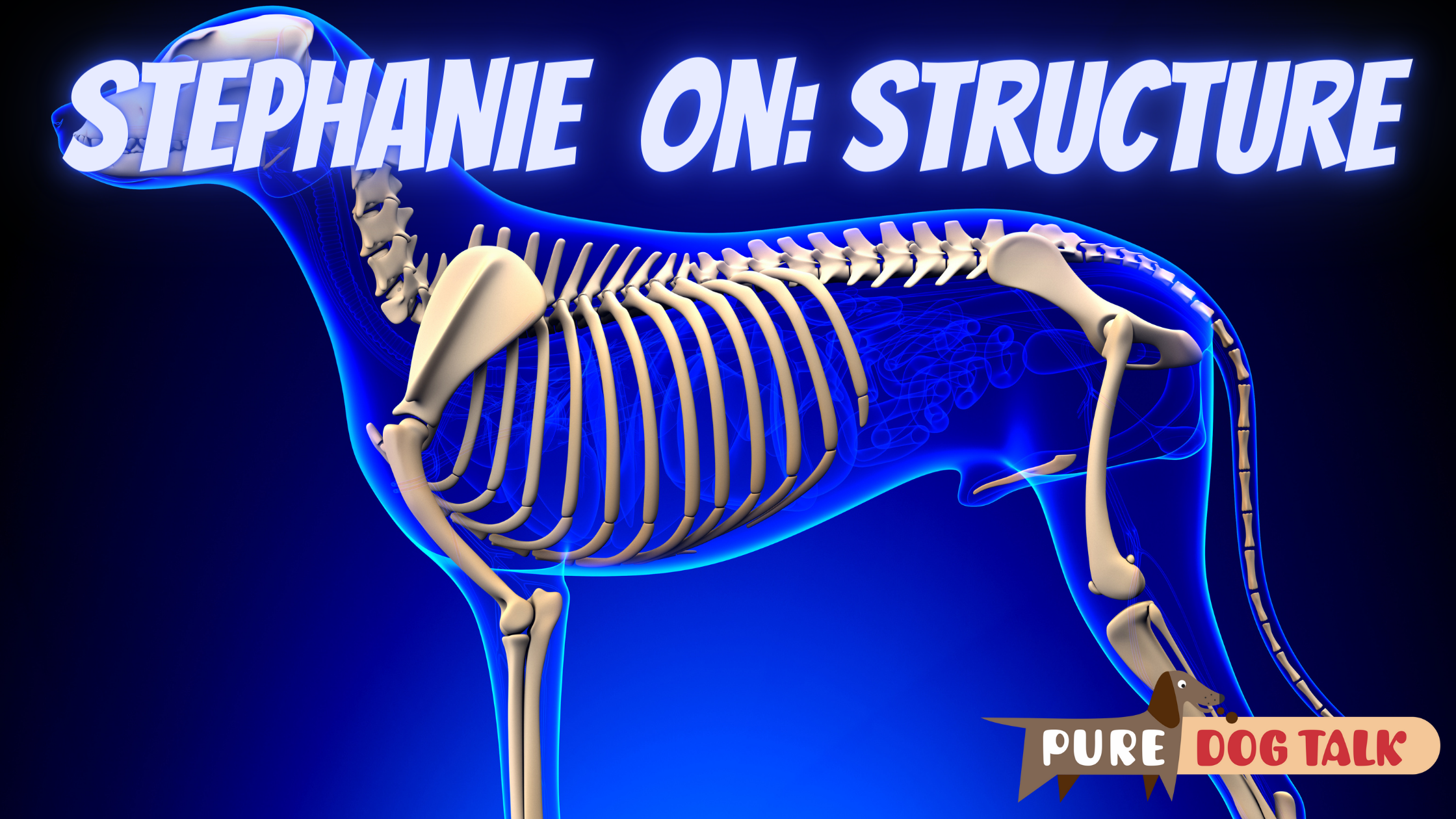
Stephanie Seabrook Hedgepath on Structure
 AKC judge, Pembroke Welsh Corgi breeder, author and speaker Stephanie Seabrook Hedgepath joins host Laura Reeves for a conversation about canine structure. Hedgepath walks us through what’s important when evaluating a dog’s structure.
“You gotta know where to put your hands,” Hedgepath said. “You’ve got to understand the skeletal structure of the dog because that’s the basis of the whole thing. Now a skeleton by itself can’t move. It’s gotta have muscles and ligaments and all of that, but you’ve got to understand the basics underneath … you also have to understand balance.
“That front assembly is laid back, set under the ribbing so as to provide the most support in the front when it acts as a shock protector … I think what people don’t understand is the whole front assembly of the dog is held on with muscles and ligaments to the chest. In the rear we have the hip the pelvis is fused to the spine at the sacroiliac joint. It is fused to the spine and then you’ve got a nice big ball and socket that goes into that. So that is much more rigid. The front assembly, if you don’t keep your dog in shape, they can get injured very easily. But if it isn’t set up properly and those muscles and all are not going where they need to go to hold all of that together, then we’ve got a big problem.
“I think that’s the thing that the majority people don’t understand. That’s why (when) dogs are in motion we can have dogs that flip their fronts, they paddle, they go in circles…. (while) in the rear, we don’t have as many different ways for the dog to go laterally, ’cause it’s a much more fixed assembly.
“What fascinates me is the way everything works together. Anatomy and Physiology is just beyond explanation sometimes because it’s like dominoes. If one little thing goes wrong then boom boom boom boom all the way down the chain everything’s gone.”