
729 — Assembling the “Engine” in Canine Structure

Assembling the “Engine” in Canine Structure
Veteran breeder and judge Stephanie Seabrook Hedgepath joins host Laura Reeves to break down the dog’s “engine” — rear construction from croup anatomy and tail set to hock length and bend of stifle — helping breeders and judges understand how structure drives movement and longevity.
The entire rear assembly in a dog is the engine that propels it forward. Stephanie and Laura unpack the anatomy and biomechanics behind a correct rear assembly, why balance matters more than any single piece, and how faults in the rear (or the front) can break a working dog down over time.
The Rear as the Engine Stephanie describes the rear as a pole vault mechanism, driving the dog over its front assembly. The pelvis, sacral vertebrae (three fused bones), and hip joints form a solid, interconnected unit — and understanding how they work together is key to evaluating any breed.
Croup Angle and Tail Set The croup’s angle determines tail set and follow-through. A steep croup lets a dog reach far under itself but limits follow-through — the dog picks its foot back up instead of pushing off completely. A high tail set (Stephanie’s memorable test: can you see the dog’s anus from behind?) produces a tail that curls over the back and signals a structural problem, not just a cosmetic one.
Hock Length: Short Isn’t Always Better Not every breed needs a short hock. Whippets need length to generate speed. Corgis need enough leg to cover ground. The right hock length always comes back to the question: can this dog do the job it was bred to do?
Bend of Stifle and Sickle Hock Too much bend in the stifle often produces an overly long rear pastern and a sickle hock — the dog can’t stand square and loses its ability to push off effectively. Handlers may be able to mask it on the stack, but the dog’s movement tells the truth.
Why Balance Is Everything A dog that is straight both front and rear tires quickly but stays sound. A dog with a strong rear and a straight front is the most problematic combination — the front, held together only by muscle and ligament, will break down under the stress the rear generates. Movement is the proof of structure, and slowing a dog down in the ring often reveals problems that a fast gait conceals.
Breadth, Loin and Feet Stephanie and Laura also cover the importance of croup width (muscling and power), loin strength and length, and breed-appropriate feet — reminding listeners that every element of the standard exists because it helped a dog perform its original function.
505 – Front and Center with Stephanie Seabrook Hedgepath
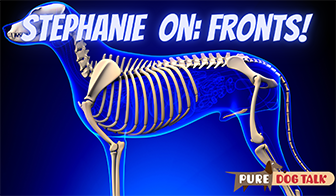
Front and Center with Stephanie Seabrook Hedgepath
Stephanie Seabrook Hedgepath and host Laura Reeves are back, chasing squirrels and discussing the single most important part of canine structure and anatomy: the front assembly.
“If you have a bitch and her front assembly is not what you really want,” Hedgepath said, “what you gotta do is you gotta find a dog that has the front assembly you do want, which is not easy in any breed. The hardest thing to put on a dog’s that front assembly. Once you find dog, …when you do that breeding, don’t be taken in by that precious little beautiful face if it doesn’t have that front assembly you’re looking for.
“We all started somewhere. You have to work at it. You have to train your dog. You have to select the proper dog. You have to learn and know what you’re seeing. Some people get lucky and they get a magic wand and their first dog is a big time winner. Most of the rest of us work our (butts) off for a lot of years.
“Learn your history. Learn what your dog’s about, even if it’s a relatively modern dog and do not try to make it something that it isn’t.
“I’ve never been one that thought that movement and type were two different things. They’re the same thing, because every dog moves according to his type and how he’s put together. Movement is an integral part of type. Movement is actually the proof of structure.
“I mean let’s just say an Old English Sheepdog and its movement and a Bearded Collie and its movement. Both fuzzy dogs, long hair and they come from kinda the same areas and totally different breed type. They worked in different train and different styles of working.
“This is something I cannot say enough times, the work that a dog was designed to do informs the structure it has to do the job the people needed it to do to live. Whether it was to put meat on the table or to have meat to sell or to be a poacher or whatever, whatever it was kept the food on the table.
“We’re fortunate today that, yes, we can breed for pretty. But what good is it if it doesn’t still represent the breed it was supposed to be. The concept of preservation breeding is to preserve the dog. It was designed to do the job, even if it doesn’t still do the job, it should be able to do so.”
In summary, front assemblies are important. They are different between types of dogs based on the work the dog was bred to do. If you are breeding dogs and looking to create better front assemblies, you have to select for the puppy that has the correct front assembly when you evaluate the litter. Once you’ve selected a good front, you have to train the dog so that the judge can actually see the movement that proves the structure.
For more episodes around this topic check out here and here.