

181 – Dog Show Judges, Family and Welcoming Exhibitors
Dog Show Judges, Family and Welcoming Exhibitors
Dog show judges, their knowledge and skill level are a constant topic of conversation in purebred dogs. This isn’t a new discussion. From the days when new judges were hand-picked by one of the “in crowd” to today’s more egalitarian system, the role of adjudicating in a subjective sport has routinely been akin to wearing a bulls-eye at a firing range.
Dog Show Judges Approval Always a Challenge
AKC Vice President of dog show judges, Tim Thomas, wasn’t born into the sport. He rose through the ranks as an owner, exhibitor, club member, breeder, handler and eventually AKC employee. His job today revolves around the always lively debate about how best to select, educate and promote judges for the conformation ring.
“… the process (by which) we approve judges is always going to be controversial,” Thomas said. “The last system was horrible, the current one is the worst ever and the next one will be the greatest one ever – that’s always the mindset.”
Thomas advocates that great dog people are born, not made.
“… the reality is, in anything, you’re going to have a broad spectrum of skill sets,” Thomas added. “You’re going to have from the most excellent, to those who are challenged and you’re going to have a whole lot in the middle. And that’s with any field and with any skill set. And we have to recognize it’s true in our judging community, in our dog show world too.”
Educating new judges and assessing existing judges is all part of the process, Thomas noted, so that exhibitors feel they are being judged fairly and haven’t wasted their $30 entry fee.
“…no matter what the process that the AKC puts in place to approve its judges,” Thomas added, “there will be individuals who will try to find a way around or look for the shortest path and there will be those that will prepare until they feel comfortable that they’re ready the judge a breed.”
Thomas strongly supports the recently re-established process of having Executive Field Representatives observe judges and discuss the entry with them to help ensure a nuanced understanding of breed standards and judging procedures.
Drawing on his extensive background in the sport, Thomas shared a deeply personal story about his favorite judge of all time. (No spoiler alert! You’ll have to listen to find out who it is… ) And why the “dog show family” is so important to the fabric of the sport.
And he shares this MOST important observation:
“…(O)ne thing that I think that we have to implore to all of us and whether it’s the way that we act at shows, to the way we conduct ourselves in social media platforms, that we have a bad habit of eating our young,” Thomas said. “..(I)t’s very easy to point the finger and blame to everyone else. But I think all of us are responsible for the way that we conduct ourselves, to have ownership in that if we want our sport to have longevity, we have to make a conscious effort to support those who are new into it. And that’s treat them with respect and nurturing them and mentoring them and not just as point makers.”
For more information about the AKC Conformation Judging Approval process, visit: http://www.akc.org/sports/conformation/judging-information/
180 – Veterinary Voice: Dr. Marty Greer Talks “Frozen Assets”
Dr. Marty Greer Talks “Frozen Assets”
Frozen semen is an investment not only in one family of dogs, but in the future of the breed in question. Dr. Marty Greer, DVM, JD takes us through a checklist of important considerations for preserving genetic material from our best dogs.
First, Greer said, be sure the semen is stored in a safe facility. Sometimes even storing the same dog’s semen in more than one facility is worth the cost.
Greer’s story about a private semen storage whose owner passed away without a will in place is a cautionary tale.
Insure the Future with Frozen Semen
Second, make provisions for transfer of semen ownership, whether in a will or trust, Greer said. This vital step will ensure the safety of valuable genetics.
“Don’t look at it as your dog line’s future,” Greer said, “but take a step back and look at it as the future of your breed.”
She contends the value of frozen semen is that the best dogs are what we have in frozen. Improvement in testing for diseases means we can use genetic material even if it is imperfect, by using DNA testing to line up the frozen semen with an appropriate bitch.
“If we can test their semen … they’ve got preserved,” Greer said “and use those to match with the appropriate bitches, we can really move our breeds forward, if we’re willing to think hard about this and not just be looking at that little tiny bit of your genetic material but look at your breed as a whole …”
Greer is a strong advocate for planning ahead for the transferal of frozen semen ownership. And to consider sharing it outside one’s own breeding program.
“And in our semen freezing contracts we have a provision made for how that semen should be transferred,” Greer said. “You should have it in your will. You should talk to your attorney about it and a lot of attorneys are going to be unfamiliar with this kind of transaction. So you’re probably going to want to talk to somebody that has some expertise. Somebody in a legal position that they’ve either got a dog ownership and they’re attorneys as well. Debra Hamilton does a lot of work with trust for dogs.”
Another point Greer makes is acquiring insurance for the storage of the semen.
“ I have a few clients that have purchased old semen from their mentors,” Greer said “and they may have 10 to 20 dogs frozen and so they may have a good deal of financial investment in that. … insurance is available through a small number of companies but don’t count on it being insured at the place that you’re storing it.”
Greer also provides input on how to estimate fair charges for owners who will sell vials of frozen semen to other breeders.
Listen today for all of Greer’s great advice.
And if you missed it, you can listen to our interview last summer with Debra Hamilton on the topic of creating plans for the future of your dogs, breeding program and more at this link: https://puredogtalk.com/96-divorce-disease-disaster-disability-delay-death-and-your-dogs-debra-hamilton-esq-how-to-make-a-maap-plan-2/
179 — Non Profit Foundations Benefit our Breeds
Non Profit Foundations Benefit our Breeds
The Clumber Spaniel Health Foundation, created by members of the Clumber Spaniel Club of America, is a nonprofit organization dedicated to raising funds for health research in their beloved breed. A low registration breed with a relatively small gene pool, the breeders were making progress on the breed’s health issues but wanted to do more.
It Is Our Responsibility to Act
“While there is no doubt our breed has come a long way in the last 25 years,” CSHF President Jen Amundsen notes on the organization’s website, “health issues such as immune-mediated hemolytic anemia, disc disease, cardiomyopathy, and hemangiosarcoma are taking many of our Clumbers much too early in life. It is our responsibility to act.”
Dr. Roe Froman, DVM referenced the Margaret Mead quote, “Never doubt that a small group of thoughtful, committed citizens can change the world; indeed, it’s the only thing that ever has” as her rallying cry in creating the group that formed the Foundation.
This group has, in fact, changed their world. The CSCA, with a membership of roughly 300, has raised over $100,000 for the Foundation in the last 10 years. The DNA bank Froman created also helped identify gene markers and DNA testing for PDP1, a very specific neurological disease, that is now virtually eliminated in the breed.
CSHF pools its resources through the AKC’s Canine Health Foundation, Morris Animal Foundation, and others, to support research being done on diseases of specific importance to the Clumber Spaniel.
Amundsen, an attorney who specializes in work that affects dog owners, provides an excellent tutorial in this episode about the actual how and why of creating a 501c3 non-profit organization for dog clubs. Groups seeking non-profit status for fundraising on health research, rescue, education, or any similar venture, will value her suggestions.
While some of the more populous breeds’ parent clubs have already created Foundations to address some of these topics, Amundsen and Froman give hope, encouragement, and direction to members of smaller clubs for ways in which they can create a positive impact for their breeds
Don’t miss Allison Foley’s Tip of the Week from the Leading Edge Dog Show Academy on flying with your dog in a cabin and how to get through airport screening safely and easily with your pet in a carry-on bag.
LINKS:
- http://www.clumberhealth.org
- https://www.facebook.com/dogsavvylawyer/
- http://leadingedge-dog-show-academy.teachable.com/courses
178 — Bergit Coady Kabel: “Groomed to Perfection”
A Legend in the Terrier Ring
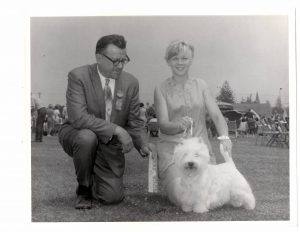
Bergit Coady Kabel with a West Highland White Terrier in years gone by.
The 2012 Winkie Award for Best Professional Handler, said it best: “A legend in the Terrier ring, Bergit Coady Kabel’s dogs are always groomed to perfection and flawlessly presented. Always polite and professional, she is totally dedicated to her dogs.”
Hard Work and Dedication
Bergit was someone I admired from afar for my entire handling career. I didn’t get to see her often, as our paths rarely crossed in the particular shows we attended. Every time I saw her, I was impressed by her immaculate charges and her unfailing smile.
I talk with a lot of folks for the podcast who have achieved the highest levels of success in purebred dogs. And I consistently hear the same themes. Hard work. Dedication. And an unquenchable thirst for knowledge. Bergit is a leading voice in the chorus.
Responsibility Gave Joy
Bergit tells the story in today’s podcast about being 13 years old and excited beyond words to have been taught by her earliest mentor how “to clean teeth, bathe dogs, express anal glands, and clean ears. … and the happiest kid you could have found.”
Let that sink in for a minute. Here is a kid who was *thrilled* to do anal glands because “Finally I knew a few things to do with dogs.”
Many successful handlers apprenticed for Bergit over the years. “A few assistants that wanted to do this by the clock, needless to say, did not work out,” she noted.
After a recent illness, Bergit is recovered and ready to take on judging with that same focus and intensity.
Focusing on Judging
“After 50 successful years of handling, I feel I can try to give back a little to a sport that has given me so much,” Bergit said. “I know judging will present different challenges and I will educate myself every step of the way. Will I like it better than handling? Never. I loved every minute of my handling career.
“…my son Ryan said to me. He is fully aware of my love for handling. He said, ‘You know, you are very lucky that you can go into judging. There’s a whole big world and big dog family. So you can see your friends again.’ He does mortgages and he said, ‘When I’m done there is no mortgage family waiting for me.’”
Bergit’s concrete advice on reaching the pinnacle of perfection in trimming dogs is invaluable. And we start a new feature on the show “All Time Favorites Best in Show Lineup.” Listen now to hear which dogs she would have in that ring and who would win!
Laura: Welcome to pure dog talk, I’m your host, Laura Reeves, and I am joined by a member of our sport who I have long had mad respect for and I think she just brings such incredible knowledge to the game of purebred dogs. So I would like to welcome Bergit Coady Kabel to our conversation because I think you guys are going to really, really enjoy this one. So thank you. Bergit. How are you today?
Bergit: Really good, thank you. Very good. Excellent.
Laura: So we have a thing here on pure dog talk that we ask our guests to give us the 411, right? The who, what, when, where, why, how, how did you get started? How did you get involved in dogs? You’ve been at this for a lifetime now, right?
Bergit: Yes, definitely. Yes. I will have to tell you how it all started. When I was five years old, my family moved from southern Germany to downtown Hamburg. Soon after that, my earliest recollection is this, and a bit old neighbor girl was able to walk a wire Fox terrier for friends. One day she let me hold the leash. I was so thrilled and could not wait to tell my mom. You would have thought I won a box of toys. I have always been crazy about dogs. Maybe got the gene from my grandmother. She loved animals. A few blocks away from where we lived in Hamburg was a grooming shop owned and operated by Mr and Mrs Buchhaltz, who were excellent dog people and also show people. They owned a Mini and a Toy Poodle, an Irish Terrier and a Scottish Terrier. For a long time I was forever trying to figure out how I could get to know them. Remember I was only a young kid then, and the dog world was not like it is today. My break came when the Buchhaltz’s daughter, who was in the same class as my younger brother, came into the classroom and asked for her parents. They were looking for a babysitter for the two year old sister. Bingo. I was it.
Bergit: I babysat… and every minute, after my job was done, I was spending time with the dogs. I was a dog walker at first and I kept telling the Buchhaltz to please teach me grooming. I was fascinated by what all the employees could create. So after awhile Mr Buchhaltz decided he had to do something with me since I was always around. The first things he taught me was — this is no kidding — to clean teeth. bathe dogs, express anal glands and clean ears.
Laura: And you were how old Bergit?
Bergit: I was 13 at the time. And the happiest kid you could have found. Finally I knew a few things to do with dogs. At that point they also started to take me to some dog shows, you know, later on in life, much later on in life. I kept thinking back to this and I was thinking maybe Mr Buchhaltz thought, you know, if I let her do all of these things…we’ll get rid of her! But it didn’t happen. By the time I left school, I agreed to a three year apprenticeship with the Buchhaltz. My parents were devastated. My mother’s dream was for me to be a super secretary like she was, but sitting still has never been easy for me. So at this point, the Buchhaltz did not really need a fourth girl.. the three they had were excellent. So they asked if I would like to go to England to work in a well known Scottish Terrier Kennel “Riander” for Mrs Elizabeth Meyer. They took me with them to Crufts and we were introduced and I looked at all the Scotties like many people would do and said, how do you know which one is which one? So this was the basic beginning to my fabulous life into dogs. I spent two years in the UK and then one year at the Buchhaltz grooming shop. They agreed to the second year if I agreed to no time or days off for that. year. That was fine. I didn’t care.
Bergit: So basically my most important mentors besides the Buchhaltz was Mrs Meyer of Riander fame. To this day, I refer to something I was taught by her daily and we don’t even own our kennel anymore. There are two most important elements that I live by. Mrs Meyer said, number one, you have to be able to take care of yourself first before you can take care of someone else or something else. Second, when taking care of dogs, you yourself have to know what goes into a dog and what comes out of a dog, so you have to look at each one every day. From her I learned how to put down a Scottish terrier, and once a month she insisted to drive me to a well known Westie breeder who taught me how to trim Westies I would spend all day at her place. Now comes the question of how did you come to the United States? Well, spending two years at the Riander Kennel in England, I met many American Scottish Terrier breeders that came to visit the Kennel. One day, Betty Malinka of Sandoone Scottish Terriers, visited and asked if I would like to come for one year to work for her in Gary, Indiana. I agreed. End of history. This year, March 12, was my 50th anniversary of arriving at Chicago O’hare.
Laura: That is pretty amazing. Bergit. I’m sorry. That kind of made me a little choked up for a minute.
Bergit: Yeah. Yeah. That’s amazing. Working for Betty was fun. She took me to a lot of shows and also I met a lot of people and that’s how I met Clay Cody.
Laura: Yes.
Bergit: We started with our limited experience but taught ourselves a lot by watching top handlers at the time. Yes, we were fortunate to have some great dog people apprentice under us… and we are still very proud of them. Again, trimming you can teach, conditioning as well, but you have to have a certain feeling for dogs. If you had assistants that wanted to do this by the clock, needless to say, that did not work out.
Laura: No,
Bergit: We always started from scratch. If a dog needed a new coat, it was stripped down… in 10 to 12 weeks later you started to show it. It takes that long on any strip breed to get the coat into show length.
Laura: Yeah.
Bergit: In the meantime, you will take care of furnishings and everything else on the dog, exercise and fresh air are of great importance… and having had a super kennel with 58 runs in southern California for 40 years was more than ideal. We also had a set of runs where you could get a profile view of the dog from the dog kitchen, and that was enlightening and very useful. All of the above we brought to the attention of all of our assistants. Your question about habits to condition and groom a dog, is difficult to answer. A dog has to feel you like him. That’s the start of everything. Then you start by putting him on the table every day, often just for a little while because once a dog is stripped, you have four to six weeks before you do what we call a defuzz, which is the same as a cleanup, but furnishings need to be washed every two to three days and blow dried.
Bergit: The dog gets used to your hands and where you put them. Be consistent in making the same movements. Always be peaceful. Don’t do any of this if you need to rush. By the time you need to put a final show trim on the dog, he should be able to stand on the table perfectly relaxed and display confidence. Anyone with love for dogs can do this — Owner-Handlers or Handlers. The secret ingredient, as you call it, to a perfectly trimmed dog, is looking at it as many times as it takes on the ground, after you finished trimming it in front of a mirror, of course on the table. Then on the ground, someone has to walk the dog for you so that you can see him in profile as well as up and down. Whatever you need to correct… then you correct it, but you can never take a dog off the table even though it looks perfect and think that that’s how it’s going to look. Because once the dog shakes or moves differently, you can have a completely different picture.
Bergit: So this is of course more work and a lot of people’s excuse is they don’t have somebody that can walk the dog, BUT you can always, if you get to the dog show early, find somebody that would do it for you, and even if they don’t walk it correctly or perfectly like you would, you can still see certain things. The other thing that a lot of people don’t do is to take a dog for a regular walk. I don’t mean at a dog show. I mean just down the street to look and hear and see strange things. Always talk to your dog and pet him in between. You will bond nicely. You have to have good work ethics, a lot of self discipline and most of all a passion for this whole dog show scene in order to make it work.
Laura: I would agree with that.
Bergit: After all. Then you asked me about judging.
Laura: YES. This is a new journey that you’re taking on, right? Just getting started, yes?
Bergit: Right, after 50 successful years of handling, I feel I can try to give back a little to a sport that has given me so much. I know judging will present different challenges and I will educate myself every step of the way. Will I like it better than handling? Never. I loved every minute of my handling career. To end this interview, I would love to tell you what my son Ryan said to me. He is fully aware of my love for handling. He said, you know, you are very lucky that you can go into judging. There is a whole big world and big dog family. Most of all, you know each other. So you can see your friends again. He does mortgages and he said when I’m done, there is no mortgage family waiting for me.
Laura: I love that. It’s totally the truth, Bergit.
Bergit: It’s totally the truth.
Laura: You know, I just got done interviewing Lorraine Boutwell for example, and she talks a lot about this and a lot of the people I talk to about this, they started in dogs either as breeders or as breeders and then handlers or what have you… and continued judging and I think so much of it is because this is your family. Right?
Bergit: Right. Right. And I mean, you have no idea. I mean when I got sick, I mean I still have all the cards and all the stuff and I mean it was incredible. You know, I was just truly overjoyed and now everybody that sees me at a dog you know, goes crazy and is happy for me
Laura: like I did.
Bergit: You know, I’ve always tried to help everybody. Because people tend to dislike you when you win a lot, but you know, that’s never affected me. You know, I’ve always given credit to where credit is due and you know, I think people remember that. You know.
Bergit: I think so too. So two more things. Your best advice… especially for the people that are getting started. We have lots of people who listen to this podcast who are less than five years, for example, with purebred dogs. What is your best advice for these folks when they’re getting started? Showing their dog, grooming their dog, whatever it is.
Bergit: Definitely to get the best rapport going with your dog. That means you take the dog for a walk just as a pet. You pet it, you talk to it. You make sure it learns to stand on the table perfectly still so that you can groom it. Whatever dog it is… in order to groom it you can’t be fighting with it. That you can’t be every time making excuses, for it or all these things. But if a dog knows that you want this from him, you give him so much. To my mind, the dog can also give something back to you and they’ll figure it out. I mean it doesn’t matter what we dealt with many different bleed, you know, so you have to be patient and then when you need help you try and get helpful my hand low or if you watch somebody at a dog show that you think could give you ideas, you approach that person at the end of the day or when there’s a break, obviously not while they’re showing a dog, you know, most people will help you and that’s how you really keep going. And if you run into somebody that won’t help you, don’t be discouraged and go to the next person that you think could do it for you.
Laura: Yeah, and I think that that’s so true. And one of the things that has kept me going, I mean every time I handle a new breed… I go ask someone. That’s just a thing I do and I think that if you just are willing to ask, people are always willing to help, somebody will help you.
Bergit: Yeah. I mean look at it. A few years ago somebody offered us a Komondor. I had finished two Wheatens for them in 1987. They said to me, do you want to show a Komondor? And I said yes. I said, I don’t know much about them, most people don’t, but I said Bill McFadden knows and I’ve seen him show one. And I said I will talk to him and I will get all the information and I will do everything he tells me. So I got it finished. And of course you have to be friends with people in this breed because there’s so few of them that you have to know when there will be a major, you know. And we got it done. But it was really interesting, you know, I mean it was great to do it differently like that.
Laura: I did a Briard, I mean completely outside my comfort zone. And it was great fun, I really enjoyed it because you get that chance, right, to learn something new.
Bergit: Yeah. Yeah. And the same with the Black Russian. I got a Black Russian finished… also with the help. This is when the kind of first started, you know, also with the help of key people and you know, I’ve never forgotten the people that have helped me, you know, and they get a Christmas card every year. I mean I’m a great Christmas card writer. I’m sorry. I like to do that. You have to do these things, you know.
Laura: Yes, absolutely. Okay, so then listeners, you guys are gonna love this. We’re going to add this as a new feature for all of the interviews that we do with some of our great legends of the sport and Bergit gets to be our test case. So Bergit? Now you have 50 years in the sport in the United States. So I’m asking you in your mind, and this is a game we play as handlers, right? Like, I’ve always done this. So, in your mind, the greatest best in show lineup of all time… of dogs that you have personally seen. Ready, Go!
Bergit: I would say for the Hound Group – Pepsi, the Afghan Hound. For the herding group… Manhattan, the German shepherd. Non-Sporting would definitely be London, Standard Poodle, black Standard Poodle. Terrier… Coco the Norfolk.
Laura: Wow. That says a lot coming from you. Wow!
Bergit: Yup. Yup. Working… and that would probably win my best in show right there, Matisse, the Portuguese water dog.
Laura: Okay…Wow.
Bergit: Toy…John Oultan’s Papillon, Kirby,
Laura: Beautiful.
Bergit: Sporting… the Black Cocker of Michael Pitts — Beckham.
Laura: Those are some beautiful, beautiful choices and I think since I saw this in somebody else’s social media and I said, it tells so much about what you value as a judge, as a handler or what have you, what you see in that best in show lineup. I just think it is a wonderful, wonderful thing. Plus it makes us think about cool little dogs. Awesome. Alright, well Bergit, thank you so much for your time. It was wonderful to see you at the dog show a few weeks ago. I am thrilled to see you back and I wish you the very, very best in your judging career. You will be outstanding.
Bergit: Thank you so much. I appreciate that. Thank you. Take care. Okay..bye-bye.
177 — Developing An Eye For a Dog: Recorded LIVE
Developing An Eye For a Dog: Recorded LIVE
San Mateo Kennel Club invited PureDogTalk to sponsor a live expert roundtable at its all-breed show in March. Exhibitors who participated were treated to a rare opportunity to interact directly with some of the most knowledgeable people in the sport. Judges Pat Trotter, Desmond Murphy, and Ken Murray were joined by professional handler Andy Linton to address the topic of developing an eye for a dog and answer audience questions.
“Lifers” Share Their Knowledge
These folks are what we think of as “lifers” in dogs. They started young with a passion for dogs and have applied that intensity to achieving their goals as breeders, handlers, and judges. Each and every one of the panelists is a lifelong student, who possesses the noted “eye for a dog” we were discussing.
While each of the panelists brought their own perspective to the conversation, there was complete agreement that developing an eye for a dog entails focusing on and rewarding a dog’s virtues rather than picking at faults. Riffing on a quote from the well-known judge of the ‘60s, Bea Godsol, whom Trotter noted was gifted with a tremendous eye for a dog, the panelists each shared their spin.
Ken Murray – “Great dogs carry their faults well,”
Pat Trotter – “An absence of faults doesn’t guarantee virtue,”
Desi Murphy – “Great dogs blind you to their faults.”
Andy Linton agreed, noting also that, “having an eye for a dog gives you responsibility in so many ways. Do I take that dog to show? Do I put that dog up? Do I breed that dog? The more you know, the more responsible you become.”
“An eye for a dog,” according to Trotter, “is when you see one that gets your attention. It’s an arresting animal because it exudes beauty and correctness. Like a work of art.”
Trotter added wryly, “Sometimes great dogs get lost at shows where they are the right look. They’re different from the other dogs who are, shall we say, modest at best.”
Even if a person isn’t “born with it” in terms of that eye for a dog, Trotter does believe that studying and learning, and listening to the greats in a breed will allow someone to develop the skill.
Murphy qualifies that with an observation that some people are simply better at the skill than others.
“I mean there were certain subjects, if I went to school for 10 years on that subject I would never have been any good,” Murphy observed. “… judges are like dogs. You have excellent, very good, good, satisfactory and unsatisfactory.”
When an audience member asked how to know which judges have an “eye for a dog” and how to discern to whom they should show their “great dog that doesn’t look like the others,” Bill McFadden, speaking up from the gallery, noted we all need “an eye for a judge.”
Trotter summed up much of the advice with this observation, “I think one thing that helps breeders is to look at your own dogs with a jaded eye. Look at them with a jaded eye and see their shortcomings. And look at your competition through rose-colored glasses. That will help you advance in your efforts to become a better evaluator as a breeder and exhibitor.”
Please enjoy this special and valuable conversation. What it may lack in our normal audio quality, it more than makes up for in the quality of the knowledge.
Additional Q&A coverage from this event is available ONLY to our PureDogTalk Patrons! Click the button on our website to “Be My Patron on Podbean” for more information about joining the “in” crowd.
And, making a surprise Thursday appearance, Allison Foley’s Tip of the Week from the Leading Edge Dog Show Academy provides insight on dealing with stains on white dogs.
176 — NAIA’s Patti Strand on Pet Expo for Public Outreach
Pet Expo Provides Public Outreach Opportunity
Patti Strand, President of the National Animal Interest Alliance, has spent nearly 30 years attending America’s Family Pet Expo in Orange County, Calif. Instead of insisting that JQ Public meet purebred dogs only at dog shows, where most of us are too busy to actually interact with visitors, Strand says Pet Expo and other public venues are a great way to introduce our responsibly bred purebred dogs to folks in the community.
Reach New Club Members
Strand, along with her husband Rod, have been active in growing the participation of breed clubs at the Orange County event, which last year boasted 47,000 visitors. Representatives from more than 90 breeds had the opportunity to interact with those families, with long lines at most of the booths, Strand said.
“… one of the things I’ve seen that’s pretty cool on the part of the breed clubs is how they’ve evolved over time, to now they have begun to create literature,” Strand said. “Maybe they had a brochure or a flyer, to begin with, but now they have a lot more materials that they’re passing out and I think they’re finding it not only is a great place to educate or inform the public about their breeds but also they’re recruiting fanciers, people who love the breed. People who live in the area and had a Dalmatian or had a bulldog but didn’t know there was a club.
“… what we have found at the pet expos are the number of people who have our breed, who love our breed and really, really want to connect with other people who have the breed. So, if some of the memberships are a little smaller than the clubs would like them to be, this is really a great place to meet other fanciers of your breed that you never knew existed,” Strand noted.
Home for Animal Heroes, an organization NAIA supports that provides resources to foster and rehome retired medical research dogs, will offer an adoption opportunity at the Orange County event. The Expo is April 27-29, 2018 at the Orange County Fair & Event Center.
Homes for Animal Heroes also is sponsoring a “virtual 5K run” to raise money for their goal to expand their fostering and adoption network to more states.
Strand noted that public events like the Expo allow responsible preservation breeders to take back the conversation about animal welfare in the public dialogue.
“…when you really think about the dog fancy as a whole,” Strand noted, “there are no other people in the world that give as much of their time, their love, their money, their energy, their intelligence to trying to make sure that dogs have good lives, that they’re able to live longer, that they are socialized well enough to live in the world comfortably, … you know all the things that go in to raising dogs.”
Patti Strand is a long-time Dalmation breeder who has been blazing the path of animal welfare and providing a voice for the rights of dog breeders for 25 years.
And don’t forget! Listen to Allison Foley’s Leading Edge Dog Show Academy Tip of the Week on how to not lose your equipment at the dog show!
175 — Tibetan Mastiff History, Lore and Modern Living
Tibetan Mastiff History, Lore and Modern Living
“No one knows where they came from,” said Sabrina Novarra, one of the original Tibetan Mastiff breeders in the U.S. “The myth of the old monks of Tibet say that snow leopards bred with wolves. Now, we know that’s not true. But, we cannot trace the ancestry. They are the oldest large breed in existence.”
Novarra acquired her first Tibetan Mastiff in 1987 and worked to help establish the breed with the American Kennel Club, where it was recognized in 2007.
Low key breed is long-lived but not easy to train
She said this ancient breed is relatively healthy and long-lived, but, while generally low key, they are not particularly biddable.
“This is a landrace breed,” Novarra said. “… basically, a breed that has evolved itself as opposed to us evolving it. They are self-thinkers. They are not easily trained. You learn after you’ve had them as long as I have, that you make them think it’s their idea to be trained.”
In Tibet the dogs developed as family and flock guardians who were tied during the day and roamed the village at night as protection. They still bark at night if they are outdoors, as that was their job in ancient times.
“This is not a dog if you want to do agility and obedience and take 300-mile hikes, this is not the dog for you … they’re very lazy,” Novarra said. She did note that she accomplished an obedience title on one of her older girls.
The dogs are very large and powerful and need significant amounts of socializing, according to breeders.
“Tibetan mastiffs need to see everything twice,” said Dan Nechemias, owner of the 2018 National Specialty Best of Breed winner. “Just because they saw a red basketball doesn’t mean that they’ll accept a yellow basketball. They were bred for 2000 years to be suspicious of absolutely everything but their family. So, everything that they see in their space — which is their entire visual field — is a threat until they decide it’s otherwise.”
Nechemias, who purchased his first Tibetan Mastiff in 2001, adds that, like many of the working and guardian breeds, the Tibetan Mastiff is very discerning about people they meet.
“… Tibetan Mastiffs are wary of people that are determined to meet them,” Nechemias said. “So what happens is the person’s just really working hard. They’re staring at the dog — you should never stare down an Asian breed much less a Tibetan Mastiff — they’re in their face. … If you ask a Tibetan Mastiff permission to touch it, it will wonder why you’re asking it permission. They’re an incredibly sensitive breed and then they say well this person’s asking me permission they must not be OK.”
174 – 65-Year Love Affair Started with a Brittany
65-Year Love Affair Started with a Brittany
When Loraine Boutwell and her husband, Victor, acquired their first Brittany in 1953 they paid $35. The puppy traveled by train from Oklahoma to Topeka, Kansas in what Loraine describes as something like a wooden orange crate
Victor Boutwell, who passed away in 2003, owned a Brittany as his hunting dog when the couple began dating. Eventually they attended field trials and Loraine says she loved watching the dogs work. She fell in love with one of the field trial champions and decided they needed one of his puppies. According to Loraine, Victor said it was her idea, so she had to pay for it!
Beautiful Field Trial Brittany Goes to the Dog Show
The Boutwells were smitten with their new puppy and decided she was so beautiful they had to take her to a dog show. Thus
began their long history with the Heart of America Kennel Club and love affair with dog shows.
From breeding a champion in every group to handling all-breeds, from active all-breed club involvement to judging six groups, Loraine has been long involved in every aspect of the sport.
She said sound, correct movement remains her top priority in any of the breeds she judges.
“… when a dog comes in, I don’t want to see them stacked first,” Boutwell said. “… I’d rather see them moving. And I have them come in one at a time. And I spend quite a bit of time, I usually watch them go almost all the way around… And then I think this is a quality class or I’m going to have to work at this. I have a clue from just going around what kind of quality I have. And then I’ll think, well I have about five dogs there that are just wonderful. And one I’m going to have to move several times because the owner is new. And we can spot it right away. Because you want to evaluate that dog, even though the person may be not a wonderful handler, but you want to be able to evaluate that dog as best you can.”
Boutwell still retains the love for performance work that was sparked in a young woman’s heart so many years ago.
“I just love to see the dogs work doing what they were bred to do. That, to me, is icing on the cake if they can do that,” Boutwell said. “If they win their championship that’s perfect but they’ve got to be able to do what they were bred to do.”
Loraine and Victor Boutwell celebrated their 50th wedding anniversary the year before Victor passed away. Purebred dogs were their lives, Loraine said.
“I’ve been judging for 38 years,” Boutwell said. “And they’ve been wonderful and if I had had any idea that I would still be judging now, at my age I would say ‘oh no no. Couldn’t do it.’ Well I am. And I’m loving it. I had to cut back, but I still want to do it. I still want to be able to judge.”
I hope you enjoy this delightful conversation with one of our sport’s most enduring and charming participants. I know I did!
173 – Dreamland Chow Chows “Show Ring is Mirror of the Whelping Box”
Chow Chow Breeder/Handler Shares His Story
Michael & Linda Brantley were AKC’s Non-Sporting Breeders of The Year in 2013 for their Dreamland Chow Chows. Michael is a professional handler, member of the Professional Handlers Association, and has shown top ranked, multiple Best in Show winners in numerous breeds.
Breeding is the Art
“Still, the breeding is very important to me,” Brantley said, “probably more so than the handling. The handling is more the game, but the breeding is the art.”
While Michael says he’s never actually counted, Dreamland Chow Chows have produced more than 200 champions in last 40-plus years.
Brantley’s folks started in Pekingese and were breeding and showing them when he was born. His family acquired their first Chow Chow when Michael was in grade school and never looked back.
The first time Brantley was paid to show a dog, he was thrilled to realize he could “support his habit” with handling.
“I’ve been handling full-time for 40 something years,” Brantley said. “So that ended up (going) from a hobby to a career.”
To this day, handling and breeding, for Brantley, work hand in glove.
“ I think the handling of the other breeds has really helped me understand my breed better,” Brantley said. “It helped me understand structure and function tremendously. More than if I had just stuck with my breed and not sat around and watched these other dogs show or learn the standards of them before I showed the dogs. So, it’s been a double edged thing there where it’s taught me a lot.”
But the hobby, the breeding piece, remains the most compelling for Brantley.
“The show ring is just a mirror of the whelping box,” Brantley observed.
“… maybe 20-25 percent of the dogs that we breed will end up in the show ring,” he added. “Maybe. So, the rest of those dogs are going to go as companions to people. And in a breed that is very strong willed, very independent like Chow’s are, like our Tibetan Mastiffs are as well, it’s extremely important to have that proper temperament to where they end up as being great pets for somebody.
“They think for themselves. They’re happy you’re there, but they would rather go out by themselves. So, you’ve got to learn how to deal with that and it’s not something you learn overnight and it’s something that you’ve got to figure out.”
I hope you enjoy this great Talk with a man who brings a wealth of knowledge and wisdom.
And don’t forget to stick around for Allison Foley’s Tip of the Week on how to manage the male dog’s performance when bitches in season are in the ring.
172 – Veterinary Voice: Cruciate Ligaments
AVOID EXPENSIVE, PAINFUL CRUCIATE LIGAMENT RUPTURE
Early spay/neuter is one of the primary indicators of a potential for a “blown knee” in our dogs, according to Dr. Marty Greer, DVM. The cruciate ligaments in the stifle joint of the dog serve as a hinge when working properly. When these ligaments are stretched, frayed or torn, the dog will be painful, limping, or “off” on a rear leg. Environmental factors such as overweight and lack of condition also can contribute as causal factors, Greer adds.
TRAUMA NOT ALWAYS THE CAUSE
WHILE TRAUMA HISTORICALLY HAS BEEN CONSIDERED THE PRIMARY CAUSE OF THIS SITUATION IN THE DOG, GREER SAYS SHE SEES MORE AND MORE DOGS WITH NO KNOWN INJURY SUFFERING FROM A DAMAGED JOINT.
“… THERE’S A HUGE INCREASE IN INCIDENCE OF CRUCIATE RUPTURES IN DOGS THAT ARE SPAYED AND NEUTERED WHEN THEY’RE YOUNG,” GREER SAID. “AND BECAUSE THERE’S BEEN A BIG MOVEMENT TO EARLY SPAY AND NEUTER FROM THE RESCUE ORGANIZATIONS AND THE HUMANE SOCIETIES FOR REASONS OF POPULATION CONTROL, THEY’VE PUT OUR DOGS AT INCREASED RISK. INADVERTENTLY, THEY DIDN’T SET OUT TO DO THAT, BUT INADVERTENTLY, THEY SET OUR DOGS UP FOR FAILURE IN THE DEVELOPMENT OF THEIR JOINTS. SO, WHEN A DOG IS SPAYED OR NEUTERED WHEN THEY’RE REALLY YOUNG, THEIR GROWTH PLATES STAY OPEN LONGER. WE KNOW THAT FROM LLAMA’S. WE KNOW THAT FROM HUMAN EUNOCHS … SO, IF YOU WALK DOWN THE AISLE IN A HUMANE SOCIETY AND YOU SEE A LONG LEGGED SKINNY STRAIGHT KNEED BLACK 60-POUND DOG, ODDS ARE PRETTY GOOD THAT IT’S A MALE THAT WAS NEUTERED WHEN HE WAS 3, 4, 5 WEEKS OLD, MAYBE TWO OR THREE MONTHS OLD. BUT WE DO KNOW THAT THE INCIDENCE IS MUCH, MUCH INCREASED IN DOGS THAT ARE SPAYED AND NEUTERED REALLY EARLY. SO THAT’S ONE FACTOR THAT REALLY NEEDS TO BE TAKEN INTO ACCOUNT.”
Anterior Cruciate Ligament (ACL) Rupture
Rupture of the anterior or cranial cruciate ligament is more common after gonadectomy than in intact dogs (Whitehair et al. 1993; Duval et al. 1999; Slauterbeck et al. 2004). Breeds at risk for rupture of the ACL include the Akita, American Staffordshire terrier, Chesapeake Bay retriever, German shepherd dog, golden retriever, Labrador retriever, mastiff, Neopolitan mastiff, Newfoundland, poodle, rottweiler and St. Bernard (Duval et al. 1999; Harasen 2003). Other risk factors include obesity and abnormal angulation of the stifle (Ragetly et al. 2011). One could argue that increased risk of ACL injury after gonadectomy is because of decreased athleticism and obesity in gonadectomized animals but the trend stands even in studies that statistically compensated for these effects in dogs. Joint laxity may differ under varying hormonal stimuli, suggesting one possible cause‐and‐effect mechanism. Another hypothesis is increasing stifle angulation with asymmetry of growth plate closure in the femur and tibia.
https://onlinelibrary.wiley.com/doi/full/10.1111/j.1439-0531.2012.02078.x
Tick borne diseases that can cause joint inflammation are another area Greer notes that may cause complications. Often times, a dog will not have a fully ruptured ligament, but these important sort of elastic bands in the joint will have frayed or “stretched.” Treating these dogs with crate rest, testing for tick borne diseases and treating with a prophylactic course of Doxycycline that both treats tick borne diseases and confers some anti-inflammatory process in the joint is Greer’s recommendation.
Patellar luxation is a genetic disorder that serves as complicating factor for potential injury to the knee joint as well, according to Greer.
Surgery to repair a torn cruciate ligament is expensive and requires the best orthopedic surgeon you can find, Greer said. But it isn’t an emergency situation. If you suspect a cruciate injury,
- Keep the dog quiet and crated.
- Take it to your veterinarian for diagnosis.
- Research the best surgeons available in your area.
- Be diligent about maintaining *strict* crate rest during recovery.
We hope you enjoy today’s podcast with Dr. Greer. For more information on this topic, visit:
https://www.researchgate.net/publication/312054514_Top_5_Genetic_Diseases_of_Dogs