

171 – New AKC Department Supports Clubs
AKC Club Development Has Your Back
All breed and specialty clubs throughout the country are struggling. Members are aging, new members are few and far between. Some clubs are struggling financially, others burdened with a handful of active members. Some have even closed their doors.
AKC Club Development’s main focus is to help clubs grow. Whether that means providing ideas to recruit new members or offering guidance to organize events in a cost-effective and exhibitor-friendly manner. Success should be defined by the club, said Guy Fisher, Manager of Club Development. In a general sense, Fisher noted, success for a club is creating a fiscally strong organization with the means to support its members and community.
New AKC Department Created in 2017
Glenn Lycan, Director of Event Operations Support and Doug Ljungren, Executive Vice President of Sports and Events, looked around a couple years ago and noted that while the AKC had lots of resources for new clubs just getting started, they didn’t have a structured way to help existing clubs thrive.
“We had a goal to assist clubs to be more successful in every aspect of their development,” Lycan said. “… it’s funny you commented about how people think that the AKC is just businessmen in suits … that’s exactly how clubs looked at it, too. So, Guy’s first task, and what Guy has been excellent at, is letting clubs know that we are dog people, that we have a lot of dog experience, but we also have a lot of AKC experience and our phone is always available. We will help you. So, you hear about the glass ceiling. But AKC had a glass wall between clubs and us. And that was our whole goal for year one was to break that wall down so people felt comfortable coming to us.”
Dog people helping dog people
Fisher said he was literally born into the sport. His family raised Boxers and the Boxers raised him. An active member of all-breed and specialty clubs in Michigan, Fisher was a professional handler and his children remain active in the sport.
Lycan’s family bred Samoyeds and put him in charge of the kennel at 13 years old. He later went to work for Houston and Toddie Clark, then professional handlers and today well-respected all-breed judges. He apprenticed with them for three years, met his wife who also worked for them, and eventually began their own professional handling career in Georgia. There they were involved with their local all-breed club events and various national clubs as well.
Clubs Are the Backbone
“The clubs are our backbone of our sport,” Fisher said. “If we don’t have clubs we have nowhere to facilitate our sports and to participate. So, I always viewed it as a club needs to be a source of breeders owners owner handlers professional handlers to come together and educate their community within their territory.
“… And one of my main questions for clubs was what do you do for your membership. And a lot of clubs didn’t do anything … one of my suggestions was ‘how about trying to make it a little bit more of a fun, welcoming environment for these people’ so that they would want to … give off good positive vibes to the rest of the sport.”
170 – Ann Yuhasz, Four Generation Family of Dog Breeders
ANN YUHASZ, FOUR GENERATION FAMILY OF DOG BREEDERS
We talk a lot about pedigrees in dogs, but AKC Judge Ann Yuhasz and her family have been involved in dogs, specifically English Setters, since the 1960s. Yuhasz noted that starting with her mother, to herself, to her daughter, to now her granddaughter, purebred dogs are an inextricable part of their “family DNA.”
SPECIAL RELATIONSHIPS
Yuhasz shares memories of her mother, Nancy Frey, and her daughter, Rebecca, and the special relationships the purebred dog world has brought her
“It was unbelievably valuable,” Yuhasz said. “(Mother and I) had such a very special relationship. I understood what she was doing. She understood what I was doing and it was remarkable…. she was my best friend. She really was. And there’s a big hole when your best friend has gone. And still to this day I sometimes think she’s sitting on my shoulder laughing at me for whatever I’m doing.”
She also discusses the challenges and rewards of judging the sporting group, a numerically large, diverse group of dogs used for every type of bird hunting.
“…the sporting group is basically pointers, setters, retrievers and spaniels. … those four are very different, yet very much alike. They all hunt. They all should hunt. They all should be made so they can hunt. And if you can keep that in mind when you judge them then you should be okay.”
While English Setters were her family’s lifetime passion, Yuhasz spent a number of years working with Flat Coated Retrievers. They aren’t black Golden Retrievers, although they are considered the progenitor breed of the Golden Retriever.
“…the Flat Coat is essentially a pickup dog,” Yuhasz said. “He sat there all day while they shot and then he went out with his buddies and cleaned the field. That’s what he did. And he’s a very, very sweet creature. They are very touchy-feely, they want to be with you, they make lousy kennel dogs but they are very unique. Their head property is so different and so hard to find correctly.”
PASSION FOR BREEDING AND JUDGING
Yuhasz brings passion and excitement to her love of dogs, of breeding, of judging.
“That’s how I feel about some of these dogs,” Yuhasz added. “I can’t wait to get my hands on them, you know? I mean, Good Heavens. So that’s what judging’s all about – getting your hands on wonderful dogs and admiring what somebody has done.
“If you can get a litter with one good specimen – my goodness that’s terrific! If you can get a bunch of good specimens, how fabulous is that? How lucky you are! The genes just fell just the right way. You got the things you were looking for, and I think as breeders you’ve got to have a pattern … you’ve got to know where to go how to go and you have to be hard on yourself. You’ve gotta say, ‘Mmm, that isn’t it.’”
I hope you enjoy my talk with Ann and that her passion can inspire you as much as it did me!
169 – Jessica Ajoux Westminster KC Agility Champion Talks Form and Function
WKC AGILITY WINNER SHARES HER THOUGHTS
Jessica Ajoux and her Border Collie, Famous, won the WKC Master Agility Championship in February. She shares her insights on how a dog’s structure affects its performance on the agility course.
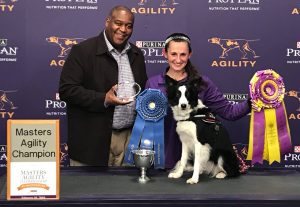
Jessica Ajoux and Border Collie, Famous, are the WKC Masters Agility Champions
PASSION FOR AGILITY STARTED EARLY
This February was her first time winning the prestigious WKC competition, but Ajoux started in the sport of agility as a teenager. Her mom drove her to her first classes and agility shows, which were scheduled around school and homework.
Watching an agility competition for the first time on television, Ajoux noted, “I’m not joking when I say the skies parted, angels sang, and I went, ‘Oh my goodness I’m going to be doing that!’ And I have been doing that since that particular day in … 1999.”
Ajoux began her agility competition with a mixed breed dog who she says taught her a lot and was very forgiving. When she graduated from college and was ready to begin competing at the next level, she began her search for a Border Collie.
BORDER COLLIES BECOME THE FOCUS
“One time a friend of mine actually let me run one of her Border Collies and that was it,” Ajoux said. “And I knew that that was the breed of dog I was going to pursue. … They can’t compete at the lower heights … because they obviously don’t measure in. But I just find that they’re the most competitive dog. That doesn’t mean that they’re easy – getting a Border Collie doesn’t solve all the problems. They’re ‘special.’ … you have to actually like the breed too you can’t just think of getting a Border Collie for agility ….”
As Ajoux progressed in her agility training, competition and understanding of the sport, she began to notice that certain dogs were better able to handle the unique athletic requirements of the sport. And she started to see correlation between their underlying structure and their actual ability.
AGILITY ATHLETES
“I train a lot of agility dogs and I watch a lot of dogs do a lot of athletic things,” Ajoux said. “I have a pretty good eye for watching movements and especially related to agility. What I find is that the Border Collies are very athletic and there’s a lot of variation even between the individual dogs. Fame happens to be an exceptionally athletic dog … She has a long neck, a long back, she’s very light and she is able to accelerate and decelerate very well which I think is the key to agility. It’s not just about speed, right, they can run very fast in a straight line but that doesn’t mean that they’re able to slow down and turn, right? They have to be able to downshift well.
“I have another Border Collie, my younger male, and he’s a lovely dog but he’s a little heavier boned. He’s a little straighter in the front and he doesn’t have the ability to what I describe as get underneath himself. … So, he has a much harder time in agility because if you run at a jump at full speed and you’re expected to turn it’s very useful to be able to rock your weight back, have the rear under, have some flexibility in the spine to do that. And it’s just much harder for him and that’s simply based on how he’s built. You can train, you can try to help them with their weaknesses, but ultimately how he moves will never be the same as how Fame moves for example. And it’s very predictable, based on the dogs that they’re related from and that type of thing.”
Agility competitors and breeders are producing what Ajoux described as “sport dogs” bred specifically for the conformation needed for agility. While Border Collies are very successful, she noted, they are originally bred to herd sheep, not jump. While the breed’s inherited speed, dexterity, focus and drive make them a good choice for agility, the functional structure changes some with the particular application of the sport.
“…one of the saddest things I see is people getting upset at dogs and their performances because they’re not ‘doing what they want,’” Ajoux said. Even though training has a huge part of it, I’m never going to be a professional basketball player. I’m not built to be – it’s not going to happen. Right? So you have to be realistic with what they can and can’t do.”
Ajoux talks about the unique structure of the Westminster Kennel Club Masters Agility Championship. She even adds details on injury prevention in canine athletes. Listen to the full length podcast or read the full transcript below. We hope you enjoy this fascinating conversation on the actual application of form following a specific function.
168 – Breeder Education Advocate Claudia Orlandi Shares Knowledge
CLAUDIA ORLANDI ON EDUCATION AND DOG BREEDING
AN EARLY “EYE FOR A DOG”
Orlandi grew up with miniature and standard Poodles, but her first show dog was a Saint Bernard from Betty Roberts. When her family visited the breeder to pick a puppy, somehow the divider between the “show” dogs and the “pet” dogs had fallen down. With an “eye for a dog” at even an early age, the puppy her family chose led Orlandi into a life of dog shows. Eventually, shown by Bob Forsyth, that Saint Bernard became a Best in Show Winner.
“…structure and performance or, form following function, are the key characteristics of breed type and are what distinguish one breed from another.”
Horses and dogs were a passion she shared with her first husband, Dom. They acquired their first Basset Hound from a pack in Vermont. There they learned the functional aspect of their hound by following the pack on rabbit hunts. Orlandi now lives part-time in Spain, where she had just returned from a month of hunting with her hounds when we spoke for this interview.
“… I have to say that having had the experience of hunting with Emma (her first Basset) was a great starting point for really understanding the basset hound breed,” Orlandi said. “…structure and performance or, form following function, are the key characteristics of breed type and are what distinguish one breed from another.”
Orlandi attributes much of her knowledge of anatomy and animal husbandry to the 4-H program. In her shout out to the horse 4-H program she noted, “We had to pass difficult written and hands on tests on equine anatomy and movement, in addition to giving presentations and learning animal husbandry. All of this knowledge relating to horses, I was easily able to apply to breeding and showing dogs.”
But as she progressed in her breeding program, she came to understand that other breeders didn’t have the same good fortune.
“If we to learn about photography we can go to photography school,” Orlandi said. “If you want to become better cooks, we can take cooking classes. But at that time, we really didn’t have anything comparable if we wanted to learn to become better breeders.”
Knowledge is power, Orlandi noted, in everything that we do. So, she began to develop her education programs and books, including the fabulous Basset Hound University program she created and has shared with other Parent Clubs. She insists that breeders can be successful with some basic information to help them move forward.
Some of her best recommendations?
- …the concept of preservation breeding is an extremely important topic that deserves our ongoing support and attention.
- …one of the biggest myths is the belief that because breeding revolves around chance and randomness applying genetic principles won’t make a difference. Nothing could be farther from the truth. In reality, it’s very unlikely that a breeder can consistently produce healthy, quality dogs in which every generation the dogs are better than they were in the previous generations, without understanding how traits are passed from one generation to the next.
- …don’t purchase a bitch younger than 12 to 18 months. If you get a bitch much younger than this, they have not been able to do enough health tests and body structure might still be developing.
- …I think it’s really difficult, in a way, to find a good person to work with in a breeding program or to find a mentor. Because in a way it’s kind of like a marriage. I think you have to be psychologically compatible and you have to have a lot of the same goals and the same beliefs in common.
- … a few decades ago if people were honest about health problems they are absolutely shunned, many times, by their peers. Talking about health was considered taboo. Nowadays, we understand much more about controlling canine genetic disease and we know that if we’re honest about the health problems, about who the affected dogs are in our pedigrees we can control health problems in our breeding program very, very easily. But it all revolves around being honest.
Please enjoy my visit with this legendary advocate for breeder education in purebred dogs.
167 – Komondor Breeder Anna Quigley on Cords and Clubs
ANNA QUIGLEY – ON THE KOMONDOR, CORDS AND CLUBS
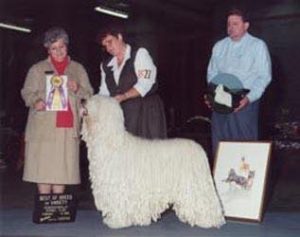
Ch. Lajosmegyi’s Patent Pending
Anna Quigley is synonymous, for many in the purebred dog world, with a 110-pound, powerful, white mop. She bred, owned and handled the three-time national specialty winner, best in show winner, Westminster Kennel Club group winner that took the Komondor breed to new heights in the 1990s.
45 YEARS DEVOTED TO THE KOMONDOR
But it all started with a Rough Collie. She met her long-time breeding partner and friend, Patricia Turner, when Quigley brought her female to Turner’s stud dog to be bred. Indeed, Quigley housesat when Turner drove to California to bring home her first Komondor. Thus Bobo, and a long, successful family of robust, corded guardian dogs, entered Quigley’s life in 1973. Quigley, Turner and their extended families have been involved in the breed together for the duration of the intervening 45 years.
Quigley and Turner acquired a second Komondor from show photographer Ken O’Brien and their foundation bitch from Salt Lake City. Although Quigley noted the bitch wasn’t perfect, she had important breed qualities. They bought their foundation stud dog, Tiger, from Dottie Collier in 1976, having only ever communicated with Collier over the phone or by letter.
“There was room for people in the breed and we managed to become successful. The breed has been very good to us,” Quigley said.
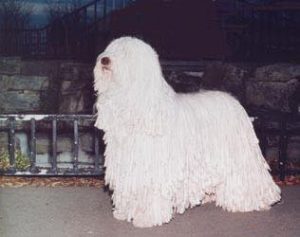
Ch. Lajosmegyi Far and Away
Komonodorok are not a breed that will ever become popular, Quigley noted, primarily due to the coat and the intense work required to maintain it correctly. She said a fully coated Komondor requires anywhere from seven to 10 hours to dry. I have clear memories of watching Quigley leash walk the dogs at shows with their coats tied up and tube socks on their feet.
“Here in Western Washington, we have a lot of gravel area for the dogs because it’s so wet,” Quigley said. She added that the breed’s native Hungary and parts of Europe, where the dogs still serve their traditional roles as livestock guardians, are typically far drier climates.
The breed, like many in Europe, was nearly wiped out at the end of World War II, but Quigley noted the world wide estimated population in recent years has approached 10,000.
The breed was recognized by the AKC in 1932 and the Komondor Club of America worked proactively to expand the gene pool early on.
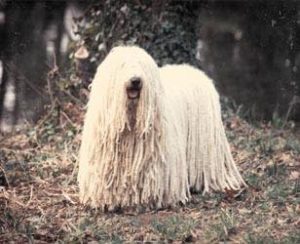
Summithill Save The Tiger
“Well, when we first joined the Komondor Club of America,” Quigley noted, “one of the requirements was that you could not breed any closer than three generations back. And that was to help expand the lines and create different lines.”
Quigley said it’s tough breeding a Komondor litter these days. The number of breeders, and consequently the number of dogs being exhibited, has decreased since its heyday in the late 20th century.
“… when we bought Tiger from Dottie, he was 10 months old,” Quigley said. “And he was out of an outside female and it was her puppy back. So, he was a little bit different pedigree than the rest of her litters. … often when he was used for stud, instead of taking a stud service, if the pedigree was right on the female, we would take a puppy back. …. my comment to Pat (while considering a particular stud dog) was we always agreed we’d breed to the devil if it could improve our line.”
Dahu, the dog who won the group at the garden under Irene Bivin, was originally placed in a home because Quigley and Turner didn’t want to keep another male at the time.
“We went down to see him and he was tied to a tree in the back yard,” Quigley said. “And very much willing to bite somebody. And the family really didn’t like him. So, he came back. And he just easily worked his way into our hearts and he was totally reliable with everybody in the family, but he knew how to bite. Which of course you don’t want a dog to figure out. But I went to a lot of work to open up my heart and my mind to suggestions on how to get this stopped and we did.”
Quigley and Turner would drive a couple hours each way to a handling class near Seattle to work with Dahu. “(the instructor) always tried to convince me… when he’d do the down and back, he would have a tendency to jump straight up in the air,” Quigley said. “And she said just ‘trust him to come down and be right.’ That night (in the group at Westminster Kennel Club) he jumped straight up in the air and I trusted him, and he came down in a perfect gait.”
I hope you enjoy this wonderful talk with one of the greats in our sport. Her knowledge, wisdom, humor and dedication are an inspiration.
And stick around for Allison Foley’s *excellent* advice on treating problem ears.
166 – Mark Dunn: AKC Registration Trend Reversal
AKC REGISTRATION REVERSES 20 YEAR TREND
According to Mark Dunn, AKC Senior Vice President of Registration and Customer Development, more breeders are registering more dogs, reversing a 20-year downtrend.
MARK DUNN BREAKS DOWN THE REGISTRATION STATISTICS
The last four years have shown notable increases in the number of dogs registered. Mark Dunn tells us that the number of litters registered and the number of people breeding dogs are also on the rise.
“…it says something about the role that AKC Breeders are playing in getting dogs into American homes. Which is really important to all of us, to be there for people who love dogs,” Dunn said
Good news on the overall increasing number of registrations is tempered somewhat by a different trend in the low-number breeds. Dunn notes that while the Top 10 breeds have been booming, the bottom 60 breeds are in decline or showing noteworthy reduction in registrations. Labrador Retrievers, for example, represent 15 percent of ALL dogs registered in more than 200 breeds.
Some of the lower registration breeds are new to AKC registration and working to improve their numbers, while other ancient breeds like Otterhounds and Dandie Dinmont Terriers struggle to maintain their popularity.
“I want to be there for parent clubs and provide any information or help those breeders need,” Dunn said.
The Breeder of Merit program was established seven years ago. Dunn believes it had a vital impact on these increasing registrations. Today, nearly a quarter of AKC registrations are produced by BOM approved breeders or those on that path, he noted.
Research indicates that Americans LOVE their dogs. Ninety million of them, in fact. With average lifespans, an estimated 8 million “replacement” dogs are required to meet the annual demand by dog owners in the US. Dunn says AKC breeders produce 1.3 million, with another several million available through shelter placement.
“… THERE IS STILL A LOT OF ROOM FOR GROWTH FOR AKC BREEDERS AND RESPONSIBLE BREEDERS THAT ARE WILLING TO DO WHAT WE EXPECT BREEDERS TO DO TO BREED AKC DOGS,” DUNN SAID. “I THINK WE HAVE A GREAT OPPORTUNITY IF WE CAN FIND WAYS TO GROW RESPONSIBLY. AND TO DO THE RIGHT THING FOR DOGS AND FOR THE PEOPLE WHO LOVE THEM.”
The low registration breeds are a popular topic in this area. Dunn noted that during his presentation to the AKC Delegate’s Parent Club committee, he was asked about marketing rare breeds to increase demand.
“The worst thing we can do is make a hard-to-find breed more popular,” Dunn said. “… if we simply try to market our way to success for particular breeds, we can create a real problem. …if we drive demand for a hard-to-find breed, someone is going to go try to fulfill that demand. Unfortunately, it might not be the parent club breeders and it might not be the people that are … most concerned about the proper stewardship of that breed.”
As registration and breeder numbers increase, Dunn advocates continuing the positive direction with specific actions, including education.
“So, what we saw last year,” Dunn said, “was a lot of growth in the number of people breeding that are not currently considered either commercial, by any definition. They only bred one litter with AKC. They’re very low volume. Maybe one or two litters tops. But they’re not currently on track to be a Breeder of Merit so they either have not finished dogs or they are not competing in conformation to any large extent. Now half of those breeders are very new. They’re either new as in last year was the first time they showed up on our radar. Or they’re new because they’ve shown up once or twice in the last two or three years. The real key is to bring those people in. To bring them along. And the way we do that is through education.”
Here at Pure Dog Talk, we’re happy to offer education to new and old alike! Hope you enjoy my talk with Mark.
165 – Agility at 83 Years Young: Laurie Morrow
LAURIE MORROW – A LIFETIME IN DOGS
I talk to a lot of famous people on this show. People who have been around the block and have enormous resources of knowledge to share. But one of the things I find the most touching about the purebred dog fancy is that for every well-known name, there are dozens of folks who have worked long and hard, paid their dues, quietly succeeded in their chosen endeavors and just never got around to the fame and fortune part.
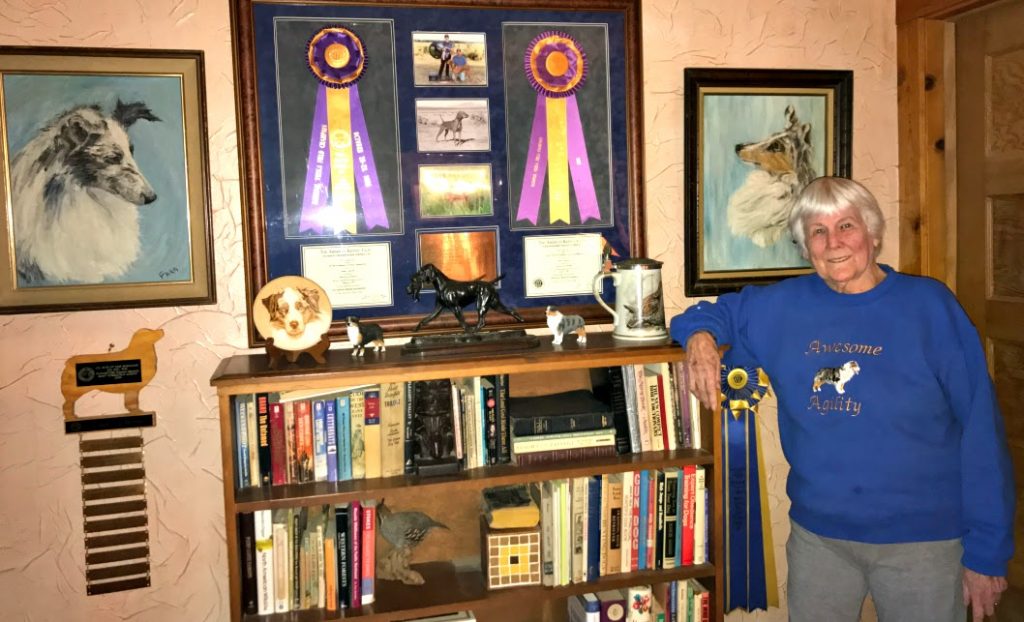
Laurie Morrow Trophy Room
Laurie Hatcher Morrowis 83 years old. For 70 of those years she has been actively involved in one aspect or another of purebred dogs. As a young girl, she saved her allowance in order to buy the 1947 edition of the AKC Dog Book. And she studied it until she could recite all 114 breeds. And she decided that the Shetland Sheepdog was the breed for her. At 13 years old, she convinced her father to drop her off at Madison Square Garden for the day so she could watch Westminster Kennel Club.
“I look back on that and I think my god you’d be arrested for child abuse if you left your 13 year old daughter alone at the Garden (today),” Morrow said.
That day at the Garden, Morrow was given the name of a person who might hire her for summer help at their kennel. Little did she know the kennel would turn out to be one of the top Sheltie kennels in the country. She turned 14 the year she spent the summer with them.
“We played a game after dinner. I would go and bring a dog and they would be blindfolded and they could tell every dog in the kennel,” Morrow reminisced. “Eleanor taught me all my beginning obedience training and pretty soon I was doing all the training and it was just great fun and she was right there you know to correct me if I didn’t do it right.”
Morrow’s lifelong love affair with dogs grew from that summer on. Morrow tells the story that she literally broke up with her first true love because his business would have prevented her showing dogs.
Dog shows, breeding, obedience and now agility have kept Morrow busy her entire life. She handled professionally in and around Chicago. She had multiple top winning obedience High in Trial Shelties. She bred, owned and ran Vizsla’s in field trials, including a top winning National Field Champion. She now owns Miniature American Shepherds and started running them in agility at the age of 70.
Morrow is the poster child for all of us who love dogs, who have always had that passion, whose paths in life have more than once been directed or dictated by dogs.
“I just can’t imagine my life without a dog in it,” Morrow said.
164 – Busting the Genetic Testing Myths: Dr. Jerold Bell
BUSTING THE GENETICS MYTHS: DR JEROLD BELL
Last week we talked with Dr. Marty Greer about health testing 101. This week we’re taking the graduate course in genetics with Dr. Jerold Bell from Tufts University’s Cummings School of Veterinary Medicine.
Bell has some serious myth busting going on in this discussion that I think our listeners are going to enjoy.
MIXED BREEDS ARE NOT HEALTHIER
First of all, mixed breeds are not healthier than purebred dogs.
“The most frequent genetic disorders that we see in practice are seen equally between purebreds and mixed breeds,” Bell said.
Second, there is a heritability factor in many diseases we had not previously considered. Bell talks specifically about studiesindicating even something as seemingly obviously traumatic as cruciate ligament tears have a genetic component.
Third, all breeders should be health testing their dogs. The increasing number of DNA tests available enables breeds with simple recessive gene pairs creating disease to quickly and easily apply positive pressure to the pedigree. Breeding a quality carrier status animal to a clear, then breeding the resulting quality clear offspring, Bell said, will rapidly eliminate diseases such as a specific form of Progressive Retinal Atrophy.
“And that’s really the take home message for today,” Bell said. “Is that anyone that’s doing breeding must be doing breed specific genetic testing of the parents and if they’re not doing that then they should not be breeding. Then they are not an ethical breeder and not a health conscious breeder and there’s no place today for breeders that are not going to do that.”
Fourth, for complex inherited diseases, in which a combination of genes is causing a disease process to be expressed, the OFA/CHIC database offers the opportunity to research a “vertical pedigree” to study the incidence of disease in the entire family of the dogs being considered for breeding.
OFA IS FACEBOOK FOR DOGS
“So when you look up at dog’s web page on the OFA Website,” Bell said, “and this is Facebook for dogs, this is the dog’s own individual website. They can have their picture on there, it has all their information. It has all the information of the tests results from the parents from the siblings from the half siblings. … even in a normal individual that you’re looking at for breeding, if the parents or the parents’ siblings (indicate) more disease present, it tells you that you’re going to have a greater genetic load of liability genes for that particular disorder.”
Finally, using health testing *appropriately* is mission-critical. Bell noted that breeders’ selection processes should emphasize only those diseases which are of concern within their respective breeds. He presented an outstanding webinar for the AKC Canine Health Foundation available here which goes into even greater detail on this topic.
“…people might say that because (our dogs) purebred they have limited diversity and therefore they’re unhealthy,” Bell said. “And that is not true.’
We hope you enjoy this very rich conversation with Dr. Bell and are able to apply this knowledge in your own breeding programs.
163 – Cannabis for Dogs? | Kari Taylor and Alternative Therapies
CANNABIS FOR DOGS? ALTERNATIVE THERAPIES AND CANNABINOIDS
Cannabinoid compounds as an alternative therapy for dogs are a growing area of interest. Kari Taylor talks with us today about exactly what medical marijuana and cannabinoids are, how they can help our dogs, and answers the legal and safety questions many pet owners have.
The increasing use of medical marijuana and CBD compounds in human health has led naturally to potential uses in our pets. While anxiety and inflammation issues appear to be the primary uses to date, Taylor contends the therapy has many potential applications.
It is important to understand that CBD is derived from industrial hemp and therefore is legal in all states in the US. Medical marijuana, which may contain THC, the psychoactive component of the recreational drug, is legal in more than half the US.
Equally important to note, particularly in states where recreational marijuana use is legal, is that THC and the drug which makes a person “high” is dangerous, although generally not lethal if ingested by dogs.
DOGS NATURALLY MAGAZINE ON CANNABIS
From Dogs Naturally Magazine’s article on the topic, “This article’s not about marijuana, but this is important information. With the legalization of marijuana in many places, poison control centers are hearing more and more about pets getting into their owners’ marijuana stash.
It may be hard to tell if your dog has the munchies (isn’t it a permanent condition in dogs?), but other side effects from marijuana can be quite severe, including lethargy, dilated pupils, drooling, being off balance, muscle twitching, vomiting, involuntary urination, and even unconsciousness.
If this happens to your dog, take him to the vet immediately. He’ll need palliative support until the effects wear off.”
KARI TAYLOR EXPLAINS WHAT TO LOOK FOR
Taylor shares with our listeners excellent explanations and provides an understanding of how cannabinoids work with the body to produce the reported results. She also reminds listeners to seek products that are sourced from plants grown without pesticides and to educate themselves as to the actual amount of active ingredients in the product they are purchasing.
“I have visited some of the top pet CBD sites and, in many cases, you can’t determine how many grams of CBD are in a treat or in the oil itself,” Taylor says. “In many cases they list the number of milligrams of hemp oil versus the number of milligrams of cannabinoids. Now, those are two different things. CBD is the actual compound that will trigger the receptors. Hemp oil is the synergistic blend of all constituents derived from the concentration of a hemp plant. So, when you’re using, say, hemp oil, you are getting a lot more of the original constituents that were with that plant, which is oftentimes very supportive in the absorption of the cannabinoids or the CBD itself. … All of our products are labeled by the number of cannabinoids that are present is what people are looking for. If you’re wanting to buy CBD oil, don’t you want to know how much CBD is in it?”
ENJOY LISTENING TO PURE DOG TALK!
This is a cutting-edge area of the pet health industry in which many of our listeners have expressed interest. Taylor’s useful information, case study examples, and real-world experience provide excellent applicable knowledge for all pet owners. We hope you enjoy today’s podcast!
162 – Veterinary Voice: Health Testing 101 with Dr. Marty Greer
VETERINARY VOICE: HEALTH TESTING 101 – DR. MARTY GREER
Dr. Marty Greer, DVM, JD returns to our Veterinary Voice series to talk about health testing for our breeding programs.
Using testing to improve our dogs’ overall health involves looking at both “phenotype” — diseases we can test for with xrays, blood or other physical exam — and “genotype” — those diseases identified by DNA testing.
Dr. Greer also provides some great input on the various DNA tests cropping up all around us. These tests, all spinning off from the identification of the canine genome, provide breeders, exhibitors and pet owners with a plethora of options for naming everything from the mixture of breeds in a shelter dog to the specific heritable genes for deadly diseases.
One of Greer’s primary points, which we’ll touch on again next week in our podcast with Dr. Jerold Bell, is that these health testing options provide breeders with the ability to *expand* their gene pools. Scientifically identifying a dog as a carrier and another as a non-carrier of a specific disease gene, for example, enables breeders to breed those two individuals with the assurance that none of the resulting progeny will be affected by the disease in question.
Many of our dogs are impacted by polygenic diseases, in other words something like hip dysplasia, for which there is no DNA test because it is predicated on more than one simple gene pair. Nonetheless, the future of breeding healthy dogs is made profoundly more “user friendly” with the available testing protocols for those who use them wisely.
“So, the tricky part, and I think the really hard part for people that as breeders are running these tests are for them to try and decide how to use that information in their breeding program,” Greer said. “… I see a lot of breeders who are so distraught about finding a genetic defect in their dog or in their line of dogs that they will throw out a whole line of dogs genetically. They will just stop breeding that whole line and it is narrowing and bottlenecking our gene pools even further than a lot of the breeds already are. So, we have to be really careful how we interpret and use those results.”
BREEDING DECISIONS
Greer goes on to discuss various health concerns and how those should apply to making breeding decisions.
“So, I tend to rank, personally, genetic diseases on a ranking of one, two and three, because you can’t treat them all the same,” Greer said. “So, things like an umbilical hernia, or an extra eyelash, you fix it once surgically, it is corrected. …the reality of it is those are not life-threatening diseases … Ranked two are things like allergies and thyroid disease, which require chronic medications. They always have to be on medication for those diseases if they have them. … And then ranked three are the things that are life-threatening, life-altering, life-changing diseases, and those are arthritic changes like hip dysplasia, seizures that are life-threatening, and, frankly, bad temperament in my opinion has the same categorization because some of those dogs have such bad temperaments that they bite people and that’s life-changing, life-altering and life-threatening. … I want to kind of frame it so people understand that not all not genetic diseases are the same, not all should be treated equally, and we have to really be thoughtful about how we use this information in breeding programs.”
The judicious and thoughtful use of health testing results and criteria in breeding healthy dogs presents almost a continuum of application in Greer’s experience. Potentially unhealthy dogs with no testing on one end and dogs with extensive testing but a potentially limited gene pool which may entrench diseases at the other end of the spectrum.
“…the Dandie Dinmonts, the Otterhounds, these people with small gene pools can serve as models for other breeds,” Greer said, “because even Labradors and Golden Retrievers are narrowed pools compared to what we have seen in the past. So, absolutely we need to be looking at these kinds of opportunities to perpetuate our genetics and not breed ourselves into such a bad corner that we end up with everything having a genetic disorder that is insurmountable, because some of these diseases are pretty serious and they become very ubiquitous in a breed.”