A couple of years ago, I interviewed and compiled a piece for As The Wheels Turn, my then-column in Best In Show Daily, about the rising stars of the sport.
That was my first encounter with today’s Breeders’ Voice subject, Kristi Green of Knockout Chihuahuas in Bayfield, Colorado. I was impressed then and remain so now. So I thought I’d share an excerpt of that article as a prelude to her responses to the Breeders’ Voice questions. I’m always encouraged by young people with passion, and Kristi has plenty to share. I know she’ll be an inspiration to others.
by Laura Reeves, excerpted from As the Wheels Turn on BISD
I hear a lot of folks decrying the woeful state of our sport, populated, as I’ve been repeatedly assured, by all-about-me Millennials who never learned to work or be told no, and who require a participation ribbon just for showing up. I’ve even been known to mutter on this topic myself.
So it was with a bit of trepidation that I succumbed to the nudging of none other than Mr. Bill to touch base with some of the young people in the Fancy. And I’m absolutely thrilled that I did. A few of these up-and-coming handlers, breeders, and owners were known to me, but a great many were not.
These young men and women express the insight, work ethic, commitment, and passion to lead us forward into what may well become a new “Golden Age” of the sport. I see an awful lot of talent and smarts in this group.
Shine on, twentysomethings!
Kristi Green, 30, Breeder, Owner, Handler, Durango, CO
How many years have you been “in dogs”? 6 years.
What breed was your first dog? Chihuahua (long coat).
What is your primary breed now? Chihuahua (smooth coat).
Who is/are your mentor(s)? Initially, I didn’t have a mentor. I couldn’t find people in the breed who were able to answer my questions or wanted to do more than sell me a dog that really wasn’t all that great. A little later, through breeding to their studs and visiting at specialties, I was very lucky to meet and get to know Darwin Delaney and Kathy Sawyer of Dartan Chihuahuas, who helped me get a better grasp on the finer points of breed type. Friends at Destiny, Bloomsbury, Shorepointe, Jem, and TEGS kennels also really helped me learn the aspects of the breed that aren’t easily understood. In my case, it took, and takes, a village.
What was your favorite or most memorable win? Winners Dog under breeder-judge Max Hurd at the 2014 National Specialty with my little bred-by dog, GCH Knockout Captain America.
What lesson did you take away from your most humbling loss? The hardest part of losing is that it’s so subjective. I try to look at losing as an opportunity to learn: to find the virtue I might have missed in the dog that beat me. And honestly, I don’t always deserve to win. Otherwise, it’s really easy to walk away from a weekend bitter and upset, and I see a lot of people do just that. I had to make a conscious decision after a weekend of losing, when I really should’ve cleaned house, to change my attitude about losing.
What is your #1 “secret to success”? The whole dog matters. Focus on virtue. Watch. Listen. Learn. Study. Read. See what those who have made breed history in the past have done, and why it was successful. Try similar breedings. Don’t be afraid to let an “okay” puppy go, or to accept that a breeding simply didn’t produce what you were hoping for. Most importantly, work with people who share similar goals and values, you can’t do this alone.
15 years from today, what do you hope will be your “claim to fame”? I want people to think of my Chihuahuas as the whole package: typey little dogs who move well and are sound mentally and physically. I don’t ever want to be known for “one” dog, but for the quality of my dogs as a whole.
If you were “King/Queen for a Day,” what one change would you make to the sport to revitalize it? That’s tough. I’d say some way of leveling the playing field above the breed level. That requires breeder-owner handlers who are willing to work hard at producing a competitive dog and training it to be such, and judges who are willing to really dig deep in the groups they have and look past the popular winners. I often wonder what it would look like if advertising went away and people had to walk into groups to show their dogs wearing a bag on their heads (lol), but I truly feel it’s a twofold issue.
Breeders’ Voice: Kristi Green, Knockout Chihuahuas
BV: Give us the 411. Your background as a breeder, what got you started in your breed, your mentors, other interests, etc.
KG: I purchased a little pet Chihuahua 10 years ago. I did enough basic research to know no pet store, and knew I wanted a purebred. When I went to the breeder’s house, the 5-month-old puppy was terrified, she had to literally take apart the crate to get her out. It was love at first sight (maybe first stupid?), and I brought her home. I figured that with socialization she would adjust. She never did. She would literally disappear whenever anyone came over and not come out. Coupled with a challenging personality, she also had a multitude of health issues.
In my research to find a breeder, I also came across this idea of showing dogs, and I thought I might like to get a show dog and maybe breed some dogs. I still have my first little Chihuahua and love her dearly, but she taught me the importance of trying to create healthy, happy, well-adjusted little dogs.
In my search for a mentor and dogs suitable to breed, I probably made all the mistakes most make. Going to my first national was where things really began to click. Every time I came across a dog I liked, I’d mark the catalog. Nine out of ten all went back to a specific line, and I was lucky enough that that breeder, Darwin Delaney, and his daughter Tamra, are truly some of the kindest people in dogs. Not only did they share their stud dogs with me, they shared a wealth of knowledge. Truly, I can say I was mentored also by many other young breeders working with the same lines, but I’m lucky to have had access to the best from the very beginning.
BV: You have consistently produced successful dogs. Let’s talk about breeding a “family” of dogs. Type, style, breeding plans, how you got from point A to point Z.
KG: Above all else, I breed for health and temperament, with follow-up attention to type. At the end of the day, I breed mostly pets, what elements are important when you need to be a good pet?
In toy breeds, building a family of dogs is an arduous process that’s challenging on a good day due to litter size and lack of general information available. My mentor taught me to choose a stud I loved, one I could also have my hands on, and breed him to as much as was possibly workable. Keep the best that resemble your goals and place the rest. In doing so, you begin to set virtues and also see the faults of what you’re working with. When you choose the next sire, you choose with those elements in mind.
Over time, your dogs begin to look like each other, versus the concept of breeding each bitch individually to the “perfect stud.” Breeding this way in toys would make it virtually impossible to ever set any consistent or recognizable type without keeping hundreds of dogs. This is the closest way to model a program after breeds that produce much larger litters and give you much more information, and it’s been a very successful way for me to quickly better my overall kennel of dogs, not just get “flashes in the pan.” While not every bitch in a program goes with one dog, a good dog goes with many bitches.
BV: What do your most successful pedigrees look like? Why? Are you working with a prepotent sire? A powerful dam line? What is the secret to your success, in general terms, and how did you arrive there?
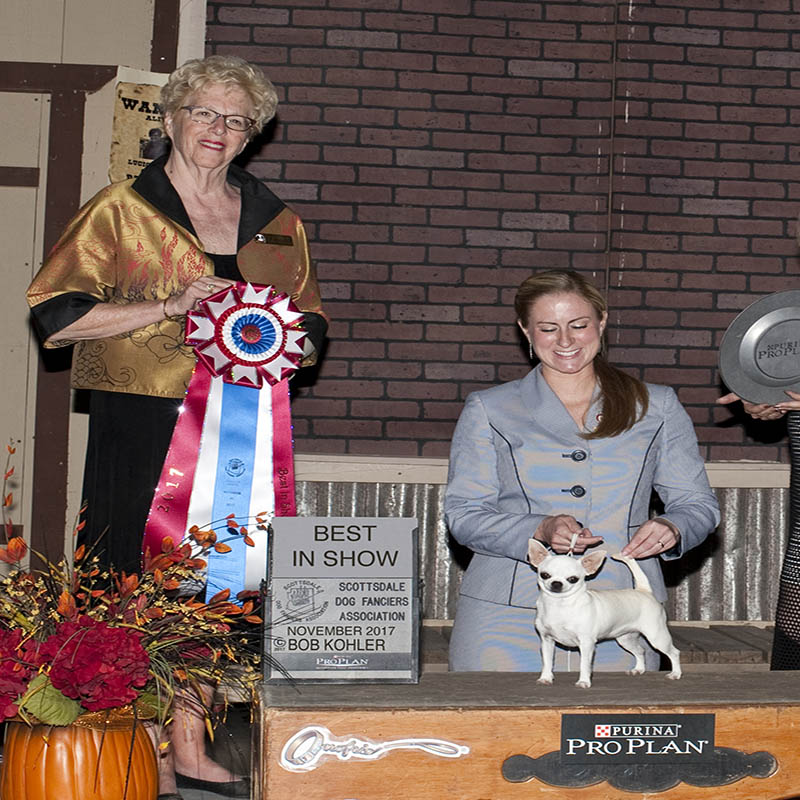
KG: My pedigrees combine Dartan and English lines with a splash of other European lines. CH Dartan Grand Slam is in every pedigree of every dog at my house that I’ve produced, and I credit this dog for much of my success. My multi-BIS-winning bred-by bitch is 18x Grand Slam in 9 generations.
While generally I prefer “looser” pedigrees with inbreeding coefficients under 5%, on occasion I’ve bred closer when the pieces simply fit, and seen both the good and the bad that’s really there firsthand. I learned early on to observe the pedigrees of dogs who were what I wanted to see, figure out where that combination produced “like” dogs, and then find the closest way to model that and get enough puppies of that combination to be able to select for type.
BV: Give us some idea of the struggles. Dead ends or pedigrees that didn’t pan out, health or temperament issues that caused a reset of the program and how you handled it, the breeding that looked incredible on paper and was a disaster, like that.
KG: Figuring out how to get the type without forgoing soundness is an ongoing challenge. I would have much, much better dogs, to the naked eye, if I bred without considering health and soundness first and foremost. Those who show dogs but don’t breed them have no appreciation or understanding of just how phenomenally difficult it is to balance these elements in toy breeds (and I imagine large breeds, too).
For every success, there’s something to keep you humble. Being willing to learn from those things is essential to moving forward. I went through close to $50k worth of animals and breedings before I finally had my foundation. That’s a lot of money, time, energy, and effort from a mid-20s gal who isn’t independently wealthy. I’ve actually been incredibly lucky that I’m still working with my foundation stock, but I was relentlessly picky. I’ve added some things in that simply didn’t work, then added them again a different way that did work. Sometimes the nicest dogs simply do not produce. Being willing to accept that and move on can be tough. The closest dog I’ve ever owned to “perfect” was a remarkable disaster in the whelping box. Her puppies were awful.
BV: Your best mentoring, suggestions, tips, or reminders for current and aspiring breeders?
KG: All dogs have faults. The great ones wear them well. “To their virtues be vigilant, and to their faults a little blind” (Nigel Aubrey-Jones). Try to steer clear of and ignore the people who don’t really breed but are obsessed with winning. They’re the first to be nasty or critical, and also know the least. A good mentor and support system make all the difference in the world.
BV: What are your future plans? What are you still working on or want to achieve with your dogs?
KG: I have so far to go, still. Actually, the further along I get, the less I feel like I know. I recently acquired a dog of another breed, as I’d like to eventually judge. The more breeds I can have hands-on experience with, the better, but learning a new breed after learning how many mistakes you can make with the first is formidable. I look forward to the day when I’ve successfully created a recognizable Knockout “type.” Producing multiple BIS-winning Chihuahuas is definitely on the list.
BV: What is your strongest encouragement to breeders everywhere?
KG: Work hard if you want to play hard. No one, and I mean no one, is intentionally going to sell you a great dog, but you can make one, and you can take it to the top if you have the determination and intelligence to do so. Most of the time, the game is more fair than some will lead you to believe, but you have to work as hard or harder than those earning a paycheck. But it is possible.