

230 – Storm Kloud Alaskan Malamutes: Continuation of a Dream
Storm Kloud team of Alaskan Malamutes proved their heritage in 1994
After two years and 3,000 hours of training, Nancy Russell’s Storm Kloud Alaskan Malamutes were ready to compete in the iconic Iditarod Race in 1994.
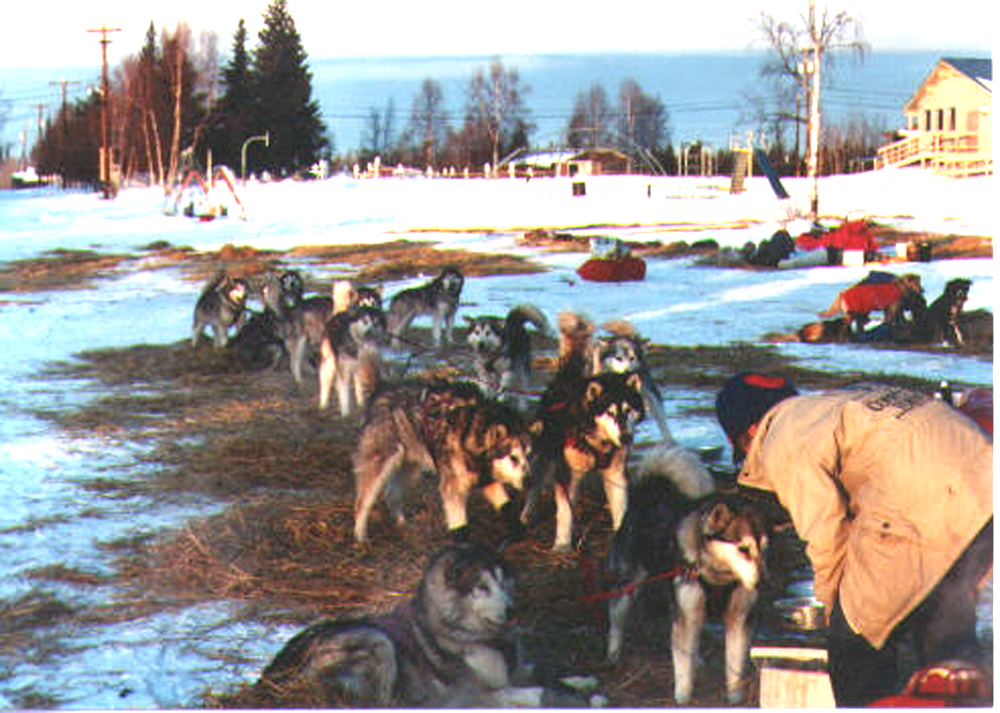
Storm Kloud Alaskan Malamute team at a check point on the Iditarod in 1994.
Russell shares her stories of this epic journey, noting that she was proud to show that “Our dogs can still go on and do what they were bred to do.”
Twenty below for eight days
Russell and her crew drove with the five females and 10 males, all but one bitch intact, that made the final team. “It was 20 below zero when we left Minnesota. And it never got above that for eight days, all the way to Alaska,” Russell said.
“There was no snow in Anchorage,” Russell said “so they hauled in snow and put enough on the street to run the teams 15 blocks. Because a driver would not be able to set a snow hook if they had trouble with a team, an extra person had to ride with them. Therefore I got to ride in the sled for the ceremonial start of 15 blocks that year. Jamie chose 5 Champions and Josh to run as only 6 dogs were allowed in the team.”
Dog aggression was a major concern for the race organizers, Russell noted. The Alaskan Malamutes of the day were considered very “tough.” Part of the hours of training was that “we had to be sure the dogs could pass (another team of dogs) without causing problem before would be *allowed* to run this team,” Russell said.
Show dogs to team
Another obstacle, Russell said, is that the “show dogs” had to learn to be part of a team. Of the 15 dogs on the team, 11 were or became show champions.
“Show dog is not a team event,” Russell said. “Going from ‘I am the coolest’ to teamwork was a huge issue for Jamie (Nelson, the professional musher who trained and ran the team) to overcome. She had a hard time getting the dogs past people with cameras… the dogs were so convinced they were cool…”
Russell was amazed that the dogs actually gained weight along the route of the race. She noted that the dogs would push away the straw put down for bedding and held up well in the arctic environment of their heritage.
Danger on the trail
“When Jamie arrived at Finger Lake she went into a Dodge Lodge (tent furnished for the mushers) to sleep,” Russell said. “Later she woke as she was cold and went to get her sleeping bag. She was unable to stand and crawled out and then realized they were being asphyxiated from the stove. She crawled back in and turned it off and tried to wake the other mushers but could not wake them. She called for help and Beth Baker MD who was in the checkpoint heard her and they got them out. Jamie and Beth received the Sportsmanship award for saving the lives of the other four mushers.”
Eskimo welcome
The native people were thrilled when the team arrived near their communities.
“When they got to the Eskimo villages, the school teachers let kids come out of school to see the Malamutes,” Russell said. “One elderly gentleman came and brought his grandkids. He said ‘you have to see these dogs. This is what we used to have.’”
The struggle, Russell said, was the dogs’ feet. The weather was unusual that year, she noted, with rising temperatures causing rivers to melt.
“The dogs went through the river,” Russell said, “but the conditions caused a number of dogs to have feet susceptible to injury.”
Feet are the foundation
Despite special boots designed for the dogs, the team was struggling with ice balls in their pads and swollen feet in the boots.
“I do feel people are breeding smaller, tighter feet because they are pretty, not because they are functional,” Russell said. “The snowshoe foot, as described in the standard, doesn’t look as nice in the show ring.”
The dogs’ feet were what caused them to end their run after 640 miles of the 1,500 mile race, Russell said.
“Here I was in Ruby, more than halfway through the race, trying to make the decision. The dogs’ feet had gotten progressively worse in the last 300 miles. When I bootied them they swelled up. When I ran without, they snowballed within a few miles. The vets and I had tried everything we knew. I was running out of options. It seemed such a shame. For the most part, their bodies were like fine-honed machines. They could easily have completed the course. Only their foot problems were to let them down. Yet they were the feet that had carried me close to 600 miles in less than seven days through some of most rugged country Alaska had to offer. To take advantage of their willingness to please and push them on in their condition wouldn’t give us any more answers, only serve to inflict unnecessary pain. I thought back now to the time we had spent training together. I had worked with some these guys for four years and trained intensely for the better part of the last two years. They had taxed every bit of my knowledge on training. They had tried me every step of the way and through this I had grown to love these guys. But, it wasn’t just love I was feeling now, it was something else. They had developed a trust in me, a trust that I would always do what ‘s right for them. A bond of trust that is stronger than love or even life itself, a trust that once broken can never be regained. I went back and took another look at their feet, then I looked into their eyes, and the decision was made.” — Musher Jamie Nelson
By any calculation, 15 show dogs running in harness for 640 miles in the brutal arctic conditions is a tremendous accomplishment. Russell remains proud of her dogs’ ability to prove the breed can still do its job in the most extreme conditions. Listen to part one of this story here.
229 – Allison’s Insights from the World Dog Show
World Dog Show unites dog enthusiasts
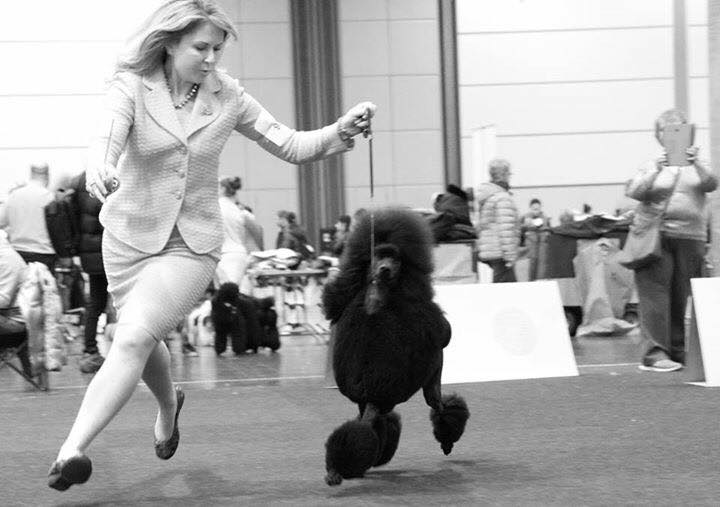
Allison Foley at the World Dog Show 2017 in Germany.
Allison Foley talks with host Laura Reeves about the incredible spectacle that is the World Dog Show.
“The World Dog Show really does bring the dog world together in one place,” Foley said. She added that this year’s event in Amsterdam was particularly well attended by dogs and fanciers from North America due to the relative convenience.
“There are lots of direct flights to Amsterdam,” Foley noted. “The show allowed dogs to be shown that are legally docked in the country where they were bred, which was not the case in Germany last year.”
The World Dog Show in Amsterdam boasted an entry of just under 22,000 dogs. The enormous difference in numbers relative to North America led to tremendous depth of quality in every breed, Foley observed.
Quality throughout
“You’d watch a ring and there would be five dogs in a class that could win 25 Bests In Show,” Foley marveled. She also made the comparison that while North America groups rings are hyper competitive, even at smaller venues, they are rarely as deep in quality at the breed level.
At the World Dog Show, Foley opined, the breeds are so deep quality that the judges are less forgiving of even minor faults or failures of performance.
Written critiques
Written critiques are a frequently requested item in North America and are a requirement for every class placement at the World Dog Show. Each ring has three stewards, one of which is designated just for writing critiques.
Foley noted that in her experience, the Crufts written critiques are more in depth than most at WDS. She observed that many critiques she read were generic and not particularly breed specific.
Judging at WDS is fascinating, Foley remarked. She noted that many of the dogs with big predictions to win often don’t even make it out of the breed. Although she added that good dogs shine through, even in the enormous entries.
WDS 2019 in China
“This is a tough topic,” Foley said. “Dogs are not always treated well in China. There was a lot of discussion on this topic at this year’s show.
“As dog lovers, purebred dog lovers, any opportunity that we have to show dogs in a positive light as a companion or working animal to the public that isn’t educated that this is a thing is a golden opportunity. My job is to educate as many people as possible that dogs are wonderful companions and working companions. And that this is how we should humanely treat them for their entire lives.”
Allison adds her tip of the week from Leading Edge Dog Show Academy on keeping our dogs’ coats safe from sun damage.
And check out new tips from Show Dog Prep School, Trupanion and American Dog Fancier!
228 – Alaskan Malamute Breeder Pursued a Dream to Run the Iditarod
Legendary Storm Kloud Alaskan Malamute Breeder Nancy Russell Shares Her Story

Nancy Russell, breeder of Storm Kloud Alaskan Malamutes
In 1994 Nancy Russell bred and fielded the only AKC registered Alaskan Malamute team to ever enter and compete in the Iditarod. In part one, today’s talk, she shares the foundation of that journey, her breeding program and some of the incredible stories along the way. In part two next week Russell takes us through the arduous process of actually competing in the greatest endurance race on Earth.
Russell acquired her first Alaskan Malamute in 1964. She became involved in showing dogs, like so many of us, by going to her first dog show at the suggestion of her mentor.
“I got a blue ribbon and a trophy,” Russell said. “(My dog) beat two other dogs. I was hooked.”
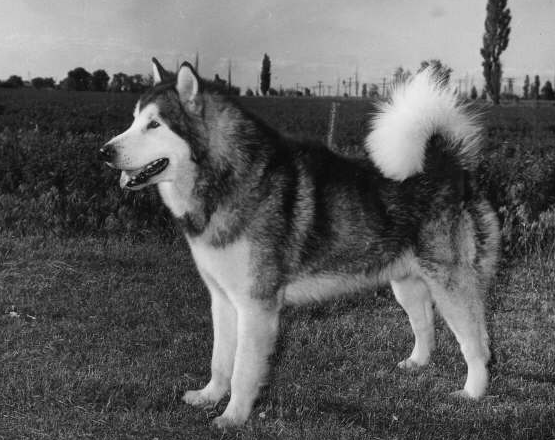
Champion Glacier’s Storm Kloud, the foundation of Nancy Russell’s breeding program.
At that show Russell saw what “I still believe is the best Malamute I’ve ever seen.” His name was Bear, Multiple Best In Show, Best In Specialty Show, American/Canadian/Mexican/International Champion Glacier’s Storm Kloud CD ROM ROM-OB ROM-WD CAM.
Bear was bred to Russell’s foundation bitch and she also eventually purchased him from his breeder. Inbreeding on Bear laid the foundation that produced the entire 15-dog Iditarod team, 11 of which were show champions.
Russell said she was always fascinated by Alaska, mushing and, the ultimate, the Iditarod. She dreamed of competing with a team of Malamutes in the 1,150-mile race from Anchorage to Nome, Alaska.
“To me this would be a real test of the Alaskan Malamute’s ability to go back and do what it was bred to do,” Russell said.
Professional musher Jamie Nelson, from Minnesota, trained, conditioned and developed the team.
“I could never have gotten the team to the Iditarod without the help of Jan Richards,” Russell said, “who took a 6 months leave of absence from her teaching job to move to Jamie’s and help with the organizing of the supplies, correspondence and help with training with an extra team. Mark Scepanski spent a year helping Jamie train both the Malamute and her Alaskan team.”
Enjoy today’s journey through time as Russell shares more than 50 years of insight on breeding, training, socializing and judging the Alaskan Malamute.
For more information, visit:
227 — German Pinscher: All-Purpose, Robust Dog for Active Owners
German Pinscher is up for anything, but not for everyone
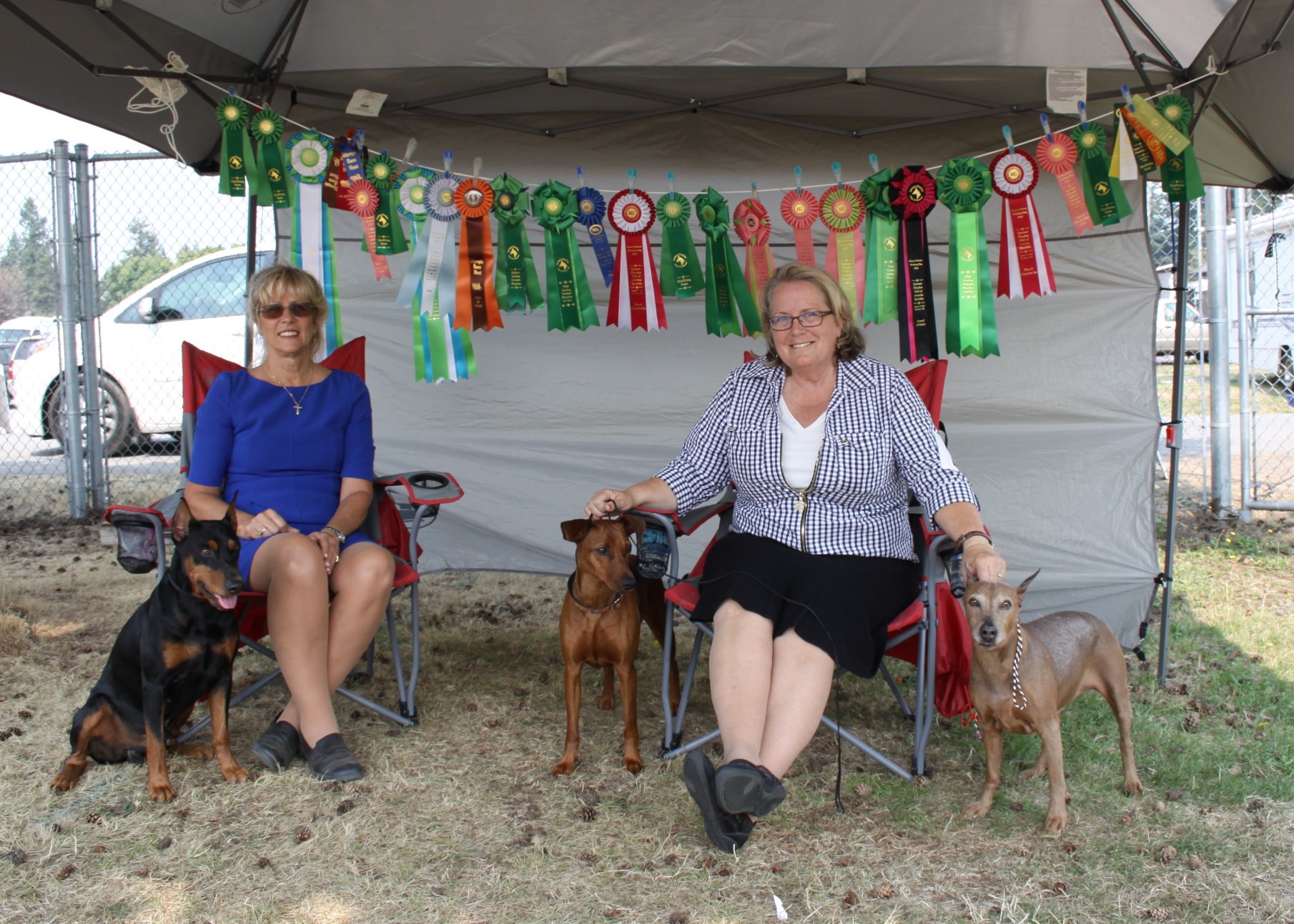
Valerie Vihlen Schluter, left, and Janet Oatney, right, show off their winnings and their dogs at the GPCA national specialty in Washington.
I visited with German Pinscher fanciers at the GPCA national to learn about this ancient breed. Valerie Vihlen Schluter and Janet Oatney were kind enough to share their enthusiasm and words of advice for potential owners.
German Pinschers date to the 1800s. This family farm dog was the foundation for Doberman Pinschers and Minature Pinschers. They are also split off as the “smooth coat” variety of the dogs that became the Standard Schnauzer. In fact, in Germany to this day, Oatney said, the Pinscher Schnauzer club remains united.
Like so many other purebred dogs, the German Pinscher was salvaged after the devastation of WWII. Werner Jung, the breed warden, smuggled a GP bitch out of East Germany and mated her with oversized Miniature Pinschers to establish the modern breed.
A Ferrari vs a Cadillac
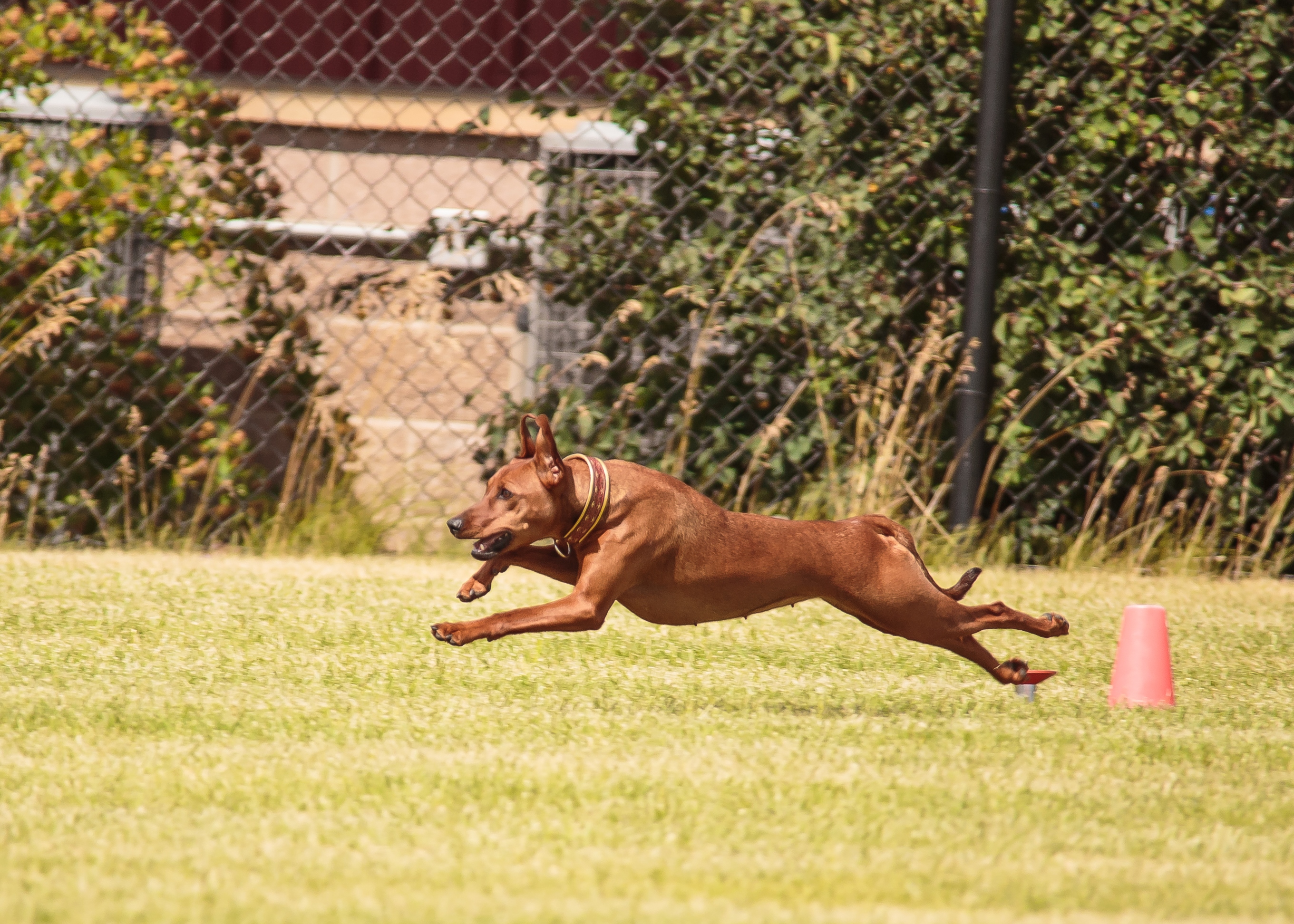
German Pinschers excel at many sports, including Fast CAT.
“These dogs are competitive in all kinds of sports,” Oatney said. “They take an experienced dog owner. They are not a good breed for the first-time dog owner.”
Ferrari and Cadillac are both great cars, Oatney offered as a comparison. “These are like the Ferrari of dogs… You need to be on your toes.”
Vihlen Schluter also noted that because the breed is so in tune with its owners, they can make excellent service and therapy dogs. In this arena, the breed boasts a FEMA certified disaster assistance dog that dispatches to disaster areas to comfort victims.
The German Pinscher Club of America has excellent resources available at https://germanpinscher.org/
From the national club:
A Working Dog of Great Intelligence
An ancient breed of great intelligence and high energy. They are medium sized and robust with a strong prey drive. Alert and intelligent, they are outstanding performance dogs as well as companions with an instinctive drive to protect home and family. Because of their strong will, intelligence and independent nature, obedience training is a MUST!
AKC Standard
The German Pinscher is a medium size, short coated dog, elegant in appearance with a strong square build and moderate body structure, muscular and powerful for endurance and agility. Energetic, watchful, alert, agile, fearless, determined, intelligent and loyal, the German Pinscher has the prerequisites to be an excellent watchdog and companion.
Allison Foley, Leading Edge Dog Show Academy, offers her Tip of the Week on using available classes to best showcase your individual dog.
And learn more about Trupanion’s “breeding rider” insurance policy with Harin Greer.
Don’t forget to check out Pure Dog Talk’s new online store for great swag!
226 – Jane Killion Shares the Evolution of Puppy Culture
Jane Killion on Puppy Culture for New and Experienced Breeders Alike
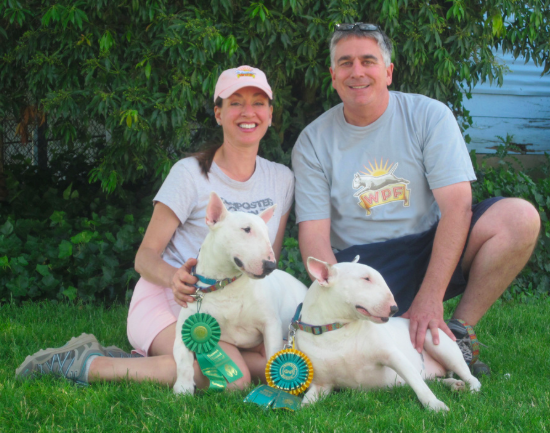
Jane Killion, Mark Lindquist and Bull Terriers.
One of my most frequently requested interview subjects, Jane Killion, author and breeder, joins me today to talk about how Puppy Culture got started and why even experienced breeders should check it out.
Killion is a Bull Terrier breeder since 1997. She wanted to do some performance sports with her famously not very tractable breed. So, she wrote a book called When Pigs Fly to help folks train their non-biddable dogs in agility.
When that took off, Killion left her corporate job with the intention of making a video about the book. Meanwhile she had a litter due and said, to herself, “Wouldn’t it be fun to video development periods in Pat Hastings Puppy Puzzle book.”
Explosion of demand
“Four years later, we have a five-hour DVD and an entire series of protocols per development period,” Killion noted. “I thought it would be a 20 minute video!” That idea changed and developed as Killion saw how deep the topic was. So she reached out to scientists, experts, dog trainers to add information.
“Puppy culture isn’t really anything new,” Killion said. “It’s the gift of wisdom passed to me by my mentors and augmented with science. It’s what we all do, but more organized.”
Like many of us who have breeding dogs for an extended period, Killion said she did most of the things noted in the book. She noted, though, that “doing things as you go along is ok, but not optimal. You start observing puppies and really getting in heads. Breeders start to look at puppies like a behaviorist vs a breeder.”
Puppy Culture is “what I wish someone could have put into my hands when I had my first litter,” Killion said.
Protocols based on behavioral markers
One of the primary pieces of the program, Killion added, is to peg socialization and experience protocols to a puppy’s individual behavioral timeline, not a temporal timeline.
“For example, our puppies at 6 weeks enter the Curiosity period ,” Killion said, “– the highest approach and lowest retreat time – which is a great time to do heavy in home socialization. Other breeds, that period arrives at drastically different ages.”
The days of breeders with everything in their heads who are willing to share are gone, Killion noted.
“We’re trying to step into that void. Puppy Culture, we call it a mentor in a box,” Killion said. “Like you, we’re people who have a passion, with the overarching goal of infecting the next generation with our enthusiasm.”
225 – Fighting to Preserve our Breeds and their Purposes
Inside the battle to preserve racing Greyhounds
Jennifer Newcome, chair of the committee to support greyhounds, joins me to talk about the fight to preserve Greyhound participation in a sport they love and the current ballot initiative in Florida to ban betting on Greyhound racing.
The proposed legislation is a Constitutional amendment that effectively allows Animal Rights extremists to define what constitutes humane treatment of animals, rather than breeders, owners and exhibitors, Newcome said.
Equating a dog’s purpose-bred job with inhumane conditions, is a “terrifying” concept, Newcome added. It creates a vehicle for banning all activities with animals at the constitutional level.
From the Greyhound Club of America:
About The Greyhound
Purpose
The Greyhound is a sighthound and one of the oldest breeds of dogs. Sighthounds are hunting dogs that pursue running game by sight rather than by scent. This manner of hunting is called “coursing”. The attributes of speed, agility, strength and endurance are necessary to catch and hold game. The feature that distinguishes Greyhounds (and sighthounds) is their ability to run at speeds of 35 miles per hour or more using the double suspension gallop. The Greyhound demonstrates the double suspension gallop in its highest perfection. Their incredible speed comes from the singular combination of skeletal structure, musculature, and the ability to focus completely on the object of the chase.
Greyhounds and other sighthounds course game independently of humans. Sighthounds are unlike other breeds such as herding dogs that take signals from humans when moving sheep from pasture to pen or sporting dog breeds that range out to point and hold birds in one spot until their human indicates it’s time to flush. Once the chase is on and the Greyhound is on its way, there is very little you can do to intervene until the chase is over.
Newcome encourages all Florida residents to vote no on Amendment 13 to protect all of our rights to enjoy the various sports we play with our animals. The American Kennel Club and National Animal Interest Alliance also oppose this legislation.
224 — Veterinary Voice: Pyometra is an Emergency
Pyometra is a life threatening disease
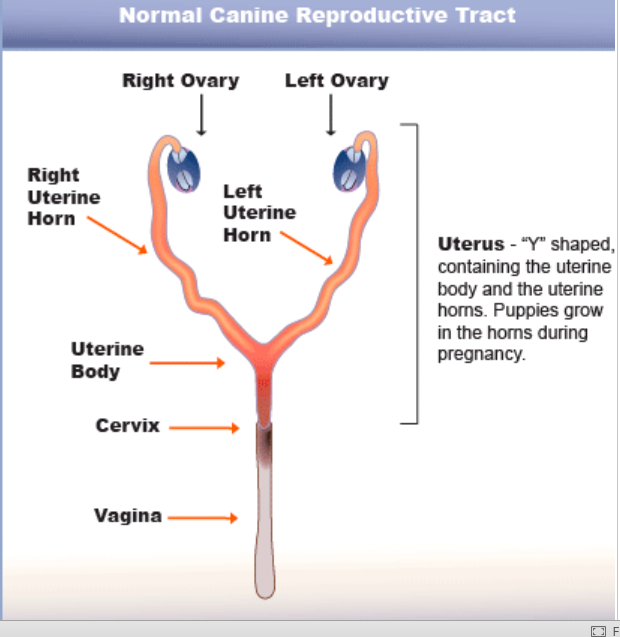 Pyometra is a severe bacterial infection with accumulation of pus within the uterus. Though it often occurs with middle-aged or older unspayed females, younger dogs are sometimes affected. Pyometra most commonly develops a few weeks after a heat cycle. The condition results from hormonal changes that decrease the normal resistance to infection. As a result, bacteria enter the fluid in the uterus and large volumes of pus can accumulate.
Signs of Pyometra include loss of appetite, excessive thirst and urination, lethargy, and/or vomiting. Sometimes, there is a vaginal discharge. The disease may develop very slowly over several weeks.
This condition often requires emergency surgery, provided the animal is stable. Surgery consists of removing both ovaries and uterus, which not only corrects the condition, but also eliminates bothersome heat cycles. Because the patient is ill and the uterus is infected, the surgery is more complicated and carries a higher risk than a routine spay. Ultrasound and blood tests are useful in both diagnosing and evaluating surgical risk. Post-operative treatment includes antibiotics and intravenous fluids.
For dogs who are in a breeding program, Dr. Marty Greer, DVM provides information in the podcast about medical management that may avoid the spay surgery.
Pyometra
From Dr. Greer…. “Your pet has presented with a condition called pyometra, or a uterine infection. These can be life-threatening, and most cases will not resolve without surgery. Pyometra usually occurs 1-5 weeks after the last heat cycle. In this illness, the uterus has filled up with pus (white blood cells and bacteria) and is at risk for rupturing if not treated immediately.
Prior to surgery, we will stabilize your pet with intravenous fluids, antibiotics, and pain medications. Most patients with pyometra are very sick – with either a very high or very low white blood cell count, fever, dehydration, a low blood sugar, and vomiting and diarrhea. As soon as your pet is able to tolerate anesthesia, we will start surgery to remove the uterus.
Your pet will be in the hospital for at least 2-5 days, depending on how she does during surgery and afterwards. It is important to know the possible complications of pyometra surgery. These include:
- Peritonitis is the most common. This means infection within the abdomen. It is treated with antibiotics, IV fluids, and may require additional surgery and drainage.
- Rupture of uterus in surgery. The uterus is often very thin and easily damaged. It is possible that it can rupture during surgery, spilling pus into the abdomen. This can prolong the hospitalization for several days.
- Aspiration pneumonia. Fluid and food sometimes bubble up into the throat and mouth during surgery. This can be inhaled into the lungs, leading to pneumonia. Every precaution is taken to avoid this, but it still happens in some cases.
- Sepsis, systemic inflammatory response syndrome, acute respiratory distress syndrome (ARDS), and disseminated intravascular coagulation can also occur before, during, or after surgery. These are uncommon complications in which the white blood cell count drops, the patient develops or continues to have a fever, sometimes develops difficulty breathing and difficulty with normal blood clotting. These are not common but can occur. If they do, very aggressive treatment must be undertaken to save your pet and can significantly prolong hospitalization and lead to death.
- Acute kidney failure can occur before, during, or after surgery. This is not a common complication but can happen. Often patients will also have a urinary tract infection. Once your pet is stable, eating, comfortable and able to take oral medications, discharge home can be discussed with the doctor. ”
223 — Rhodesian Ridgeback: Power and Elegance
Balancing act of the Rhodesian Ridgeback
Denise Flaim, Rhodesian Ridgeback breeder, judge and historian, shares her knowledge as the RRCUS 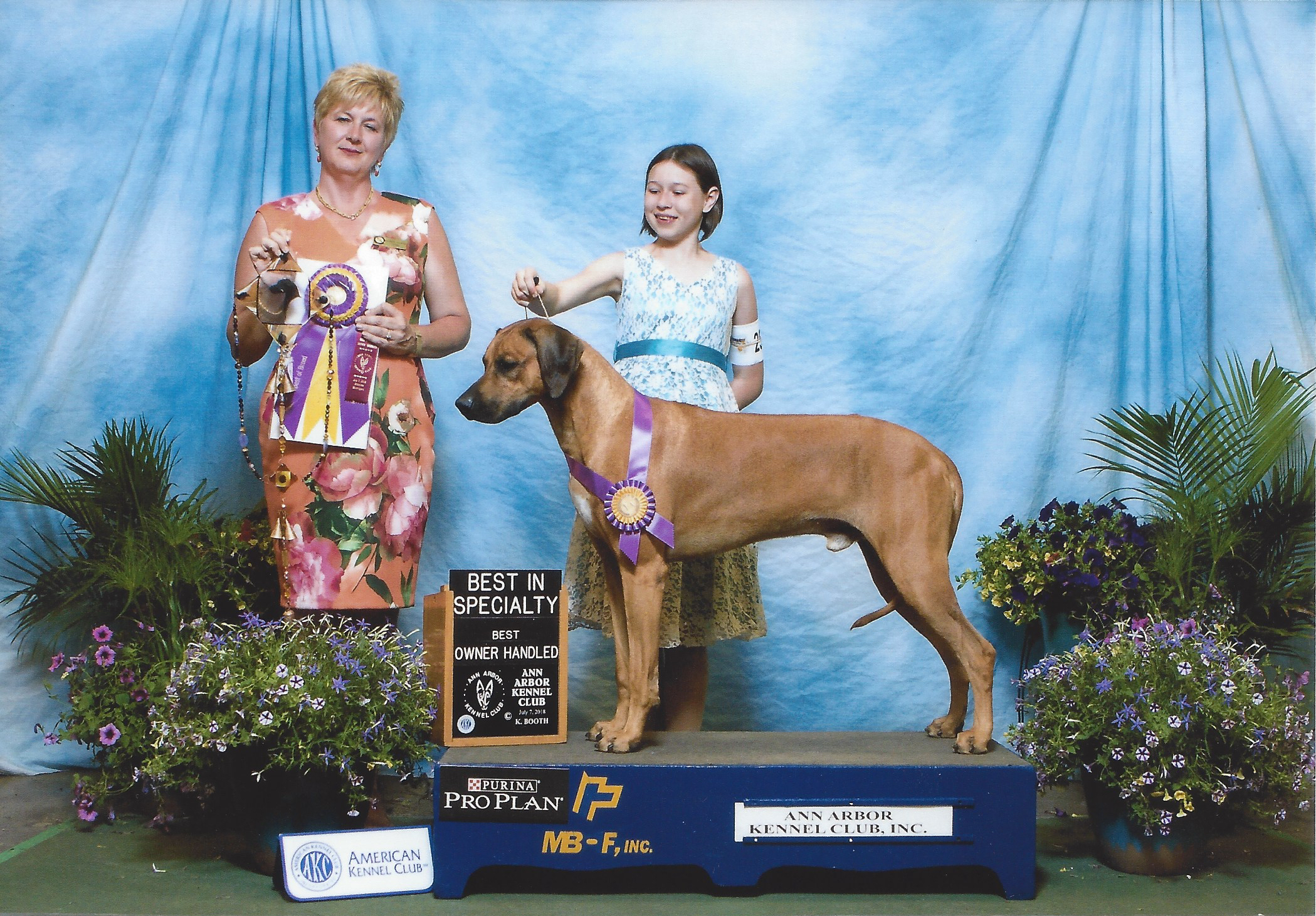 National Specialty kicks off in Colorado.
The first impression of a Rhodesian Ridgeback, Flaim said, is a “smooth dog with an unbroken fluid line from the top of the head, lovely crested neck, smooth withers, straight topline, gently sloped croup, slightly longer than tall, handy sized for trotting all day. Well angled. Not an empty front, moves freely and effortlessly. Lovely head, round dark eye, triangular ear.”
The Ridgeback, Flaim noted, is that perfect balance of speed and strength. The original dogs routinely coursed large African antelope. As with other sighthounds, the size and bone of the breed always parallels the prey it hunts. They need to be heavy enough to bring down large game like a 200-pound Nyala; lithe and fast enough to catch it. While the breed features a diversity of style within type, the ideal is a dog lacking exaggeration in any part.
“If you don’t know (a breed’s) history you’re doomed,” Flaim said “because you can’t understand its function and morphology.”
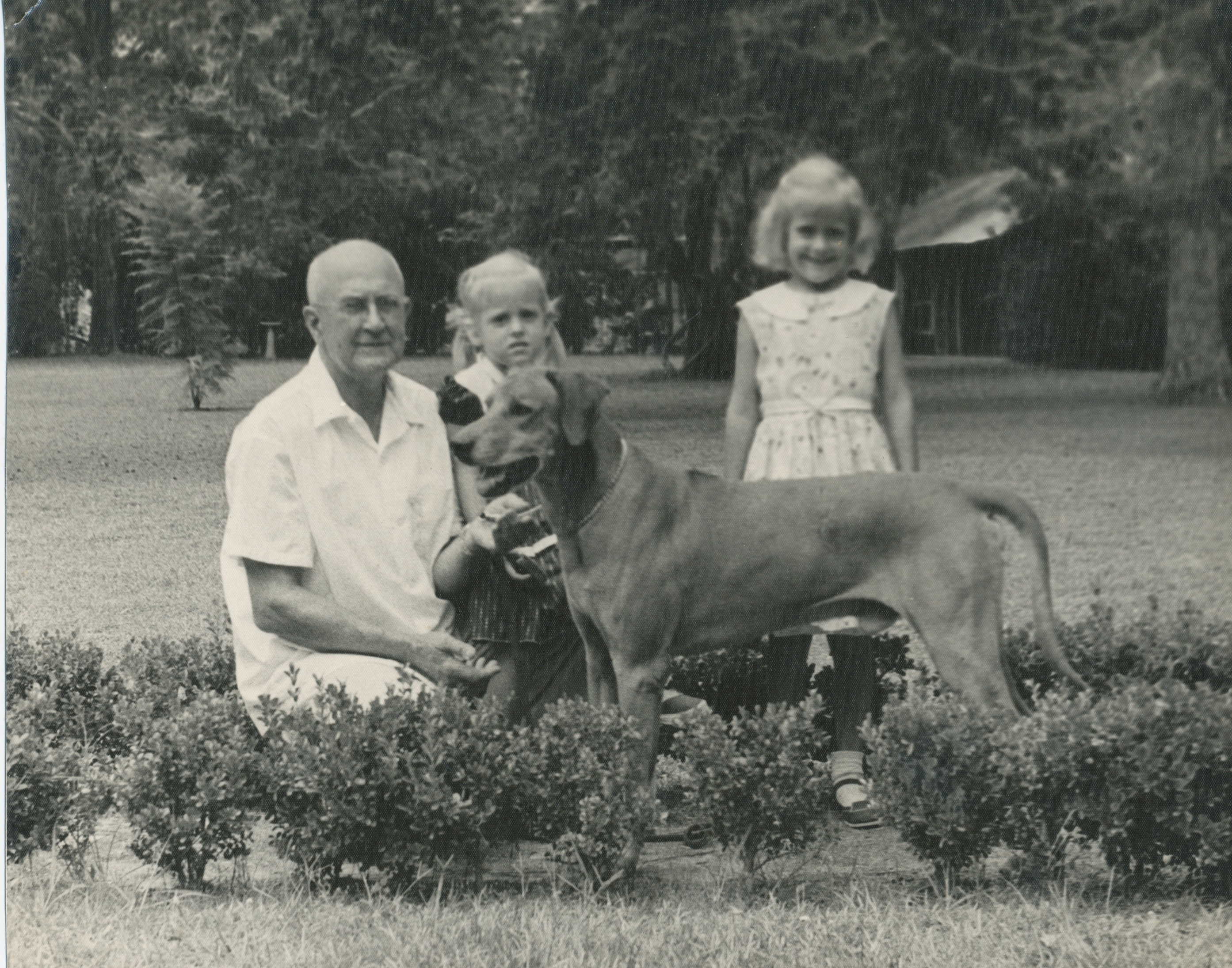
Ch. Swahili Jeff Davis — first American champion — with owner and founding Ridgeback breeder Col. Morrie de Pass of Mississippi.
Ridgebacks in Africa
In brief, according to Flaim, when the Dutch went to southern Africa in the late 1600s, they found an unimproved “border collie looking” dog that had a dorsal rise of hair on its back, Flaim summarized. These indigenous dogs that hung out with Koi Koi people, interbred with the Continental dogs, resulting in dogs that had native knowledge, resistance to tse tse flies and more.
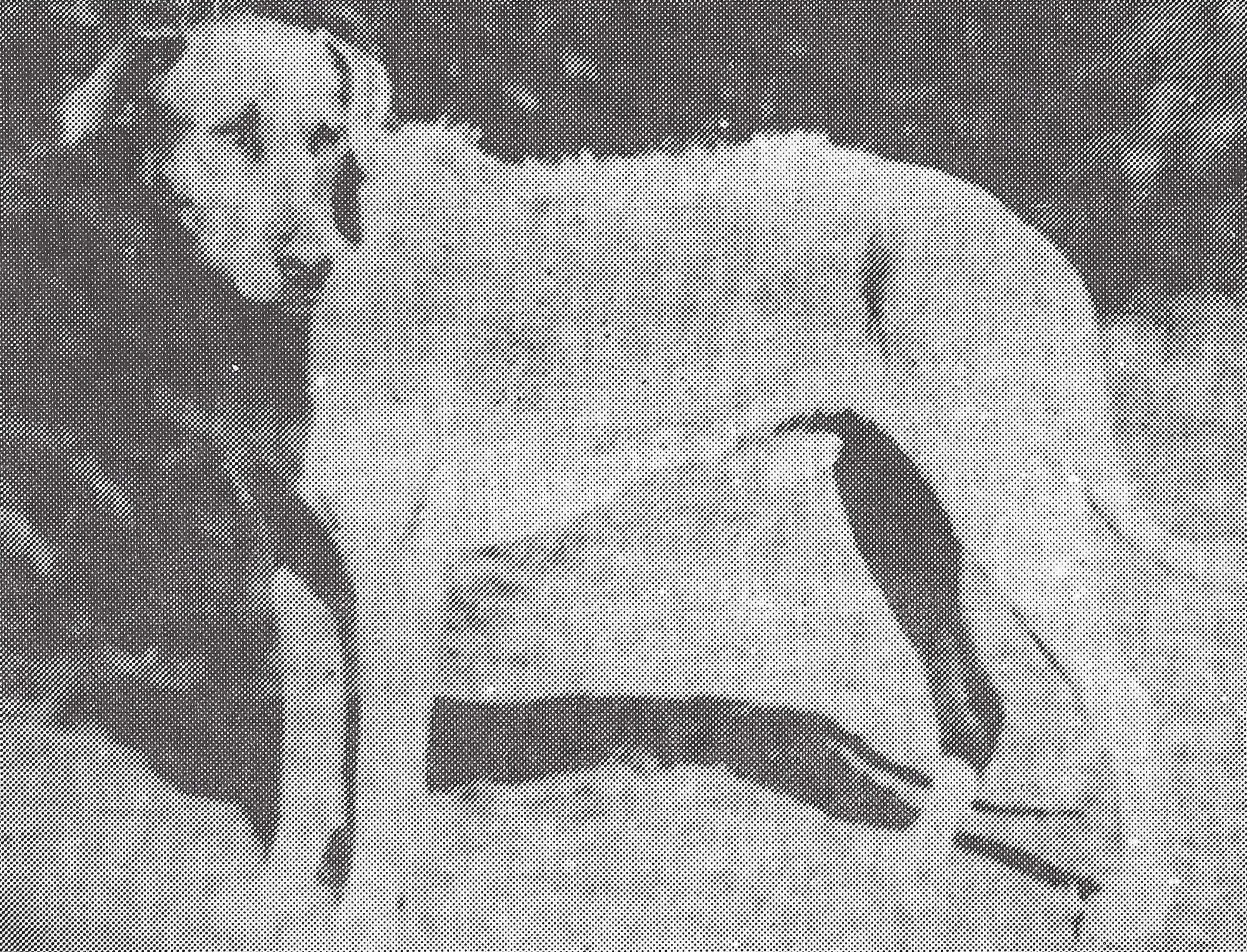
Buff of Between Two Rivers, South African, whelped 1924.
The Boers moved to Rhodesia in the late 1800s, and a popular big game hunter acquired ridged bitches and interbred them with his pack. The resulting dogs were excellent at lion hunting.
Flaim was quick to clarify what that actually entailed. The dogs would be taken with rich European hunting parties, in small packs of two or three, to find a lion and harass it, like a matador. Overall athleticism that let the dogs get out of the way of claws was most important.
“Any Ridgeback foolhardy enough to make contact with a lion, soon exited the gene pool in an unceremonious fashion,” Flaim said.
What travels with the ridge?

An endurance trotting breed, the Rhodesian Ridgeback should move effortlessly and freely.
The breed’s trademark ridge is important, Flaim observed, because “nothing exists in nature if it’s not functional. In Ridgebacks, the dogs that carried the ridge were superlative hunters and could survive in the harsh climate of southern Africa.
“Who knows what native knowledge or traits travel with that ridge,” Flaim said. “For example, Ridgebacks don’t jump into standing pools of water. They want graded entrances. In Africa, if you jump into a standing pool of water you encounter something that wants a snack.”
Rhodesian Ridgeback parent club website: https://www.rrcus.org/
And Allison Foley, Leading Edge Dog Show Academy, tells us how to use cornstarch for dematting.
222 — Lydia Hutchinson on Cairn Terriers and 54 Years Judging
Loving life and living for Cairn Terriers
I visited with Lydia Hutchinson, renowned AKC judge and breeder, owner, handler of Wolfpit Cairn Terriers, at Westminster Kennel Club earlier this year. After a day of stewarding, this enthusiastic septuagenarian was bubbling with enthusiasm about pedigrees, breeding and the sport of conformation dog shows.
Watch the video.
A lifetime in dogs
“I wasn’t quite born in to (dogs),” Hutchinson said, “But my parents got their first Cairn Terrier two months before I was born.”
Following a familiar path, Hutchinson and her family eventually wound up at a dog show. The year was 1949 when she attended her first dog show “when I was 9 years old.”
In the intervening 70 years, Wolfpit Cairns have produced 270 champions, Hutchinson said, almost exclusively homebred and largely owner handled.
Breeding, handling, judging
Hutchinson is still actively breeding and showing her Cairns. She said showing and judging dogs at the same time maintains her sensitivity to exhibitors, keeps her up to date and “keeps you young.”
Cairn Terriers are a breed noted for their adaptability, alertness and independence, Hutchinson said. She calls Cairn grooming for the show ring, “achieved naturalness.”
As she developed the family’s Wolfpit line of Cairns, Hutchinson said she utilized principles of line breeding learned from early Poodle mentor. She imported bitches from Europe looking to improve coats and fronts, but building on her program’s established sire line.
“I still hand-write pedigrees,” Hutchinson said. “I know it’s old-fashioned, but it helps solidify the pedigree in my mind.”
Hutchinson started judging in 1964 “when I was 7 months pregnant with our second child. She judges terrier, toy, herding, poodles, schnauzers. She noted that she wants to “have a relationship with a particular breed to want to judge them.”
“There is not a dog show I go to that I don’t learn something,” Hutchinson said. “Using your eyes, asking questions of knowledgeable people, you’ll learn.”
There’s something about the sport of dogs that’s very energizing, Hutchinson observed.
“I love life, I love my dogs. I’ve been married to my husband for 57 years. I’m not tired at all! I’m looking forward to tomorrow.”
221 – Testing the Genetics and Biological Markers of Fear in Dogs
Research to develop scientifically based information about fear in dogs
Candace Croney is one happy researcher. Her team has received a grant for a ground-breaking study on the genetics and biological markers of fear in dogs.
“This study is going to give us information nobody has,” Croney said.
The $2 million grant will continue Croney’s work with commercial kennels and is designed to investigate how to best identify dogs that can be successfully rehomed as adult dogs.
Part of the Canine Care Certified program is making sure the dogs are treated humanely after their breeding career is done, Croney noted. Her hope is that she will be able to look at which dogs are more or less likely to run into trouble when transitioning from kennel to home
Measurable results
But all of the research is giving Croney invaluable information about how to measure fearfulness in dogs. The research is looking at both phenotypical manifestations of fear (spinning, pacing, freezing) and actual biological markers such as cortisol levels, immune system function, and more.
Amongst the most fascinating part of the equation, is Croney’s examination of fearful dams and fearful puppies. She’s investigating both the genetic and environmental components of this equation. The results of the work have the potential to be useful to hobby breeders, shelters, and companion owners as well as commercial breeders.
“This research benefits all breeders because it’s basic information we don’t have,” Croney said. “Scott & Fuller did great work on this in the ‘60s, but we’ve done little to follow up on it.”
Croney’s research goal is to produce answers to the questions:
- What tests give valid metrics of how fearful or comfortable dogs are around people, objects
- What are biological markers that identify fear – cortisol levels, the immune function of the dog
- Do stress-fearful moms have puppies that are different
Don’t miss Allison Foley’s advice on teaching tricks to focus your dog in the ring.