

10 – Bill and Taffe McFadden Live at AKC Nationals – Wisdom Wednesday
Bill and Taffe McFadden
Two of the most beloved professional handlers in the United States. Based in Northern California, they have worked together for well over 30 years to present some of the top dogs in the country. Three times they have taken dogs to #1 all breeds in the nation, including the incomparable Mick, the Kerry Blue Terrier who won Best in Show at the Garden in 2003, Spirit the Giant Schnauzer, and Harry the Dandy Dinmont Terrier.
They have a half dozen top handler awards and 10 Westminster KC group wins between them. Their proudest accomplishments? Raising three sane children. Mick and McFadden’s win Westminster.
9 – Finding a Show Puppy
Buying a purebred dog, whether for companionship, performance competition, a show dog or all of the above is exciting. It also requires patience, study and commitment.
You aren’t going down to the car dealership and picking your favorite color & haggling over the price. This is a living, breathing soul who will be with you for 12-15 years of your life. A puppy will require time, commitment, money, love, guidance, food, medical, exercise and attention. Think of your new dog as a “friend you choose” instead of an objet d’art that gets recycled when you change the decor or move.
How to Identify the Best Breed
To identify the breed that best fits your family’s current and predicted future needs, here’s a few characteristics to consider:
- Job – Hunting, herding, guarding, service, therapy or companion?
- Lo/High Energy vs. Lo/High Drive?
- Temperament and Disposition – Aloof or snuggly?
- Tidiness? – Hair, Slobber, Size, Shedding, Grooming needs
- Space Available vs Space Needs?
- Time? – How much time do you have? How much time does each breed need?
- Children? Ages? Infant, Toddler, older children
- Other pets? Certain breeds are best with no members of the same sex
Dog Shows and Health Resources
Stop by a dog show and visit the different breeds that make your list, talk to folks that own and breed them to make informed decisions.
Find a breeder who is willing to talk with you, help you with questions and problems, mentor you if you choose to compete with the dog. Your breeder is your first resource.
Look at the health clearances suggested for the breed. Research at OFFA and CHIC. Ask the breeder about health guarantees. Understand that, just like people, some dogs develop health issues in even the most carefully planned families.
Consider an Adult dog – Rehome or Rescue
If a puppy isn’t right for you at this point in your life, talk to a breeder about offering a retirement home to an older show dog, retired breeding dog or a young prospect that didn’t pan out. Sometimes breeders are willing to part with these dogs in order to ensure they have a one on one home with more individual attention.
Check with breed specific rescues through the AKC Parent Clubs.
Working with a Breeder
Choose a breeder first, then expect to wait for a puppy.
Read and study the breed standard of your new dog. Know what are disqualifying faults in the show ring if you plan to pursue that goal.
Even within a litter there are differences in temperament, personality and activity level
Visit the litter — some puppies are bolder, some more reserved. But you want to see puppies that generally are happy to see people, willing to come toward you for attention, active, bright eyed, curious, clean and healthy. Puppies poopy… and tromple in it… almost guaranteed to happen right before company shows up… I’m talking about a pen or area that is bright, well lit and ventilated, warm but not stuffy, with generally clean bedding, toys, fresh water and obviously accustomed to human interaction. Baby puppies are sponges taking in all kinds of experiences from the minute they are born. There are a number of excellent early conditioning that breeders can and should do to make sure the puppy you take home has the best chance of fitting well into society.
You won’t necessarily get to “pick” your puppy — Choose a breeder that is a member of the AKC Parent or Specialty Breed Club and preferably an AKC Breeder of Merit so you trust that they can make a good match, and has knowledge of the breed. Be honest and share your goals and lifestyle with the breeder.
Understand that no breeder in their right mind will guarantee an 8-week-old puppy will turn into a best-in-show dog…or even a show champion. They can make an educated guess, but even that isn’t foolproof. And remember, most of these breeders are planning for the future of their breeding program. They’ll almost certainly plan to keep their very best for themselves or someone they have worked with extensively in the past. If you want a great dog from a great breeder, expect to start with a dog who is solid, but not exceptional and work toward the goal of getting a really good one.
8 – The Three Little Piggies and How They Built a Better Dog
Straw, Sticks and Bricks –
Understanding the blueprint to build a brick house, a foundation for better dogs and how breed history and the breed standard work together.
Conformation – principles of the ideal dog.
What is a dog supposed to BE?
History Matters – What was your dog designed to do and how form follows function.
Understand that a breed’s innate quality and instincts matter. Happy and forever homes depend on an owner knowing that herding dogs herd.
As a Breeder:
Memorize your breed standard and be able to apply it
Learn the language of dog – vocabulary and meaning of anatomy, movement, balance, and proportions.
Front Assembly – Function, construction, angulation.
Geometry and Angles
Balanced Angles
Mechanisms and Suspension
A race car is built different than a truck. The suspension and wheel placement has to be in the appropriate place. A dog’s “suspension” is also well underneath in the appropriate place for its function.
Cement the Blueprint in your Mind
Fix the ideal image in your mind and work to evaluate and grade how your dog and other dogs match or lack against the breed standard image. Understanding why you are winning, or not, may be answered in your education of yourself.
7 – How to Count Dog Show Championship Points
How to Count Championship Points
Understanding the Classes
All classes are divided by sex and championship status. The non-champion male dogs compete for Winners Dog. The non-champion female dogs compete for Winners Bitch. Only animals awarded Winners Dog and Winners Bitch are eligible to earn points toward their championship status. After that, the Champion animals and the Winners Dog and the Winners Bitch compete for Best of Breed.
What are the classes?
Class options and order are:
- 6-9 months puppy
- 9-12 months puppy
- 12-18 months
- Novice class (which is designated for dogs which have not won three blue ribbons in another class. It applies to the dog, not the exhibitor)
- American Bred Class (dogs bred in the US)
- Bred By Exhibitor Class (dogs bred by the person showing the dog or an immediate family member)
- Amateur Owner Handler Class. (defined by the exhibitor not the dog)
- Open Class (any animal, any age, any handler).
In certain breeds classes might also be divided by coat, color or size.
Very seldom will you see entries in every single one of the available classes. The non champion (or class dogs as we call them) males are all judged in class order. The winner of each class remains at ringside to return and compete for Winners Dog. The second place animal in each class (if there is one) ALSO remains handy.
Winners Dog
This can sometimes be a little confusing. The steward will call the winners of each class back into the ring — in the reverse order they were judged. The judge will select Winners Dog from the class winners. This is the dog who is awarded championship points (more on this later). Once Winners Dog leaves the ring, if there was a dog which placed second in the winner’s class, that dog will be called back in to the ring to be considered for RESERVE Winners Dog. If there was no second place animal, reserve is chosen from the dogs remaining in the ring.
Reserve is literally, the animal who could be awarded championship points if the Winners animal is deemed ineligible for any reason.
Winners Bitch
The female entries go through the same process in order to select Winners Bitch and reserve winners bitch.
Best of Breed Competition
All of the champions are called in to the ring, with Winners Dog and Winners Bitch, at the end of the lineup. Generally the judge will ask for male champions first, female champions next, followed by the winners. This is NOT a given and how the champions are lined up is completely at the judge’s discretion. This is one of the reasons it is smart to watch a ring for a breed or two before yours is judged.
At the end of judging, the judge will line the dogs up in order of their placement… Best of Breed winner is first. Next in line is the Best of Winners. This is the judge’s choice of the best of the class dogs. This award can have bearing when counting points, as we will discuss shortly. Next is the Best of Opposite Sex to Best of Breed. If the judge selects a male dog for Best of Breed, this award is given to a female and vice versa. Finally male and female Select awards are presented. These awards confer grand champion points and are only available to champion dogs in the ring which did not win Best of Breed or Best of Opposite.
How to Count the Points
Points are awarded based on the number of dogs defeated.
Dogs can earn from zero to five points at a given dog show. For example, if there is only class dog and one class bitch entered, there will be no points available.
Any time a dog defeats enough animals to earn three, four or five points it’s called a Major.
All dogs have to earn two major wins and accumulate 15 total points to be awarded championship status.
How many championship points are awarded is determined based upon three factors: breed, sex and area of the country.
Example:
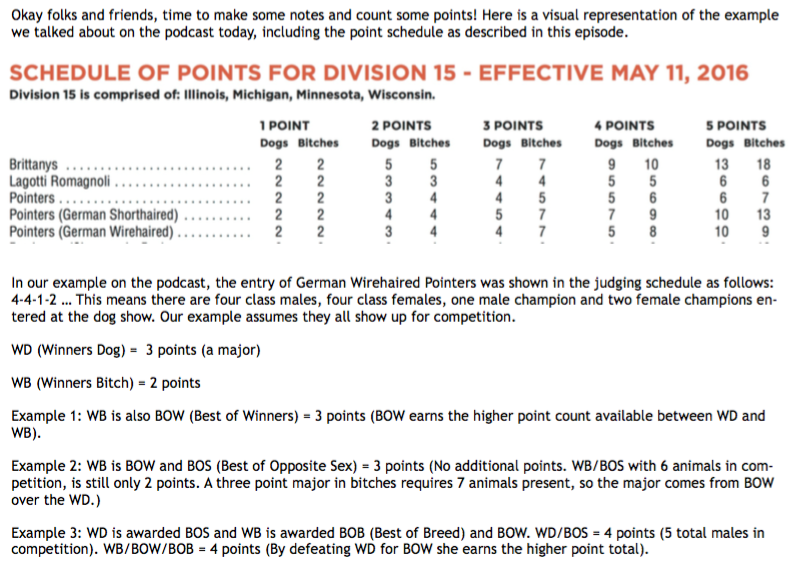
German Wirehaired Pointers in Oregon with an entry of four class dogs and four class bitches — both Winners Dog and Winners Bitch will earn three points for a major. In other areas of the country that might equal only two points. If you’re showing a Golden Retriever, it requires 24 bitches to earn a three point major.
AKC’s Point Schedule covers all 15 divisions of the country. This schedule is adjusted in May every year. So what constitutes a major on May 1 might well not count on May 15.
Now this is where the Best of Winners award might just come into play. The dog awarded Best of Winners earns the highest number of points available. This is not *in addition* to points earned. So, for example, if we have four male and four female class dog wirehair pointers being shown in California, there are three points available in dogs and two points available in bitches. If the female is declared best of winners, she also has earned a major. This is frequently referred to as “sharing” the points or “crossing over”. Keep in mind the judge does NOT automatically to do this and should be deciding whether winners dog or winners bitch is the best representative of the breed.
Let’s talk about championship points awarded in the case a class dog is awarded either Best of Opposite or Best of Breed.
If a class animal defeats champions to earn Best of Opposite, the number of champions of the SAME sex are added to the count of how many dogs in competition to earn points. When a class animal defeats champions to earn Best of Breed, ALL of the champions present are included in the count of dogs defeated.
Let’s assume in our ongoing example that the total entry of German Wirehaired Pointers is four males, four females, one male champion and two female champions. We’ll say that it takes 4 males or 7 females to earn a three-point major. Let’s first say the winner’s bitch also was awarded Best of Opposite sex. She has now defeated two more bitches, so we add those to the four class bitches, making a total of 6 bitches, but it’s still not enough for a major.
Finally, let’s say the winners bitch was awarded best of breed and the class dog was awarded Best of Opposite sex. Did she earn a major NOW? Yes, now she did! On two levels. First because BOB is also automatically BOW if it is a class animal and second because now the winners bitch has 7 animals in competition — 4 bitches plus three champions, the number needed to earn a three point major in GWP bitches.
How many points did she actually earn?? We know she has a major, but how many actual points? Quick, check the point schedule and…..
The class dog earned Best of Opposite sex! Which means four class dogs and one champion present, five total animals. The point schedule for GWP males shows that four points for five dogs in competition. The class dog just earned four points! Since the class bitch was Best of breed and Best of Winners, she now ALSO earned four points!
The Basics:
Make sure you know the point schedule for your breed in the area in which you show dogs.
Make sure you pay attention to the number of dogs actually IN the ring…. Just because the dogs are entered doesn’t count! If they don’t show up, it can drastically change the points available.
If you got a blue ribbon or a red ribbon in your class, don’t leave until the purple and white ribbon is handed out!
In all cases, if you are the winner, verify with the ring steward or the superintendent that the judge wrote down your dog’s number properly. Verify the number of dogs actually in attendance.
You can do this most easily by asking the superintendent to see the “tear sheets” from the judge’s book. These are always made available to exhibitors, usually within an hour or two of the end of judging of your breed.
So there you go. You are prepared for the dog show with hard facts about the gobbledygook that was stressing you out. This way, you can focus on your dog and making every second in the ring count.
6 – Growing Up Your Show Dog
Growing Up Your Show Dog:
In this Episode
Shaping a Show Dog
What are Why are boundaries important?
Crate Training and Safety
Exposure and Early Socialization:
Matter of fact introductions.
Your role and attitude and how it imprints on the dog.
Frequency of socialization.
Fitness Training:
Early puppy play and interaction with you.
Formal fitness training.
Cavaletti Poles
Understanding how to prevent problems in the ring.
Grooming, toenails, table time.
Positive acceptance of strangers
Show dogs make great pets, and go beyond therapy and service.
Winning Edge
George Alston is a renowned professional handler and steps into your mindset for success in his book The Winning Edge. We love the part about presenting your dog like fine art to be cherished and admired.
5 – Problem Solving 101 in the Show Ring
Problem Solving 101:
In Episode #5, we tackle three of the most consistent ring issues.
Showing the Bite
Showing the dog’s bite can be nerve-racking for the beginner handler. Since training the bite starts at a young age, sometimes an inexperienced handler needs a little help.
Listen as Laura goes through the basic steps and enjoy the video.
Backing away from the Judge
The handler’s reaction to a dog backing away from the judge is critical. Since the dog is unsure or exhibiting stress, harsh corrections should not be used to add to the stress.
Pacing
Pacing is described as both the left or both the right legs moving simultaneously. When a dog paces, the gait cannot be assessed by the judge. The simple solution is to “pop and release” the leash upward to break the dog’s stride.
Professional tips:
FIRM, FAIR, and CONSISTENT
If YOU are nervous, it goes right down the leash
ALL dogs are imperfect in some way. Know what is good AND bad about your dog and learn how to present the dog in his best light.
Dogsteps – Rachel Page Elliott
Considered one of the “Must Have” books for understanding gait and movement. Explains what to look for and why a dog moves the way they move.
4 – How to Master the Dog Show Ring
Steps to Mastering the Dog Show Ring:
In this episode, Laura Reeves takes you on a Virtual Tour – How to move from beginner to master level. Mastery is a mental game that Master handlers make look simple.
Simple Tips:
Get to the dog show early.
Checklist of what to do before your ring time.
Understanding ring times.
Preparing your dog and yourself for the show ring.
Ringside before you enter – mental preparedness.
Ring Awareness and Spacing
Sportsmanship
Bait and Toys
Stand with shoulders back and be proud of your exhibit.
Project the Winning Image!
The Art of Handling Show Dogs
Mr. Frank T. Sabella
Frank T. Sabella in the 1960’s was a sought after professional handler that started in Poodles. He won Best in Show at Westminster in 1973 with Standard Poodle CH. Acadia Command Performance and returned as the Best in Show Judge at Westminster in 1990.
Mr. Sabella awards include Kennel Review‘s Male Handler of the Year and Gaines FIDO Man of the Year.
The Art of Handling Show Dogs translates Frank Sabella’s talent as a professional dancer and dog handler into easily understood body movement and awareness to the novice and experienced dog handler. BUY THE BOOK
3 – Dog Show Basics – Moving Your Dog
Dog Show Basics – Moving Your Dog
Moving your dog.
How to move gracefully with your dog.
Why moving your dog smoothly is important and how to help you succeed.
Getting Rid of Bad Habits
Don’t mince your steps
Lower your center of gravity
Upper body and leash hand still
Stand up tall
Move your free hand naturally
Professional Tip – Line the dog up in front of the judge
Training proper movement
Start puppies out early
Walk before you run
About turns and high knees
Pop and release
Professional Tip — Give the dog something to carry in its mouth
Putting it all together
The difference between technically proficient and winning presentation is “showmanship” — it’s in your head, in your hands, in your eyes and in your body posture.
2 – How To Stack Your Dog
How To Stack Your Dog:
Stacking your dog
What is stacking your dog?
Why stacking your dog is important and how to make the “picture”.
Successful handlers and how they catch the judge’s eye.
How to Hand Stack
Starting puppies on the table
The 3 Principles of Stacking
- The head controls the body
- Placing the Legs – Elbows and Hocks
- 5 Second Rule – Automatic, Habitual, Muscle Memory
Professional Tip – How not to fidget, and walking into the stack
Teaching the Free Stack
Leash free training – No, there is no “NO”.
Watch Me focus foundation
Body Language and Non-Verbal Movement as a Command
Winning with the Free Stack
Handler’s Bond and Responsibility to the dog
1 – Pure Dog Talk 411
Pure Dog Talk 411
Your host, Laura Reeves, is an AKC Breeder of Merit and a member of the Professional Handlers Association. A professional journalist, Laura’s weekly column “As The Wheels Turn” is featured on Best In Show Daily.
Breeder of German Wirehaired Pointers, Laura handled the first GWP to win a Best in Show that also earned a dual championship in field. As a professional handler, she has finished and won with hundreds of dogs in dozens of breeds and every variety group. Laura grew up in the dog sport, from 4-H to Junior Showmanship, with an amazing network of support and mentorship of breeders, handlers, and club members.
From Laura:
Mary Albee and I started Pure Dog Talk as a way to reach out to members of the purebred dog fancy with education and resources to help them succeed and move forward in their goals and ambitions. This podcast if for you! If I don’t know the answer, I guarantee I know someone who does… and we’ll be hooking you up with those people.
We’ll be coming at you from around the country three days a week with Mentor Mondays, Wednesday Wisdom, and Free For All Friday.
Our Journey and Purpose:
- Archive the Mentoring and knowledge of our Master Breeders, handlers and judges.
- Support young people in the sport and have them bring a friend!
- Turn emphasis from winning, ranking, and ribbons, to a greater understanding of our breeds and their future.
Purebred dogs are history and art. They are beauty and brains. They are living, breathing conduits to our past, and to our future. They are our heart and our soul…and they are so much more.
All of us who are breeders, exhibitors, handlers and judges are the curators of the purebred dog. We want to support preservation breeders and the rights of everyone to own the dog of their choice, and responsibly ensure the future of their breed.
I’m really looking forward to this journey and excited about the opportunity we have to enhance every facet of the wonderful world of purebred dogs.