
175 — Tibetan Mastiff History, Lore and Modern Living
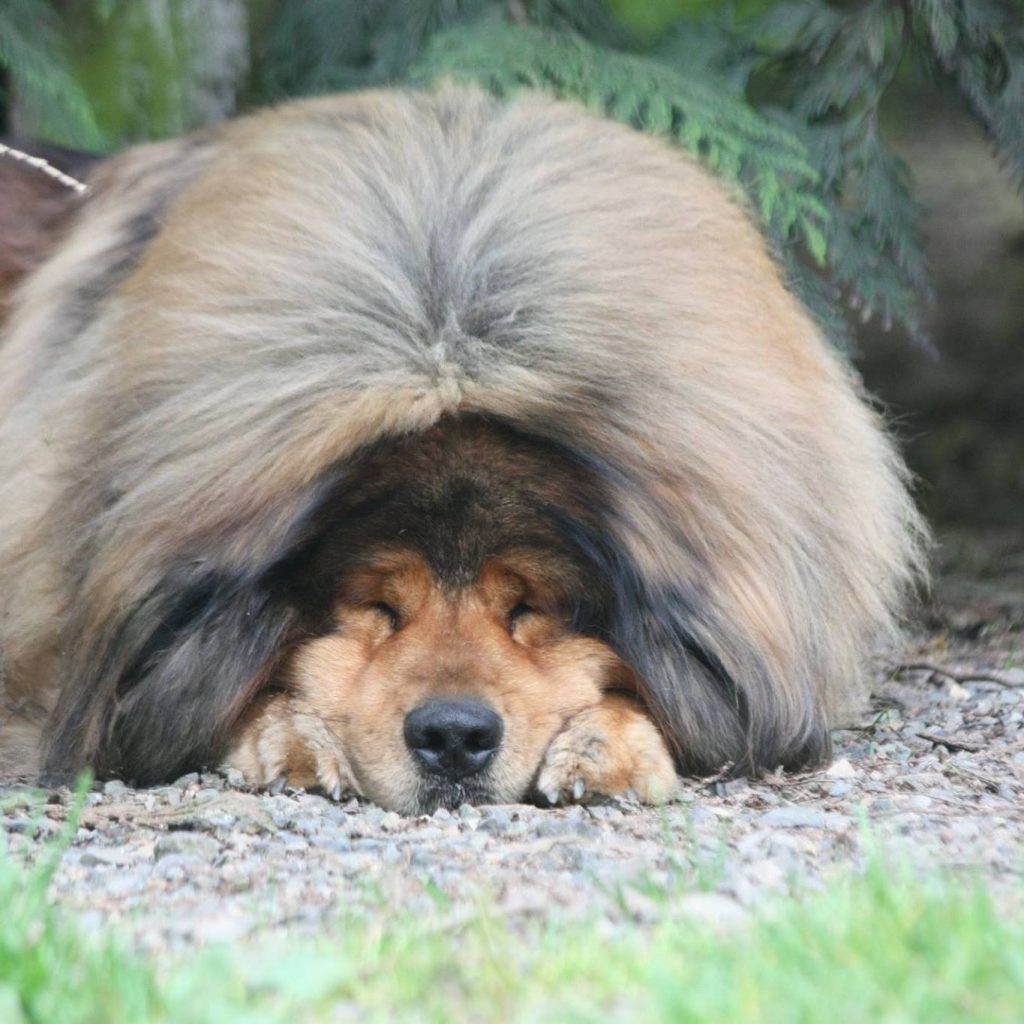
Tibetan Mastiff History, Lore and Modern Living
“No one knows where they came from,” said Sabrina Novarra, one of the original Tibetan Mastiff breeders in the U.S. “The myth of the old monks of Tibet say that snow leopards bred with wolves. Now, we know that’s not true. But, we cannot trace the ancestry. They are the oldest large breed in existence.”
Novarra acquired her first Tibetan Mastiff in 1987 and worked to help establish the breed with the American Kennel Club, where it was recognized in 2007.
Low key breed is long-lived but not easy to train
She said this ancient breed is relatively healthy and long-lived, but, while generally low key, they are not particularly biddable.
“This is a landrace breed,” Novarra said. “… basically, a breed that has evolved itself as opposed to us evolving it. They are self-thinkers. They are not easily trained. You learn after you’ve had them as long as I have, that you make them think it’s their idea to be trained.”
In Tibet the dogs developed as family and flock guardians who were tied during the day and roamed the village at night as protection. They still bark at night if they are outdoors, as that was their job in ancient times.
“This is not a dog if you want to do agility and obedience and take 300-mile hikes, this is not the dog for you … they’re very lazy,” Novarra said. She did note that she accomplished an obedience title on one of her older girls.
The dogs are very large and powerful and need significant amounts of socializing, according to breeders.
“Tibetan mastiffs need to see everything twice,” said Dan Nechemias, owner of the 2018 National Specialty Best of Breed winner. “Just because they saw a red basketball doesn’t mean that they’ll accept a yellow basketball. They were bred for 2000 years to be suspicious of absolutely everything but their family. So, everything that they see in their space — which is their entire visual field — is a threat until they decide it’s otherwise.”
Nechemias, who purchased his first Tibetan Mastiff in 2001, adds that, like many of the working and guardian breeds, the Tibetan Mastiff is very discerning about people they meet.
“… Tibetan Mastiffs are wary of people that are determined to meet them,” Nechemias said. “So what happens is the person’s just really working hard. They’re staring at the dog — you should never stare down an Asian breed much less a Tibetan Mastiff — they’re in their face. … If you ask a Tibetan Mastiff permission to touch it, it will wonder why you’re asking it permission. They’re an incredibly sensitive breed and then they say well this person’s asking me permission they must not be OK.”
Our Valued Corporate Sponsors:


Our Esteemed Advertisers:

Our In-Kind Supporters:




KNOWLEDGE IS POWER — FRANCIS BACON
When you become a patron of Pure Dog Talk you’ll tap into an exclusive community of experts to help you and your dog be blue-ribbon best at whatever you do with your purebred dog! Your support helps keep the MP3's rolling at Pure Dog Talk!
As a supporter, you’ll immediately gain access to the weekly Pure Pep Talk SMS, Pure Pep Talk private Facebook group, and priority emails. Patrons can choose to level up to the After Dark Zoom and a Patrons Digital Badge for their website— even a private counseling session with Laura on any topic.

DON'T MISS AN EPISODE!!



4 Comments
Leave a Comment

I’ve never heard about dog’s being healthier when left in tact. I’ve always heard that its better to spay/neuter because of cancers, pyometra, etc. Did you do a podcast on this topic? I’m very intrigued.
Yep, a couple on the topic. Do a key word search here for Marty Greer’s first interview — on Breast Cancer Awareness in dogs… we cover it there.
It can help with certain cancers, but may contribute to the development of other cancers. I believe there needs to be more research. Certainly early spaying and neutering is not recommended.
Tibetan Mastiff as a registered purebred breed, was developed in the West from a landrace of dogs from varying areas of the Himalaya Mountain regions. Dogs from Nepal, Tibet, India, and one from Afghanistan (arguably a different type of landrace) were used to establish the breed.
These landrace dogs were primarily used as guardians of people, property, and livestock, however they are not traditional LGDs, but rather territorial guardians. Nomadic shepherds were the primary users and the source of these dogs and any dog that was too big, lacked agility was given away or sold to be a door guard or used in a similar purpose that did not require travel or agility.
With study one can see the similarities in all of the dogs of the region, with coat length effected by climate of the region. You can also find dogs that look like they should be from one region in a completely different region. You can also see similarities with the Mongolian Bankhar in the native dogs of these regions. It is easy to surmise that during the Mongolian occupations of the all the Himalaya Mountain regions that the dogs are related, whether the Bankhar was brought and interbred with the existing population or that the dogs were taken back to Mongolia, there is certainly a ancestry there. One USA bred dog’s DNA test linked her with a Mongolian Bankar as a distant relative.
Recent DNA studies of some native dogs from Nepal linked their closest relations to the current native dogs in Tibet and to the registered Tibetan Mastiffs in the West.
As far as “trainability”, I disagree with Ms. Novarra. They are highly intelligent and are easily trained, learning behaviors in minutes (sit, down and yes, stay etc.). Many have earned their CGC. I agree that they are not biddable. They need a reason to do what you ask. Perhaps that is why it is perceived that they have not learned what they have been taught. Sometimes the reason to respond can be just because you asked because of their relationship with you. Or it can be dependent on their socialization. Sometimes it is for a reward, and sometimes it is just because it is part of the established routine. They will certainly ignore anything you say if they think they need to perform their job. At any rate they are complicated and wonderful.