Dandies Down Under: Breeding with Integrity and Soft Outlines
Laura Reeves sits down with Emma Greenway of Jolly Gaze kennels in Victoria, Australia, for an in-depth conversation on the history, breeding and styling of the Dandie Dinmont Terrier.
This episode of the Dandie Dinmont Terrier Diaries is part of Pure Dog Talk’s Clubhouse. The series features members of the Club Partnership Program who are working to preserve the knowledge of their legacy breeders.
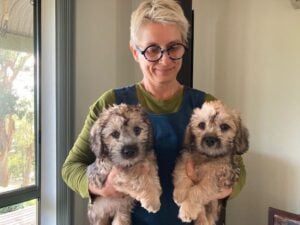
Drawing on nearly 40 years of experience, a background as a historian, and a PhD in Australian canine history, Emma shares her unique perspective on how geographic isolation forced her to “interrogate” the breed standard.
Whether you are a Dandie devotee or a general student of dog history, this episode offers a masterclass in breeding with integrity, mentoring across borders and staying true to the soul of your breed.
- From Schnauzers to Dandies: The Early Lessons of Sportsmanship
- Emma began her journey with Miniature Schnauzers, learning the ropes of grooming, showing and standard analysis from a generous mentor who modeled impeccable sportsmanship and grace in defeat.
- Her early love for the Dandie Dinmont Terrier eventually led her to seek out the breed, though she faced the hurdle of only one active breeder remaining in Australia at the time.
“Generosity breeds generosity… we have to work together and we have to share our knowledge.” — Emma Greenway
- The Quest for the Foundation Bitch: Flying to the UK
- Determined to acquire a top-tier foundation bitch, Emma traveled to the UK. She studied the breed standard obsessively and chose a bitch at a Birmingham show purely based on her own standard evaluation rather than the judge’s placement.
- Through the generosity of a prominent UK breeder, Emma secured her foundation bitch in 1992 (arriving in Australia in 1993), which she later bred to a respected male acquired from New Zealand expats.
- A Historian’s Eye on the Australian Dandie Legacy
- Emma recounts the history of Dandie Dinmonts in Australia, noting they were reintroduced in 1969 by Mary McCall (initially a Westie breeder) using imports from the famous Bellmead Kennels.
- She shares the chilling story of Bellmead maid Peggy Hume, who described the tragic loss of bloodlines during WWII, wheeling down deceased dogs in wheelbarrows due to extreme wartime starvation.
- Other early Australian pioneers of the breed ultimately drifted away from Dandies because establishing lines and winning against flashy terriers was exceptionally difficult.
“Our breed standard says body colour coming well down shoulder and hips gradually, gradually emerging into colour of legs. Not a line. Not a line anywhere. It’s a gradual merging. It’s natural.” — Emma Greenway
- The Advantage of Isolation: Rejecting the “Cookie-Cutter” Recipe
- While isolation in Australia presented logistical hurdles, Emma credits it as a blessing. Without local handlers or a dominant local show trend to emulate, she was forced to deeply interrogate the breed standard to guide her grooming and breeding choices.
- She warns against “recipe grooming”—where exhibitors blindly copy winning handlers without understanding why. Interrogating the standard yourself builds a detailed eye for puppies and prevents kennel blindness.
- Grooming Philosophy: Soft Curves vs. Sharp Lines
- Coming from Miniature Schnauzers, Emma highlights the stark contrast in grooming: Schnauzers are about sharp, square lines and dramatic skirts.
- Dandies, by contrast, are defined by soft, natural curves. Emma notes that the standard explicitly calls for the body color to gradually merge into the leg furnishings, rather than displaying a sharp, abrupt line or skirt.
“In dandies, we don’t have the luxury of throwing everything out. Sometimes you have to go back a bit to go forward a bit. Or sideways.” — Emma Greenway
- Breeding Priorities: Multi-Generational Planning in a “Gene Puddle”
- Emma describes the reality of breeding a rare breed with highly restricted genetics. Referencing Betty-Anne Stenmark’s famous description, she notes that Dandie breeders are working in a “gene puddle” rather than a gene pool, where all living dogs trace back to just two 19th-century stud dogs.
- Because she is the sole active breeder in her region, Emma must plan 3 to 4 generations ahead to ensure genetic diversity and preserve future combination options.
- While she predominantly line breeds, she occasionally imports outside lines. Her selection criteria post-outcross focus heavily on keeping puppies that resemble the Jolly Gaze style while selecting for softer, more pet-friendly temperaments.
- The Hallmarks of a Dandie: Outline, Head and the Power of “Weasley”
- If summarized, the hallmark of the Dandie Dinmont lies in its outline and headpiece.
- Emma champions the preservation of the word “Weasley” (present in UK, Canadian, and original standards, but omitted from the US standard in the 1970s), which beautifully captures the breed’s distinct curvy silhouette and athletic capability.
- The Social History of Breed Standards and the Future of Dog Shows
- Drawing on her PhD research, Emma discusses how modern breed concepts didn’t exist before 1820. She notes that while working “utility” drove early types, the 19th-century middle class artificially shaped breed standards to elevate the dogs’ social status.
- Looking ahead, Emma voices concern about the aging community, rising administrative regulations and the lack of young exhibitors learning to groom. She sees Asia’s rising middle class as a shining hope for the future of purebred dogs.