

101 – Saint Bernards of Stoan and Lasqueti Island with Joan Zielinski
Saint Bernards of Lasqueti Island – Stoan Saint Bernards with Joan Zielinski
Joan Zielinski, AKC Judge and Breeder of Merit, and Breeder of Stoans Saint Bernards, speaks with Laura Reeves about raising Saint Bernards.
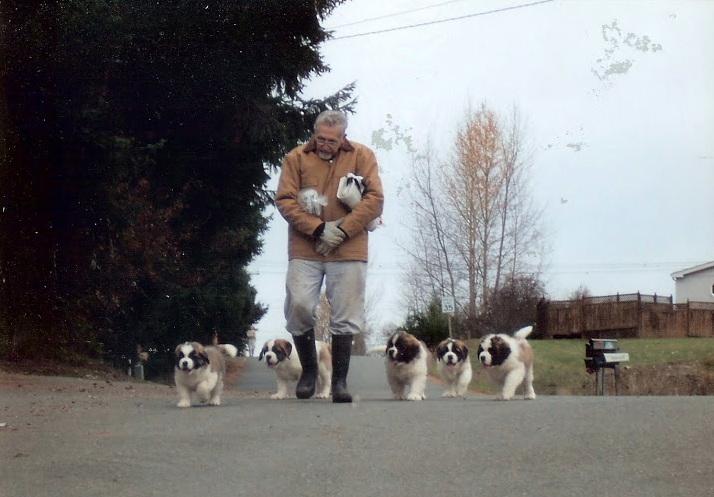
Joan Zielinski’s Stoan Saint Bernards
Saint Bernards from the Stoan Perspective by Stan Zielinski
Available through Alpine Publications, Stan Zielinski discusses Saint Bernard puppies, faults, temperament, movement, size, conformation, and just about every aspect of Saint structure.
Saint Bernards of Lasqueti Island
The Saint Bernards of Lasqueti Island, British Columbia, bred by Tikki Smith, are mentioned by Joan Zielinski, in her podcast, as she describes the famous Saint Bernards of Sanctuary Woods bred by the legendary Bea Knight. So we caught up with Tikki Smith and professional handler, Marty Glover, to talk about what makes these dogs unique.
Pure Dog Talk:
Provide some background of your introduction to the breed, why you chose Saint Bernards and what brought you to where you are today.
Saint Bernards Lasqueti Island – Tikki Smith:
I got my first St Bernard when I was 16 years old. I had no previous purebred dog experience. I just wanted a large dog and was interested in a Newfoundland or a St Bernard.
There happened to be a St Bernard breeder not to far from me so I went and visited the kennel and fell in love with the breed. I had never seen a Saint in the fur till then. I waited for over a year for a puppy and after no puppies because available I was offered a young female that was “show quality” and the breeder’s said I could have her if I would co-own her, and raise and share a litter with them.
At that point I would have probably agreed to anything! She had a litter of 10 puppies and I kept two. Then 6 months later the breeders invited me and my two puppies along to the 1997 National Specialty Show held in Colorado. I went and was introduced to showing and the purebred world. I have never looked back since!!
PDT:
Give us an idea of the set up and daily life of your dogs.
Tikki:
Now, 20 years since my first litter of Saint puppies, I have my very own kennel to be proud of.
I generally keep around 35 Saints. I have 5 acres of rough terrain fenced for them to run and play in. They also have a 60ft x 20ft kennel building beside our house. The kennel has 7, 20ft x 8ft fully covered runs each with indoor/outdoor area and self-water dishes. The Saints generally only use the kennel area for sleeping in or if I am out.
Their daily routine starts in the morning when I let everyone out and clean their runs. If anyone is in season they are of course left in the kennel but otherwise males and females and puppies 4+ month old run together while I am home. If I go out I will kennel up three quarters of them for safety while I am out. Then when I get home I let them out again.
At night I bring in 6 Saints per kennel in no particular order and they all eat together. I lock them in for the night to minimize nocturnal barking and also to keep them out of the rain at night especially in the winter months.
I have a separate puppy house and large fenced area for raising puppies up to 4 months of age after which point they join the group. The Saints have full view of our home and comings and goings of the family, yard and driveway. They are a part of the family and I often take them for walks in their huge fences in area. They love to follow me wherever I go!
PDT:
Your breeding, whelping and rearing protocols are both ancient and revolutionary in today’s world. Can you describe the process, methods, goals and results?
Tikki:
A bit about rearing. Because of my rural location, with a 1 hour ferry crossing only available 5 days a week with a limited number of crossing (2 or 3 a day when weather is permitting), I have had to (with the help of my vet) learn how to take care of most emergency situations the best I can.
This also means I do not take great measures to get my bitches pregnant. If they can’t conceive naturally then she just doesn’t have puppies. Also getting a c-section is difficult with our location so if a bitch needs a c-section then I do not breed that bitch again. I never schedule a c-section for singletons which have a high risk for being stillborns. It’s hard loosing puppies, but I remind myself that too much intervention can eventually lead to a breed who needs help in what should be a natural process.
Once the puppies are born I do everything I can to save all the puppies. Most important for newborns is to keep them warm and dry and well fed and make sure Mum doesn’t accidentally sit on them. Since my Saints are raised in a group environment, they often come in season at the same time which leads to litters being born around the same time. When this happens my bitches share each others’ litters.
I sleep right beside my new moms and litters and let them do as much of the natural mothering instincts as possible. I offer supplemental feedings and rotate puppies if it’s a large litter but I always work closely with each mother so she can raise her litter successfully.
I breed litters for myself which means I am breeding to keep a puppy or two from each litter to continue on in the next generation. My goal is to improve on each generation and as long as I see progress, I feel it was a success.
PDT:
Specifically can you talk about the relationship between the free ranging pack environment in which the dogs live and their structural health and longevity?
Tikki:
My Saints seem to benefit greatly from their natural environment and seem to be able to adjust quickly to new situations and environmental changes like going to a dog show. My Saints are raised with plenty of outdoor time in a very stimulating group environment which gives them a well rounded calm attitude. I spend lots of time with them and take the lead roll so they all look up to me and respect their human for guidance and understanding. This seems to provide a strong foundation for future bonding with other people or families. If I ever place one of my adult I am always amazed how quickly they adjust to a completely different home environment with relative ease.
I have always raised my Saints in the same environment so it’s hard form me to know exactly how they would development in a different environment. I have however seen very different expected outcomes from puppies I have bred but not raised. Sometimes the difference is so shocking it’s unbelievable!
This has led me to believe that environment plays a HUGE roll in their ability to reach their full potential, physically and emotionally. For example here I never see cow-hocked puppies, ever! I do see it though in puppies I have bred but not raised especially if those puppy’s are raised as couch potatoes living inside with non or hardly any outdoor time.
If puppies are fed puppy food this also seems to add to the issue. I always feed my puppies adult food from day one. I strongly believe Saint Bernard puppies should spend as much time as possible outside on good solid footing with plenty of exercise for the first year of their life to see them reach their full potential.
PDT:
Your thoughts on line breeding vs outcrossing?
Tikki:
I have never bred to a complete outcross. If I am going to work with an outcross, I prefer the dog to at most to be a half or better a quarter outcross himself. I prefer to stick with the bloodlines I am familiar with and believe line breeding is the only way to build a bloodline that can reproduce itself consistently. My goal for each litter is to improve on each generation. My goal for my breeding program is to create a strong foundation of healthy, sound, good moving dogs with excellent temperaments in a bloodline not just in one individual dog. I wanted to create a strong foundation behind my dogs, not just the next big winner. Basically I wanted a great dog with a pedigree!!! This meant I had to spend 4 or 5 generation just building up a strong pedigree and avoiding out crossing here or there or breeding to the next big winner in hopes of just getting one outstanding puppy.
PDT:
Marty, as a handler, what unique attributes (temperament, physical soundness, etc) do the Lasquite dogs bring you vs dogs bred/whelped/raised in a more “traditional” modern environment.
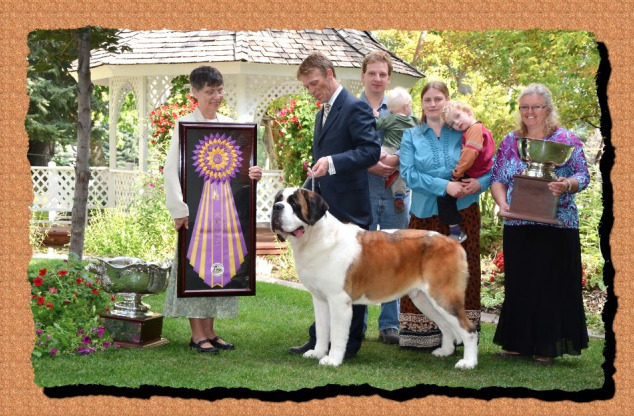
Am GCh Lasquite’s Denver v Lucas going Best of Breed at the 2012 SBCA National. He has 11 BOB wins and a Group 3rd.
Marty Glover – Professional Handler:
Tikki and I usually bring older dogs, 2-5 years old, off the island and show. The outside environment that the island provides gives the saints every thing they need to grow up sound and correct in muscle and conditioning. A Saint Bernard should be athletic and well built. The terrain on the island provides that. I’ve never seen a hocky or out of condition Saint on the island. As a saint puppy grows, the island life of woods, massive rocks and romping through forests are key in developing a big, sturdy working dog. This enables them, as adults, to perform the functions of their breed.
PDT:
Can you compare the Lasquite dogs in development to those of the legendary Bea Knight of Sanctuary Woods fame?
Marty:
Sanctuary woods was before my time in this wonderful breed. I have gone through countless pictures and even some videos of the kennel. Big kennels don’t really exist today. Lasquite and Sanctuary Woods are very similar in the fact of surroundings and breeding from your gene pool. You can look at any Sanctuary Woods pictures and Lasquite and you defiantly recognize “the look.” I often call it free range lol. I think it’s best the dogs all live in harmony and get along. After all, that’s the true temperament of what a Saint Bernard should be .
PDT:
What recommendations would you offer other breeders of giant breeds who aren’t blessed with the unique environment provided by Lasquite Island. Not all of us have an island preserve at our disposal! lol What lessons can we apply in other settings?
Marty:
I strongly urge anyone with Saint puppies, that the outdoor environment is best. Raising a big working dog like a Saint in the house, on slick floors is the worst thing you can do.
I’m a firm believer all puppies and young adults are outside. Also, we need to let our puppies be part of the gang and hang with adults and other puppies. When raised with a group they discover their pecking order and where they fit.
100 – Celebrate Our 100th Episode
Pure Dog Talk’s 100th Episode – Thanks to Our Listeners!
Pure Dog Talk Celebrates 100th Episode! Laura Reeves reminisces and reminds our listeners about summer, dog shows, and celebrations.
Laura Reeves and Mary Albee
It’s been a journey.
Laura Reeves, host of PureDogTalk, on-the-spot reporter, newspaper journalist, PHA Handler and second generation dog breeder.
Mary Albee, producer, Norwegian Elkhound fancier since 1985, has 38 years in film and television as stunt performer, stunt coordinator and 2nd unit director.
Why Pure Dog Talk?
Passion. Love for our breeds. Stupidity?
Why spend hours and hours planning, recording, editing and publishing a podcast or “radio show on demand”?
Giving Back
Pure Dog Talk is our way of giving back. Giving back to our mentors, to the generations of dogs that have touched our lives, passed over the bridge, but remain alive in our hearts.
Preservation
Preservation efforts for the future existence of our breeds, preservation of our mentors history and knowledge, preservation and fight for all dog sports right to exist.
Future of Pure Dog Talk
We don’t know… it’s a journey for us and with you, our listeners.
We watch as dog magazines fail, as PETA and HSUS efforts limit our rights to breed and own dogs, as clubs try to put on shows with only a few aging members…
We listen to the moans and groans of declining entries, poor quality dogs, lack of good dog breeders…
What is Your Choice?
At Pure Dog Talk, our choice is positive, period.
We look to a purebred dog-filled future.
Our goals are to help foster or sponsor positive, educational programs that improve our breeds, breeders, and rights of ownership:
- Preservation Breeding Programs
- Breeder and Exhibitor Education
- Youth and Public Education
- Archives for Breeds and Breeders
THRIVE: Prosper, flourish, bloom, blossom, advance, succeed, boom, to develop vigorously.
Support Pure Dog Talk
If our goals are yours, then we ask for your support.
Financial
Help Us Be Heard
- Share on Facebook to clubs and friends
- Link Pure Dog Talk on your club’s website and yours
- Join our Mailing List
Archives and Articles
- Record or talk to us about recording your club’s breeder mentors
- Talk to us about helping your breed create archives
Technical and Author Support
Our time and skills are limited. If you like we are doing, we could use writers and technical skills. It takes a village…
Our Future Secret is Out… the Breed Shows
By request, some breeds are asking for breed specific episodes.
Pure Dog Talk plans to do better than that…
(oh…there went the rest of my vacation and time off)
The Breed Shows
If your Breed Club would like, Pure Dog Talk will help create a channel (show) just for your breed. The purpose is to archive breed mentors/judges/breeders and provide education for the next generation and the public.
We have two requirements…
- A breed club “host”
- Parent Club support
99 – Soft Coated Wheaten Terriers and Mother Daughter Bonds: Cindy Vogels Part 2
Cindy Vogels: Soft Coated Wheaten Terriers and Mother Daughter Bonds
Cindy Vogels, Part 2, continues with a discussion with Laura Reeves and the mother-daughter dog show bonds.
Mother Daughter
Cindy and her mother, Jackie Gottlieb, traveled, showed, bred and whelped dogs together. Jackie only stopped showing the Soft Coated Wheaten Terriers at the young age of 89.
Nothing strengthens the bond like heading down I-70 for the Montgomery show, only to discover the hours long drive was in the WRONG DIRECTION.
Laura Reeves’ bred Clumber Spaniels with her mother, and the whelping box time and passionate pedigree discussions left lasting memories.
Soft Coated Wheaten Terriers
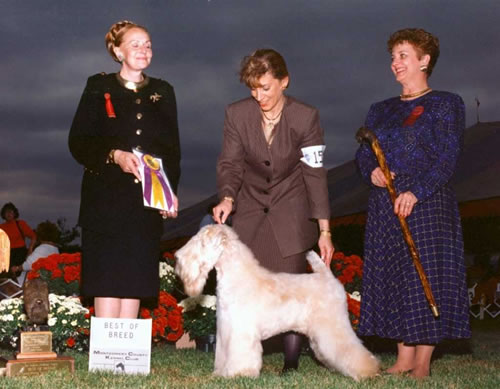
Cindy and Jackies kennel prefix is Andover and Ch. Andover Song and Dance Man won group at the garden and still has unbroken records.
The Soft Coated Wheaten Terrier breeders are a good group of people,, who in 20 years brought the breed forward both to the public and to the breed standard.
One of 3 Irish barn dog breeds on the farm, with the Irish and Kerry Blue Terriers. The Soft Coated is a terrier, tough enough that they had to take a badgers down.
Kidney Disease in the Terriers
Recently, kidney disease with a late onset has decimated the breed. While a test has recently been developed, there is still no DNA or genetic marker(s) for prevention.
Breeders are struggling to import and fight for the Soft Coated Wheaten Terriers diversity against the disease.
98 – Cindy Vogels: Soft Coated Wheaten Terriers, Westminster BIS Judge, Take the Lead and AKC Canine Health Foundation Treasurer
Cindy Vogels: Soft Coated Wheaten Terriers, Westminster BIS Judge, Take the Lead and AKC Canine Health Foundation Treasurer
- Cindy Vogels and her mother, Jackie Gottlieb, have bred over 100 Soft Coated Wheaten Terrier Champions.
- Selected to judge Best in Show at Westminster Kennel Club Dog Show in 2012
- Board Member of Take the Lead
- Founding Member and Treasurer of AKC Canine Health Foundation
- Past President of the Soft Coated Wheaten Terrier Club of America and helped breed from Miscellaneous to AKC Recognition
Are You Impressed Yet?
Listen as Cindy Vogels tells of her journey with her beloved Soft Coated Wheaten Terriers and a special win with one of her veterans.
Listen to the beginnings of Take The Lead started during the time of the AIDS epidemic and the strides to ensure privacy.
Listen to how $40,ooo,000 has been granted in AKC Canine Health Foundation research and how your breed club can participate.
Mrs. Cindy Vogels
Cindy Vogels, of Greenwood Village, Colorado, has bred more than 100 champion Soft Coated Wheaten Terriers, and champion Norfolk, Kerry Blue, and Welsh terriers, and Brittanys. These include Best in Show, specialty Best in Show, and group winners, and top producers, including the top terrier dam of all time.
Mrs. Vogels judges all terriers, all sporting breeds, Junior Showmanship, and Best in Show. Career judging highlights include Soft Coated Wheaten Terrier and Norfolk Terrier national specialties, and the Westminster Kennel Club Show.
Mrs. Vogels is a past president of the Soft Coated Wheaten Terrier Club of America and now serves as the club’s AKC delegate. She is secretary and show chair for the Evergreen Colorado Kennel Club.
One of America’s leading writers on canine subjects, Mrs. Vogels is a winner of the Dog Writers Association of America’s Maxwell Medallion for her akc gazette “Better Breeding” column. She sits on the boards of the AKC Canine Health Foundation and Take the Lead, and feels that “both these organizations are fundamental to the well-being of the sport.”
Mrs. Vogels raises and shows champion Morgan horses. AKC
Article on Cindy Vogels and AKC Canine Health Foundation
Cindy Vogels is the treasurer of AKC Canine Health Foundation. Read More …
97 – First Aid for Dogs: Bloat, Shock, Heatstroke and Snakebite
First Aid for Dogs: Bloat, Shock, Heatstroke, Snakebite
First Aid for Dogs, Part 2 with Dr. Cynthia Heiller, DVM
What conditions require immediate veterinary attention and how to recognize them can be the difference between survival or not.
First Aid for Dogs – Bloat
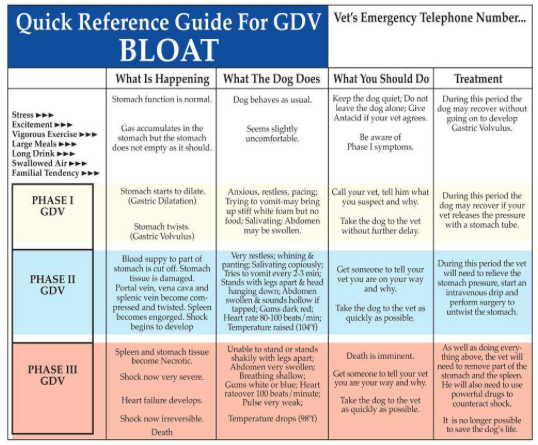
Bloat is extremely time sensitive and requires veterinary care within an hour. If your dog is a deep chested breed, meaning the chest is deeper than it is wide, it could be prone to bloat. Bloat is when the dog’s stomach distends and possibly twists. The twisting cuts off the blood flow to the vena cava which leads to shock and death.
Bloat may occur if the dog overeats, or without warning. Often the dog tries to vomit, but food does not come up. Think of how uncomfortable you feel after a huge Thanksgiving dinner and multiply that 10 times. Bloat is extremely painful and requires surgery.
While not recommended if not a vet, and only if immediate transport to a vet is not available, a needle placed three fingers behind the ribs and inserted into the stomach may temporarily relieve the gas pressure on the vena cava and buy time.
Surgery is the only treatment.
First Aid for Dogs: Internal Bleeding/Shock/Sudden Paleness
Trauma is the common cause for internal bleeding. Splenic tumor bleeds may also occur without warning. Internal bleeding may lead to shock and sudden collapse.
Test the gums for sudden paleness. Apply pressure to the gum and release. The color should refill in 1-2 seconds. If longer, the dog may be in shock or bleeding internally.
First Aid for Dogs: Heatstroke
If the dog is in distress, and it is hot, immediately take the dog’s temperature. Temperature over 105 degrees is heatstroke and critical.
Cool the dog with tepid water, NOT COLD. Use fan or air movement for evaporation cooling. Cool dog to 103 degrees. Cooling to fast or below 103 degrees can lead to other problems.
Short nosed dogs are most at risk for heatstroke.
Dogs that are overweight have fat layers that insulate and prevent cooling. Keep your field dogs in condition.
First Aid for Dogs: Snakebite
Snakebite’s may not be immediately obvious. Puncture wounds can be difficult to locate. Localized swelling is the sign to watch for.
The vet will run a blood clotting test to see if there is venom. Up to 25% of snakebites are dry, but the clotting tests are required to test. Venom amounts and concentrations injected vary.
Antivenom within two hours of the bite is recommended.
Snake vaccine is recommended, but antivenom and vet care is still required.
Do Not’s
Do not apply a tourniquet or X cut the bite.
Do not ice.
Do’s
Give Benadryl
Carry the dog, and keep them calm. No exertion.
And Finally…Foxtails
Foxtails in some regions of the U.S. keep vets in business!
Foxtails can be fatal to your dog and travel inside the body and can be found anywhere – in the lung, against the spine… Foxtails can lodge in vulva or in the sheath when a male dog lifts his leg. Oh, my goodness.
Prevention is Best
Prevention is the best option. Check between dog’s toes, the face, the eyes and ears. If a dog is sneezing or sneezing with blood, a foxtail or foreign matter may be to blame.
For heavy coated breeds, keeping a blower and table handy is an easy way to check quickly for foxtails.
Be sure to listen to First Aid Part 1 – Episode #94.
96 – Divorce, Disease, Disaster, Disability, Delay, Death and Your Dogs: Debra Hamilton Esq. – How to Make a MAAP Plan
Divorce, Disease, Disaster, Disability, Delay, Death and Your Dogs: Debra Hamilton Esq. – How to Make a MAAP Plan
What happens to your dogs in the event of divorce, disease, disaster, disability, delay, or death?
Don’t Assume
Don’t assume that family or friends know what your want, how to care for them, or who should have them. Dogs are personal property. Just because you assume that your breed friends will come to your rescue, reality is that they might not be able or willing to, or be legally able.
MAAP and Debra Hamilton, Esq
MAAP is a 4 step blueprint program from Debra Hamilton, a “legal expert” on animal disputes and an Irish Setter breeder.
4 steps of MAAP
- Make the plan you want to be followed-short term and long term. No ones knows except you what to do.
- Do it so your family doesn’t feel guilty or obligated to care for the dogs, or if that is not what you want.
- Appoint the people to care for your dogs. Co-ownership’s might terminate with your death.
- Publish it – give to friends, family, attorney and vet. Be sure that the MAAP plan is referred to in your living trust.
But I Already Have a Pet Trust
Pet Trusts are invaluable, but attorneys don’t know everything you want with your dogs and Pet Trusts to not cover living instructions.
Want to Learn More?
Listen to Debra Hamilton discuss how to make a MAAP for your dogs.
Debra spent 30 years as a practicing litigator, but she is now a full-time mediator and conflict coach for people in disputes over animals.
She works both nationwide and internationally. She has far-reaching experience in resolving interpersonal conflicts involving animals, and she is also well-known in the world of purebred dogs as a top breeder and exhibitor of Irish setters and long-haired dachshunds.
Debra speaks widely on the topic of how mediation techniques can help people address conflicts without litigation. She has presented at veterinary schools, the American Kennel Club, the American Veterinary Medical Law Association, the Society of Animal Welfare Administrators, the Living With Animals conference, state bar association Animal Law Committee meetings, and animal interest group meetings.
Debra also writes a blog for Hamilton Law and Mediation and is a contributor to the Solo Practice University blog and the Canine Chronicle. She has been featured in Forbes, the Wall Street Journal, US News and World Report, and the New York Times.
As the principal at Hamilton Law and Mediation, PLLC—the nation’s first solo mediation practice dedicated to helping people resolve conflicts over animals—Debra uses alternative dispute resolution to help address disagreements over the family pet during divorce, neighbors’ arguments over a barking dog, and confrontations between clients and veterinarians and other professionals who work with animals. HLM also looks forward to helping animal rights and welfare advocates see the benefit of having a conversation about the best interests of all parties—especially the animals—to resolve animal-related disputes.
Debra is admitted to practice law in all New York State courts. She is certified as a mediator and collaborative professional and has worked with various court-based mediation programs in New York City (Queens-Community Mediation Service) and in Westchester and Rockland Counties in New York (Westchester and Rockland Mediation Centers).
Hamilton Law and Mediation
Prepare for Your Pet’s Care – The Road Map for Long and Short Term Care for the Animals You Love.
Worried What Will Happen to your Pets?
Register for FREE Pet Care Planning Webinar
95 – Generic Dogs and Common Faults: Green Room Conversation with David Frei, Patty Keenan and Shawn Nichols
Generic Dogs and Common Faults – 2 Recordings
Today’s podcast on Generic Dogs was recorded prior to the Saturday Symposium held on Saturday, July 8, in Puyallup, Washington. Patty Keenan and Shawn Nichols are both AKC Judges and David Frei is our beloved “face and voice of the dog world”.
Listen as our guests and Laura Reeves discuss the topic in the green room, and read Shawn Nichols blog on the evening.
David, Patti, Laura and myself met prior to the start of the evening event to have a green room discussion on the topic “Generic Dogs & Common Faults”. Patti spoke up at the beginning and stated her concern that she felt this negative approach was not constructive and would not be her approach and that we should be looking for merit in what we judge and not focus on the negative, we all quickly agreed. When we all went through our history in the sport it was apparent we had all traveled different paths ending up at the same place as judges and passionate about what we do and the sport of purebred dogs. Shawn James Nichols
Pure Dog Talk Saturday Symposium – Recording 2
Below is the video of the Generic Dogs panel discussion. Thanks to BlueDog Northwest for the livestream!
Pure Dog Talk Symposium: Laura Reeves, David Frei, Patty Keenan and Shawn Nichols

94 – First Aid for Dogs – Are you Ready for Field and Show Emergencies: Dr. Cynthia Heiller, DVM – Part 1
First Aid for Dogs – Are you Ready for Field and Show Emergencies: Dr. Cynthia Heiller, DVM – Part 1
First Aid for your dogs… Are you ready?
Dr Cindy Heiller, DVM is an Emergency Vet with Redwood Vet Clinic and has saved more than one dog and horse at field trials.
Breeder of German Wirehaired Pointers, Cindy has dual champions, master hunters, won the National, and served on the Parent Club board.
Are You Ready for Field and Show Emergencies: Step 1
First Aid Books
Unless you treat dogs and people on a daily basis, it is difficult to remember everything. Add the adrenaline of an emergency situation and a first aid book becomes an essential tool.
General First Aid and Canine First Aid
Dogs are mammals too. People get hurt at shows and in the field. A general first aid book applies to both. Add a canine first aid book as well.
Red Cross First Aid and CPR Course – Step 2
Take or refresh your Red Cross First Aid and CPR course. CPR can be performed on people, dogs, birds, cats and more. You might be the only first responder available.
First Aid Kit
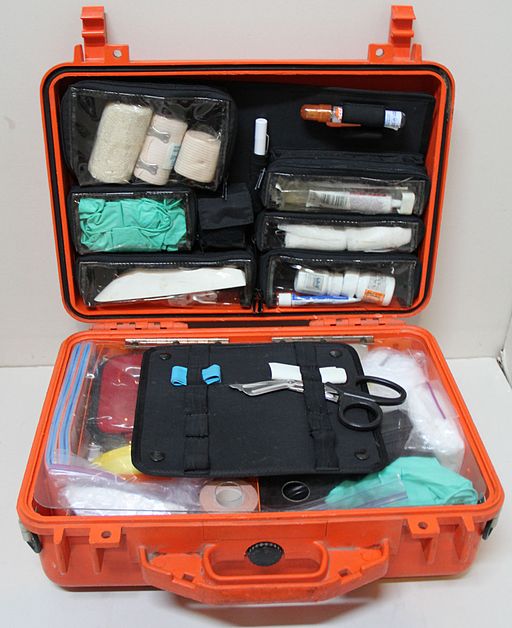
Start with a commercial kit or make your own and pack in a waterproof container.
Add to a Basic Kit
- Thermometer – electronic, don’t use mercury
- Vet Wrap (self adhering bandage)
- Dog Toenail Clippers and Kwik Stop
- Elizabethan Collar
- Skin Stapler – purchase through vet supply and ask your vet for instructions
Medications and Flushes
- Saline or Betadine or Chlorahexadine with flushing syringe
- Eyewash Saline
- Cortisone ointment/spray for bug bites
- Hydrogen Peroxide to induce vomiting – call poison control first
- Benadryl – oral
From Your Vet
- Amoxicillin
- Metronidazole – non-specific diarrhea, be careful of overdose
- Tramadol
Emergencies and Your Trusting Vet Relationship
First Aid Emergencies are… emergencies and not a substitute for veterinary care. The first hour can be critical if not assessed correctly.
As breeders, field and dog agility competitors, we and our dogs are outdoors, on the road, and in remote areas on a consistently basis. It is important to have a good, trusting relationship with your vet.
Take care to develop and not abuse that relationship. If your vet is not willing to help educate you on basic or emergency care, perhaps find someone that you can communicate better with.
https://www.facebook.com/gwpdoc
93 – Versatile Companion Champion Dog – What It Took To Be The First with Andrea Ford
Versatile Companion Champion – VCCH
Andrea (Kyllarova) Ford, newly immigrated from the Czech Republic, acquired a backyard bred Golden Retriever in 2000 as a companion. From those humble beginnings grew the very first AKC Versatile Companion Champion Dog team.
Versatile Companion Champion Jakki
Jakki introduced me to dog sports,” Andrea says. “Golden Retrievers have been my breed since then.” She adds that she’s learned along the way to research breeders to acquire her following three dogs.
I really enjoy training and showing dogs, attending seminars and learning more from different sources,” Andrea adds. “I am a member of the Golden Retriever Club of America, Huntsville Obedience Training Club and the Tracking Association of North Alabama.
Andrea says the key to success in earning the VCCH, a goal she achieved almost by accident, is the intense bond between handler and dog.
What is a VCCH?
VCCH is a title awarded by the American Kennel Club for dogs who have achieved the highest level titles in all of the companion events: obedience, agility and tracking.
Andrea and Jakki attended their very first AKC event together in February 2003. Six years later they made history with AKC’s newest championship title.
It took us three years from Novice A agility to his victory lap Master Agility Champion (MACH) run on February 26, 2006,” Andrea says. “He earned his UD title two weeks after his MACH title. All three UD legs were first placements with one of them at the Golden Retriever National Specialty in a class of more than 30 dogs.
Andrea says, “Our first time in Utility B was two weeks after finishing his UD and he won the class to earn his first 6 OTCH points. On the way to his OTCH, he earned 4 firsts in Utility, 5 firsts in Open, and 3 High Combined wins. In November, 2007, he completed the requirements for UDX and in June 21, 2008 he became an Obedience Trial Champion (OTCH).”
The PhD of Dogs
The AKC says the Obedience Trial Champion (OTCH) title is often referred to as the “PhD” for dogs, and is the highest obedience title a dog can receive. To obtain an OTCH title, a dog and handler team must receive 100 points by placing first, second, third or fourth in the Open B or Utility B classes and a first place in Utility B, and first place in Open B and an additional first place from either class. In 2015, only 88 OTCH titles were earned in the entire country.
The VCD program was introduced in 2001. While hundreds of dogs of all different breeds have been awarded VCD titles, it would be eight years before the first team achieved the impressive Versatile Companion Champion (VCCH) title.
Obedience, Tracking and Agility
According to the AKC, “The Versatile Companion Dog titles are titles that are designed to acknowledge and reward owners of all breeds that compete in Obedience, Agility, and Tracking events. The VCD titles are a way to showcase their tremendous talent in so many areas.”
Listen as Andrea tells the powerful story of the journey on which she and Jakki embarked. You can learn more about the tracking component of the VCCH in Episode 92.
http://www.akc.org/events/vcd-titles/first-vcch/
http://www.akc.org/events/vcd-titles/
http://www.akc.org/events/obedience/what-is-obedience/
92 – Tracking: Testing Your Dog’s Ability to Scent with AKC Judge Wally O’Brien
Tracking – Testing Your Dog’s Ability to Scent with AKC Judge Wally O’Brien
Wally O’Brien is currently a tracking judge for the AKC, judging TD/TDU/TDX/VST (all levels) and also a tracking judge for the Australian Shepherd Club of America at all of the same levels.
Tracking with a Siberian Husky
In the mid to early 80s my wife and I decided we wanted to get a Rottweiler. We were being very selective and knew it might take us as long as a year to get one. In the meantime, I wanted to get involved with dogs more, especially tracking. So I used the dog we had, a 12 year old Siberian Husky. Huskies are not known for their tracking ability and I never did earn any tracking titles with her.
I couldn’t find anyone doing AKC tracking at that time and ended up tracking with a Schutzhund (now IPO) tracking club. After a couple of years I ended up becoming the head of tracking for the group. A couple of years later, as happens with many Schutzhund groups, they broke up. So at that point I started teaching tracking on my own. By that time, I probably had put about half a dozen tracking titles on my Rottweilers.
Teaching Tracking
When I first started teaching, all of my students had Rottweilers. I was maybe 4 years into it, when I got my first non-Rottweilers, a couple of Bloodhounds and a German Shepherd. DOGS WITH TAILS! When it comes to tracking, tailed dogs can have a tremendous advantage. Typically they’ll wag their tail when on the track and stop wagging when off the track.
I had been running Medallion Rottweiler Club’s tracking tests and doing the same for a couple of other clubs. Was there for other clubs, when I could be, as a tracklayer. Because of all of that, I ended up knowing all of the local tracking judges. I then started thinking about becoming a tracking judge. That happened in 1991, or 1992. I became a TDX judge maybe 2 years later. VST and TDU didn’t exist.
Versatile Surface Tracking
Can’t remember the year, but some time in the mid to late 90s, the concept of Versatile Surface Tracking came up. By this time I had developed a reputation as one of the more knowledgeable people in the Chicago area when it came to tracking. I became one of the people who helped get VST off the ground, but also one of the people who helped develop the rules for VST. Ended up as speaker at a couple of the early meetings and helping people train for the concept.
From early on in my tracking judging career, I have been fortunate to be one of the “go to” judges in Chicago. At one time, I was judging maybe 14 assignments (for tracking you are there on both Saturday and Sunday). I don’t have the exact number since the AKC has changed the way they calculate the number of assignments a judge judges, but I know I’ve judged over 300 tests.
As far as students are concerned, my students have earned every AKC and Schutzhund title that is offered. I quit counting the number of students and titles after 300. I know I’m getting old in the sport because I now have students of students of students now teaching tracking.
All-Breed Tracking
Students have had Rottweilers, Bloodhounds, German Shepherds, English Springer Spaniels, Italian Greyhounds (Only TDU IG in the history of the breed), Yorkie (Only TDX Yorkie in the history of the breed), Irish Wolfhound, Siberian Husky, Golden, Border Collie, and a Sheltie.
What is Tracking?
AKC Tracking is a canine sport that demonstrates a dog’s natural ability to recognize and follow a scent, and is the foundation of canine search and rescue work. In tracking the dog is completely in charge, because only he knows how to use his nose to find and follow the track. AKC