

Posts by Laura Reeves
322 – The Winning Edge! Panel Discussion With the Masters

The Winning Edge! Panel Discussion With the Masters
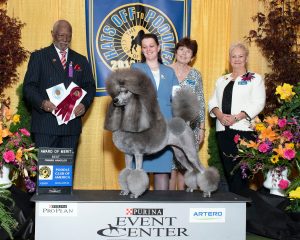
Host Laura Reeves moderates a Friday Night Forum Panel Discussion on the topic of the “Winning Edge” with Judges Rick Gschwender and Pluis Davern and Professional Handler Bill McFadden.
It is not the judge’s job to find a “diamond in the rough,” Reeves posits. “Polish your “gem stone” for your best chance of success.”
Good habits
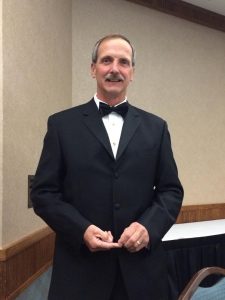 Gschwender starts the discussion by asking the audience about their habits with the dogs they exhibit.
“How many of you train your dog? Road work him? Take video to see what the judge sees? Clean their teeth?” Gschwender queried. “I see people all the time, they’re paying $30 to enter the dog and haven’t even cleaned teeth.”
Gschwender adds, “Watch the judges. If you pay attention, you will see consistency in what they put up. You might not like it, but you will figure out what I like and come back and show that to me.”
Motivated by motion
Davern noted, in a fascinating observation, that people are *predators.* Which means “we are motivated by motion. What are judges looking at?” Davern asked rhetorically. “Motion. It catches the eye. You can *subtly* move your hand to show a pretty head, for example.
“You’re in the ring, you’re all showing the same “product.” There’s 20 boxes of cornflakes. What makes yours better than the others?”
Owner handlers have a huge advantage, Davern said. They are spending time with the dog they love.
“This is a great sport! Nobody takes a golf club to bed at night,” Davern said. “Life is not all about winning.”
Be prepared
“Take a deep breath and don’t rush,” McFadden advises. He also notes that in some cases, owner handlers who are long time breeders are “experts showing to novices.” Judges are life-long learners and may be new to a breed. “Present your breed the way it should be shown.”
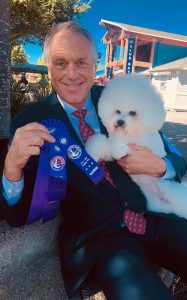 Most importantly, McFadden said, be prepared. “Make sure your dog is in condition, physically, mentally, emotionally.”
“You’ll have successes and failures you deserve and ones you don’t. It happens to handlers too. We show 20 dogs and might win with two,” McFadden added.
For more insight from a couple of these panelists, you can listen back to:
https://puredogtalk.com/10-bill-and-taffe-mcfadden-live-at-akc-nationals-wisdom-wednesday-2/
https://puredogtalk.com/34-sussex-spaniels-hunt-tests-search-and-rescue-pluis-davern-tells-all-2/
https://puredogtalk.com/35-dogs-to-the-rescue-firefighters-first-responders-and-pluis-davern-2/
321 — Tricks Are for Show Dogs! Improve Focus in the Ring

Tricks Are for Show Dogs! Improve Focus in the Ring
Show Dog Prep School founder, Vicki Ronchette, provides tips for training tricks to show dogs to help them focus and have fun.
“Training tricks is fun,” Ronchette said. “People and dogs enjoy it more than they do training traditional exercises. It is relaxing. And it’s a good way for people to improve their mechanical training skills.”
Dogs get bored in the ring, Ronchette noted. Having a repertoire of tricks available helps dogs and exhibitors relax, she said.
Bonus, the dogs and handlers having fun makes a good impression on audience and serve as crowd pleasers. Note the phenomenal success of the “sit up” by the Sussex Spaniel, Bean, at the 2018 Westminster Kennel Club show.
Ronchette shared a few of her favorite “tricks” to teach clients that provide specific benefits to dogs and their performance.
Touch!
Target training is a favorite of Ronchette’s. She trains the dog to touch its nose to her hand.
“It’s so beneficial,” Ronchette said. “It’s easy to teach. And when you have a distracted dog, it gets their attention.”
Sit Pretty
Sit up and beg can be a controversial trick, as some feel it can be harmful to the dog’s back. Other trainers argue it is indispensable core conditioning that strengthens back muscles. Either way, that super cute “begging” for attention is a sure fire winner.
Get on top
Teaching the dog to get up on a big rock, grooming table or other high perch, Ronchette says, is a great confidence builder. “They need to own these behaviors,” she noted.
AKC’s Trick Dog program allows owners to put a fun title on the end of the dog’s name, Ronchette noted, helping them “get their feet wet in something other than conformation.”
To learn more about the origins of the Trick Dog program, take a listen to my interview with AKC’s Doug Ljungren, the program’s biggest advocate.
128|Doug Ljungren is Up to Tricks…Trick Dogs|AKC VP of Sports and Performance|Pure Dog Talk
320 – You ARE What You Eat and So is Your Dog

You ARE What You Eat and So is Your Dog
Dr. Diane Brown, CEO of the AKC Canine Health Foundation, joins us again to talk about fascinating new research on the “gut-brain axis.” In other words, the microscopic bugs inside the dog’s body are being proven to interact with what’s going on in its brain.
From the CHF Newsletter: “The adage “you are what you eat” may be more profound than we ever realized. A growing body of evidence shows a complex system of two-way communication between the gastrointestinal (GI) tract and neurologic system in humans and dogs. The link between GI health and diseases such as multiple sclerosis, autism, and epilepsy has been studied in humans. In fact, patients with celiac disease or inflammatory bowel disease have an increased risk of developing epilepsy. Since the community of microorganisms that live in the digestive tract – known as the gut microbiome – plays an important role in GI health, what impact does it have on neurologic disease? AKC Canine Health Foundation (CHF) funded researchers are exploring the role of this microbiomegut-brain axis in canine epilepsy.”
http://www.akcchf.org/educational-resources/library/articles/AKC-CHF-Discoveries-Summer-2019.pdf
Gut microbiome
“The bacteria that live in the gut have been shown to have importance to both health and disease,” Brown said.
CHF research is determining what type of bugs normally live in the gut (literally any part of the digestive system from top to bottom). Which ones of those bugs are pathogens and which ones prevent disease is an enormous topic.
Many of us understand, for example, that antibiotics completely change the gut microbiome. But this new research is documenting associations with other disorders, including the impact of bacterial content in the gut and how it is influencing epilepsy and anxiety.
Using proprietary probiotics to manage post-antibiotic diarrhea is one thing. But Probiotics used over the course of six weeks are showing an impact on anxiety behaviors in dogs, providing a non-drug-based treatment for this frequent issue in all dogs.
Poop is cool!
Researchers speaking at a recent CHF conference even discussed using fecal transplants, delivered as an enema, to transplant healthy flora fecal material thereby improving the health of the dog.
319 — Cavalettis for Show Dogs with Vicki Ronchette
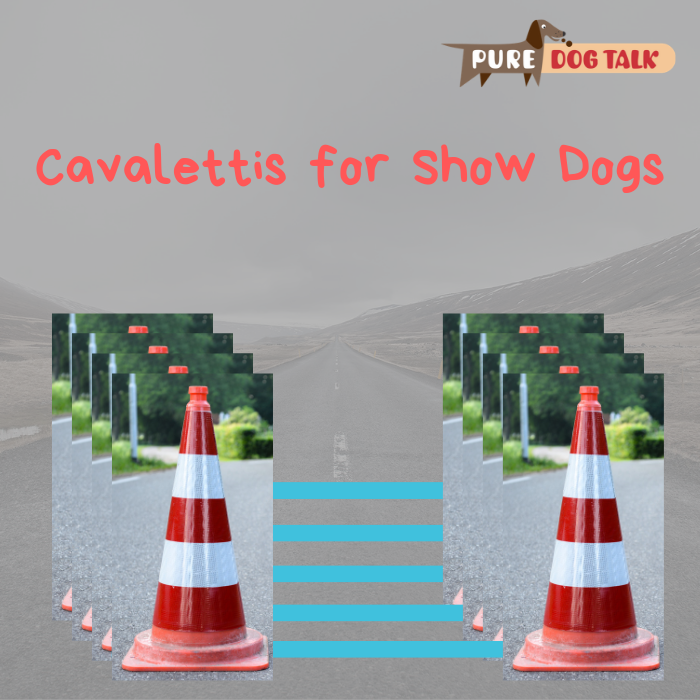
Cavalettis for Show Dogs with Vicki Ronchette
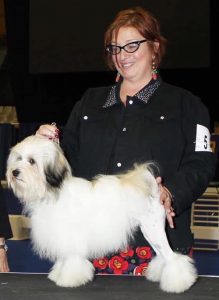
Vicki Ronchette with her Lowchen.
Show Dog Prep School founder Vicki Ronchette shares her tips and tools for using cavalettis to train body awareness, conditioning and more.
Cavalettis, Ronchette said, are useful for a variety of issues. Dogs who pace, forge on the leash, need to know where to put their feet amongst other topics are well served by practicing with caveletti training.
One of the most common uses is to build muscle memory to increase reach and extension, Ronchette said. “Most dogs love doing the cavalettis,” she added.
Using simple, inexpensive materials, Ronchette provides direction for building and utilizing these obstacles in an exhibitor’s “tool kit” of preparing the dogs for the show ring.
How To’s and Why For’s
One of Ronchette’s most frequently asked questions is how far apart to set the poles for proper gaiting. She said she measures from the front toe to the back toe when the dog is in a comfortable stack. That is the “elementary” distance the poles are placed apart. As the dog gains skill and confidence, the poles are moved further apart to make them the dog increase its stride.
“We’re asking these dogs to be athletes in the show ring,” Ronchette said. “It’s more than just walking around. It’s walking around and looking fabulous.”
One specific training opportunity Ronchette uses the obstacles for is to teach not to chase other dogs. “I make them concentrate on foot work instead of chasing,” she observed.
“I strongly believe that if there is any physical limitation the dog is aware of it and it increases anxiety,” Ronchette said. “When you do these type of exercises, the dog ‘owns’ that behavior and it creates confidence. Confidence changes a dog’s carriage.”
Ronchette’s course at Show Dog Prep School.
Canine Conditioning with Dixie Rae Sick.
318 – Owner Handler Secrets: Make a Plan and Be Consistent

Owner Handler Secrets to Success: Make a Plan and Be Consistent
Remy Smith-Lewis, breeder, owner, handler of Portugese Water Dogs, shares the secrets that took him to the top, winning his National Specialty as an owner handler.
Smith-Lewis said he did not come from a “dog” family. He was awestruck by his breed when the San Francisco Giants began using the dogs to retrieve balls that were hit over the fence.
He started as a junior handler, worked for professional handlers Sally George and Bill and Taffe McFadden. He showed his first big winner to multiple Best in Show awards and a national specialty win before turning over the dog’s career to the McFadden team to manage.
“I was at a place in my career that I really needed to decide what to do and focus on it,” said Smith-Lewis, who began his career at Google and now works for a new tech start up in the Bay Area.
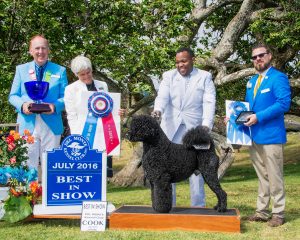
Remy Smith-Lewis handling his Portugese Water Dog to Best in Show at Del Monte Kennel Club under judge Pluis Davern.
His recommendation to owner handlers working a full-time job is, “You CAN do it!” But his secrets are: dedication, making sacrifices, having a plan, keeping on a schedule, and staying consistent.
Condition, Condition, Condition
Whether it is road work, coat work or trimming, competitive dogs MUST be in condition, Smith-Lewis noted. If that means skipping company happy hour in order to spend the extra time brushing, bathing, biking or trimming your dog, that’s what needs to happen.
“Complaining about handlers always winning is the easy way out,” Smith-Lewis said.
Owner handlers need to remember that dogs need routines, Smith-Lewis noted. The dog can’t always be on the couch. And the owner needs to find a mentor and *listen* to the mentor.
Smith-Lewis laughingly recalls a favorite admonition from one of his early mentors, Bill McFadden, “God gave you two ears and one mouth, use them wisely.”
“We need to break away on our own at some point,” Smith-Lewis said. “But a mentor’s job is to guide you back onto a good path when you get too far out of line.”
One final suggestion? “Join an all-breed club and work and learn,” Smith-Lewis said.
Want to hear more from Owner Handlers? Check out these past episodes:
57 – Best in Show: How an Owner-Handler Competes with the Pros – Tricia Stanczyk
25 – Patricia Trotter: Legendary Breeder, Author, and AKC Judge – Vin-Melca’s Norwegian Elkhounds
317 – New Resources for Purebred Dog Enthusiasts

New Resources for Purebred Dog Enthusiasts
Host Laura Reeves visits with two exhibitors, Cara Ryckman and Michelle Conroy, who have each taken huge steps to create resources to benefit purebred dogs and their people. These three 50something women with passion, dedication and a desire to “*do* something, not just complain” encompass close to 120 years of combined experience in purebred dogs.
Both Ryckman and Conroy saw voids in the world of purebred dogs and created ingenious ways to fill them. Spending their own time and resources, they have created a brand new social media ap (Ryckman) and a certification of breeders/rescues for the general public’s use (Conroy).
Cara Ryckman – Social media gone to the dogs
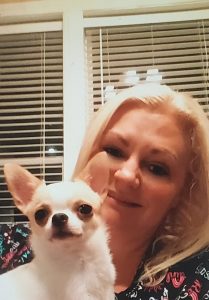
Cara Ryckman with her heart dog, GCH-S CH Hi-C Chanel Pearls and Ice at Terlingua.
“Dogs are our life!
This page and our site brought to you by Cara Ryckman of Terlingua Chihuahuas. I strive to create a friendly, positive, free social experience for people who love purebred dogs!
This site was created as a positive step in uniting the dog fancy and the general public in the hopes of preserving our heritage breeds for the future and bringing awareness to the predictability and dependability of purposefully-bred dogs and the fun of the purebred dog world. All are welcome!”
Michelle Conroy – Applying a lifetime of knowledge to certify breeders
“After more than 30 years working with animals, we have seen a lot and we haven’t always liked what we saw. Bad breeding practices and low-quality rescue operations are gaining ground. Many buyers and adopters hold negative views of breeders, and that’s largely due to a lack of quality control across the industry.
Here’s the truth: There are many quality breeders and fantastic rescues out there.
The problem is that it’s almost impossible for buyers and adopters to identify them. From mountains of misinformation to practically zero credible resources for finding ethical breeders or rescues, the public struggles to figure out what’s what.
We think it’s time for that to stop.”
https://breedercertification.org/
Listen now to hear their stories. Then check out these amazing new resources. Join Laura in her ongoing initiative to build up and showcase other innovative folks in the sport. You, too, can support MORE dog people helping dog people.
Listen to our previous episodes with OTHER great resources.
79 – Valerie Nunes-Atkinson Handling Seminars: Ready to Handle Like a Pro?
60 – National Purebred Dog Day: Susi Szeremy
91 – Dog Show Grooming, Poodle University, Online Handling and Allison Foley
201 – Exhibitor Education Courses Come Online | Pure Dog Talk
316 — Ireland’s “Heritage Status” for Native Dog Breeds
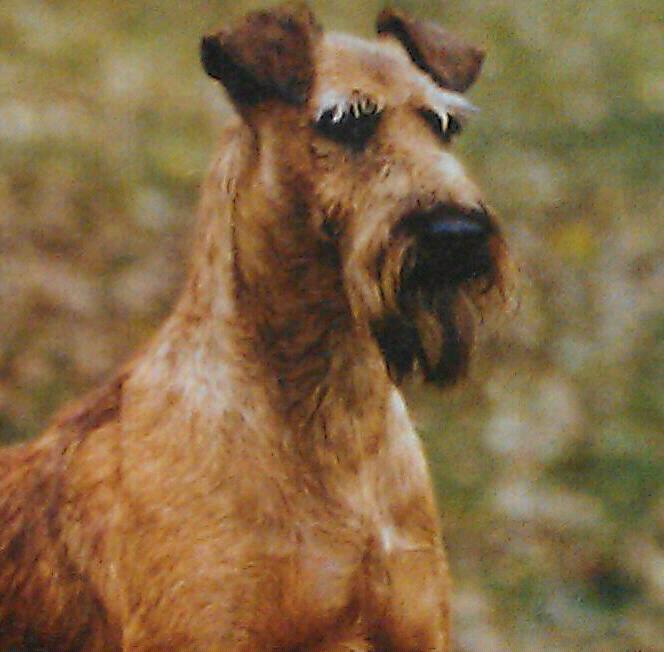
Ireland Designates “Heritage Status” for Native Dog Breeds
Sean Delmar, president of the Irish Kennel Club and Kerry Blue Terrier breeder, has just achieved the holy grail of “heritage status” for the nine native Irish breeds.
Heritage Status
JULY 16, 2019
I am pleased to announce that the 9 Irish Breeds have been granted National Heritage status by the Minister.
This is a wonderful step in the future protection and development of our amazing Irish Breeds and comes after many years of representations by those committed to Irish Breeds.
On behalf of The Irish Kennel Club I would like to specifically acknowledge the commitment of the following who put there heart and soul into making this a reality. Cathy Delmar, Eddie Burke, Vincent Flannelly.
Sean Delmar, President
“I thought there was a chance these breeds could go out of existence,” Delmar said. “I thought the Government should take some responsibility. We wanted to convince them these dog breeds are part of the patchwork quilt of the Irish people.”
This exciting success required a lot of initiatives over 10 years, Delmar noted. The small group of folks involved did demonstrations, paraded dogs at schools, had dogs on “chat shows” on TV.
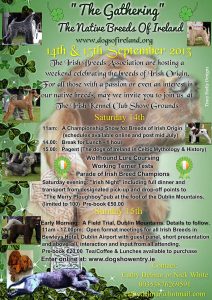 “We built up a portfolio so we had something to show the government, not just an idea,” Delmar said. “We created a heritage weekend revolving around dogs. Even hawking with setters in the midland bogs. People learned a lot about Irish breeds. The general populace is now more aware.”
The Irish Kennel Club was only the national body that made the application. So much enthusiasm and work done was from a handful of devoted fanciers, Delmar said.
“Dogs developed because of working ability originally,” Delmar observed. “Ireland has the Irish Wolfhound and Kerry Beagle, Red setter, Red and white setter and Water spaniel. In the terrier group we have Kerry Blue, Irish, Glen of Imaal, Soft Coated Wheaten.”
Purebred dogs are history and art
Wolfhounds are one of the ancient symbols of Ireland along with the shamrock and harp. Kerry beagle are a hunting pack unique to Ireland. During the potato famine in Ireland, ships carrying refugees to the US, took Kerry beagles with them. Delmar expects these dogs could be found behind coonhounds in the US.
Romantic figures in Irish history hunted on horseback with hawks and setters, using nets before guns were invented.
Delmar’s telling of the rich tapestry of Irish history, includes Grace O’Malley — one of the earliest known female pirates, born around 1530 in Ireland and growing up to lead a 20-ship fleet. Her contribution to the development of the Irish Water Spaniel was the connection to her incursions on the Iberian Peninsula.
“We just undersell everything we do,” Delmar said. “We don’t spend enough time telling people that what you get with pedigree dogs is predictable qualities, predictable characteristics. Don’t get that in crossbreds. Can be great dogs. They might have one or two of the qualities. But it’s a lucky get. Like Forrest Gump’s box of chocolates.”
314 – Dog Shows Through the Eyes of Newbies

Dog Shows Through the Eyes of Newbies
I was honored to visit with four brand “newbies” recently in a panel discussion format. These folks shared truly valuable information about what got them started, what they love and even what they don’t.
Huge thanks to listener Dr. Clifton Jamil Kenon Jr whose idea this was. The announcement on PureDogTalk’s FB page garnered 147 comments from folks who were so excited to share their experiences. I hope to make a continuing series of these types of conversations because the stories I received were so amazing.
Kenon, Kristin Eberly, Neil Trilokekar and Kayla Croteau represent a wide spectrum of the dog fancy. They share their fascinating journeys into the sport of purebred dogs, talk about mentors, what they love and what has been frustrating in each of their individual experiences.
Mentorship
“Meet people where they are,” Kenon advises mentors and would be mentors. “Everyone comes to the table with their own goals. This is a sport that lends itself to diversity.” Kenon’s mentor, Susan Giles, visited with me on the podcast just recently.
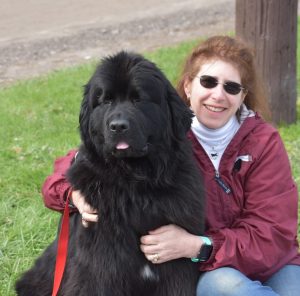
Kristin Eberly
The best help Eberly found is from her handling class instructor, who she says offers “criticism wrapped in something positive.”
Trilokekar said his mentors have encouraged him to study and think critically. “They share their knowledge without expecting me to be obedient,” he noted.
Croteau said her mentor is always open to the silliest of questions and is always positive.
Kayla Croteau
Strongest encouragement
- “Set your own goals,” Kenon said. “Celebrate the wonderful people who help you get there. Ignore the people who want sink everybody’s ship. Don’t go broke doing it. Have fun.”
- “Don’t be afraid to ask for help,” Eberly offered. “Long time people in the breed can be intimidating. Those people will help you if you just ask.”
-
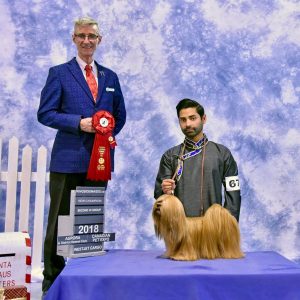
Neil Trilokekar
“Find your fascination,” Trilokekar encouraged. “So many facets you can be engaged by. Learn about history, and heritage of your breed. Go do other things with people when you’re at a dog show. Build a relationship. Never stop learning.”
- “Coming in it was pretty terrifying,” Croteau opined. “Remember we’re all here because we love the dogs. Set small goals. Don’t just come to the show, show and go home. Hang out. Have an open mind and big ears.”
313 — Falconry: Relationship of Human, Dog, Bird of Prey
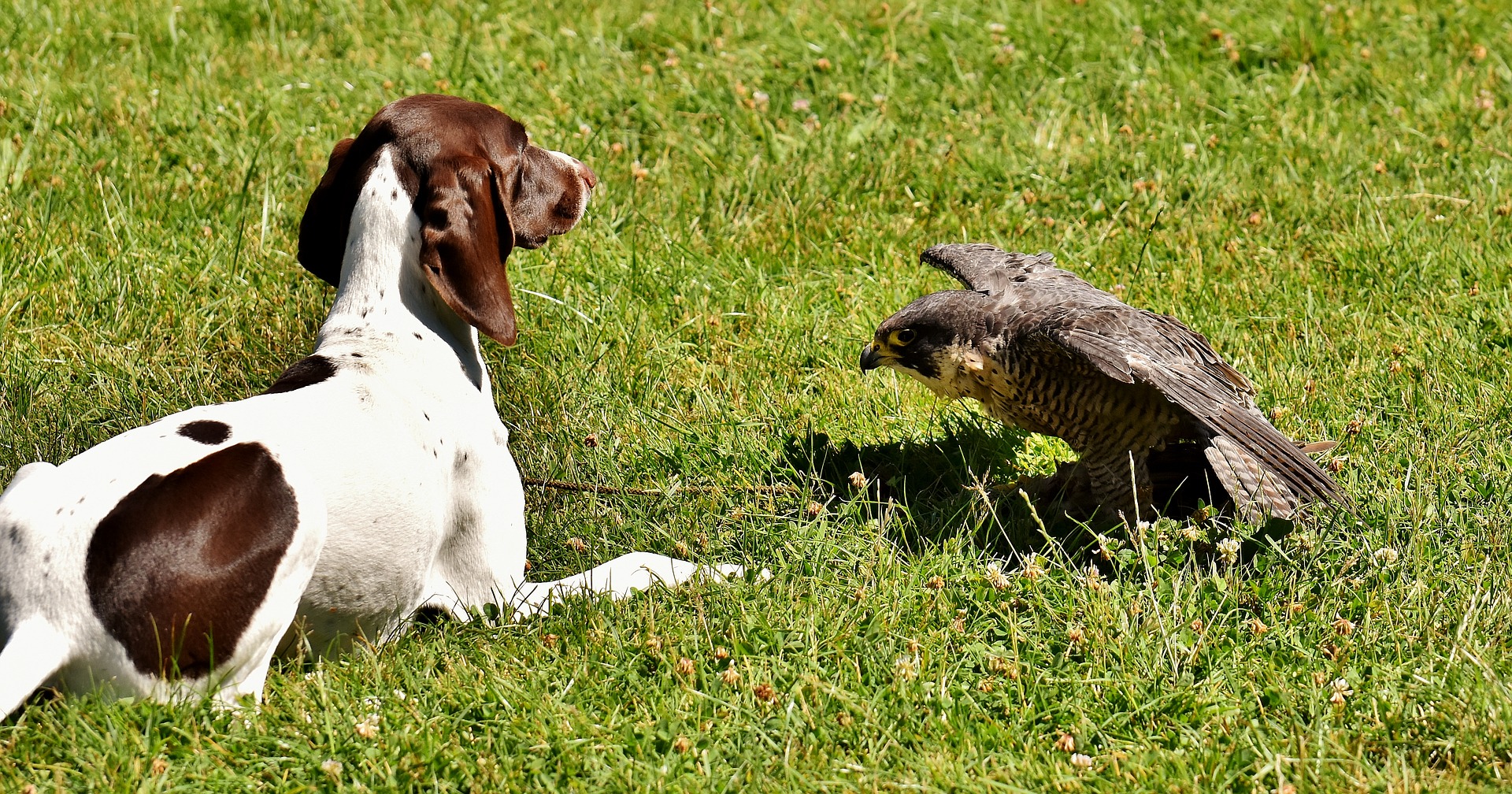
Falconry: Historic Relationship of Human, Dog and Bird of Prey
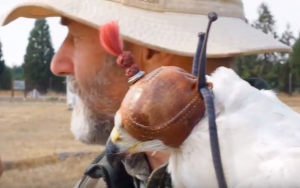
Steve Layman with a Siberian Goshawk.
Steve Layman, raptor expert, shares the fascinating history of falconry and its symbiotic relationship between man, dog and bird of prey.
Natural history
Layman, a zoologist who has worked with raptors and dogs for nearly 60 years, said that the teamwork between bird, handler and dog bridges the mists of time.
“It’s a natural history moment,” said Layman, a noted speaker on the training of raptors. He uses operant conditioning methods to train the birds of prey to return to him. But he said the birds often help train the dogs.
https://www.youtube.com/watch?v=JAcIqqqniYQ
“Records of …taking prey with a trained raptor…. have been found from as early as 2000BC. It is generally accepted that the origins of falconry began in China and Mongolia and then came to Europe later on.
In the records of the Spanish Conquistadors, evidence was found to suggest that the Aztecs used trained hawks and falcons although whether this was for hunting no one knows. Aristotle also mentioned falconry twice between 384 and 322 BC. Falconry UK and the rest of Europe began in around 400 AD and quickly became extremely popular.
At the time, falconry was less of a sport and more of a necessity than it is nowadays. The art of falconry was taken very seriously as birds of prey were one of the most sophisticated and highly sought after means of hunting for food.
The techniques of falconry have stayed the same since the very early years. Medieval Falconry was much the same in practice as it is now and if you look at the picture from the 1240s you may well see that the perches, leashes, swivels and jesses are almost identical to the ones we use today.”
More information:
312 — Susan Giles on the Lhasa Apso, Grooming and Breeding
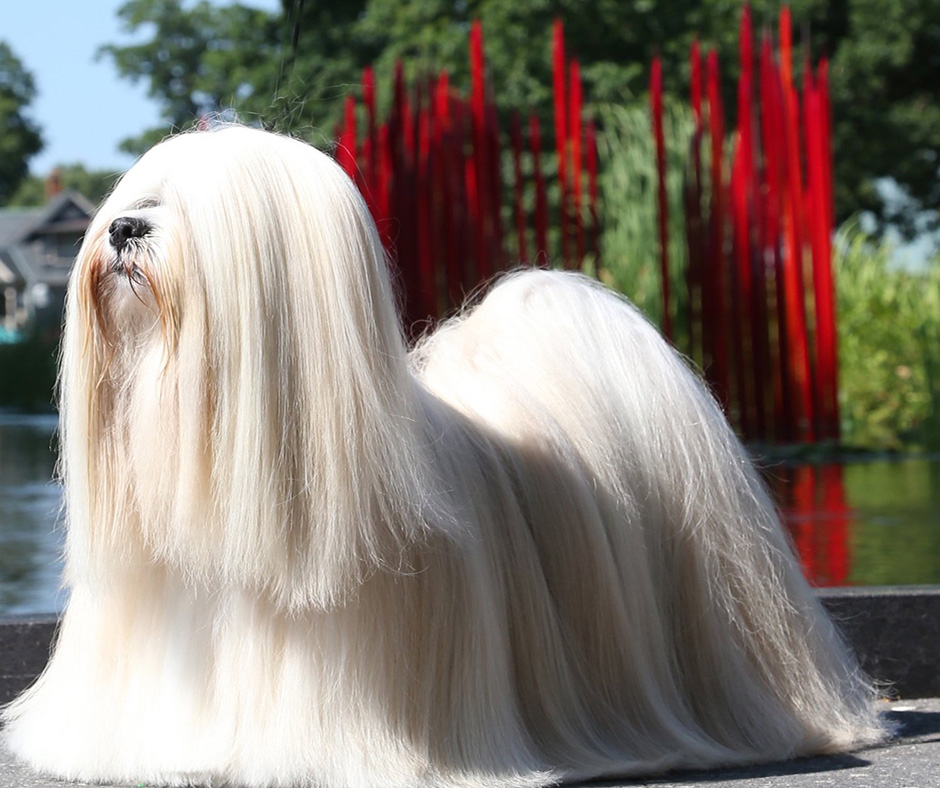
Susan Giles on the Lhasa Apso, Grooming Secrets, and Breeding
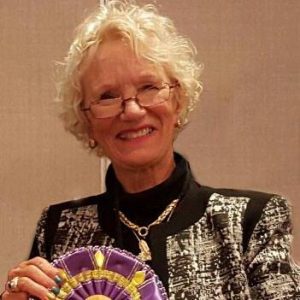 Susan Giles, Lhasa Apso breeder for 45 years, shares her grooming and breeding secrets, as well as the history of this ancient breed.
The Lhasa Apso is thought to have been the alert dogs in Tibetan monasteries, where they would bark to alert their larger brethren, the Tibetan Mastiff.
“These dogs are extremely intelligent,” Giles said. “They’ll make you think they don’t know anything. They are aloof with strangers. An independent breed, they’re not sitting on you or demanding.”
Hair, not fur
Apsos have hair, not fur, Giles noted, so owners don’t have hair shedding or dander. Dogs kept in coats require maintenance, but she says brushing the coat is calming.
“The important part is to stay on top of it,” Giles said. “They need to be brushed a couple of times a week and, bathed each week. The texture and hardness of the coat depend on how much brushing you’ll do. Clean coats are easy. Dirty coats mat.”
The Lhasa Apso temperament, although aloof, can be sweet, Giles observed.
“It’s all a matter of breeding,” Giles said. “A sharp temperament will take over in a pet home with growling and biting, if it’s sweet, it takes over by being cute.”
A proper Lhasa Apso expression is like “looking into the eyes of a very old soul,” Giles said.