

Posts by Laura Reeves
301 — Ring Stewards: The Unsung Heroes of the Dog Show
Ring Stewards: The Unsung Heroes of the Dog Show
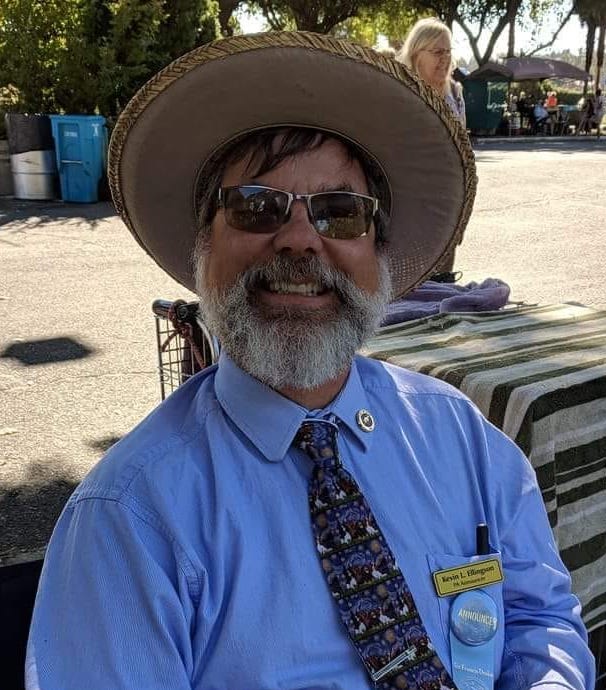
Kevin Ellingson, member of the Professional Stewards Association of Northern California, started ring stewarding in 2006 as a way to learn more about the sport while his wife was showing Cavalier King Charles Spaniels .
Ellingson said a couple of the most important things he learned when he started stewarding were to “respect the judge’s time and that judges are people too.”
“Ring stewards are ambassadors to the dog show world,” Ellingson said. “For new exhibitors, stewards may well be their first contact with the sport.”
From the PSANC website:
“A good dog show steward makes the work of judging a dog show easier by relieving the judge of unnecessary details. By assembling classes promptly, one will be able to keep the judging on schedule and eliminate, to a large extent, delays between classes.
Main Professional Steward duties:
- Hand out armbands and mark absentees
- Confirm with the judge the procedures that s/he wish to see carried out
- Assemble classes promptly and check to see that those entering the ring are wearing the correct armband
- Keep an eye on the clock to make sure the judge is on time
- Keep an accurately marked catalog noting placements, absentees and disqualifications
- Prepare ribbon and trophy awards for each class
- Keep the ring neat and clean, watching to make sure everything is running smoothly
- Assist exhibitors (new, experienced, or professional) to make them comfortable and at ease; treat all exhibitors professionally and with courtesy and respect (be cautious to not be too familiar with exhibitors to ensure professionalism)
- Contact show photographer, superintendent, or AKC Representative as needed
- In general, it is your duty to make the experience efficient and pleasurable for everyone.”
Learn more about this critical role at the dog shows. Ellingson provides a rundown of all the jobs the steward handles and why exhibitors should always be nice to the ring steward.
300 — Episode 300!! Favors, Table Training and Hot Dogs

Episode 300!! Favors, Table Training and Hot Dogs
Holy hot dogs batman… Episode 300?! How did THAT happen? Time flies when you’re having fun!
Honestly, a year ago, I wasn’t at all sure I’d make it this far. I’d just taken on sole ownership and management of PureDogTalk. I was running the show out of my own VERY shallow pocket and, frankly, scared to death… The fact that I decided to retire from a 25 year long professional handling career, start a year-long ENORMOUS home remodeling project AND take this on full time, pretty much all in the same month, speaks to either my courage or my sanity, depending on your perspective! Lol
Patrons
Hindsight being what it is, I probably *could* have managed this all a bit more smoothly, but, the gods are kind to crazy people … today the Patrons Support is growing steadily – a HUGE shoutout to those of you who supported the show early and faithfully… YOU literally are the reason there is a podcast today… I’d love to have even more folks join our outstanding community of PureDogTalk Patrons. For as little as $5/month, you, too, can be counted as supporters of GREAT content and education for the entire purebred dog fancy. These funds are earmarked exclusively for operating expenses. Website upgrades and more are on the list when that pot of gold grows just a little bit more… Just Click the “Be my patron on Podbean” button on the homepage at www.puredogtalk.com
Meanwhile, we have another VERY exciting and VERY cool partnership to announce in the VERY near future… Yep, this is a tease… Watch this space…
So, with all that business out of the way, here’s a thing…. I LOVE doing this job. It not only combines my passions – dogs, talking dogs and helping people – but *I* literally learn something every single day.
Metaphor
And, what’s our teaching moment for today? This podcast is a perfect metaphor for your life in dogs! How you say? Try this out.
- Follow your passion.
- Take chances, even when they are SUPER scary.
- Seek and find the positive in every. Single. Day. Even when you have to dig for it. Maybe even especially when you have to dig for it.
- Nothing worthwhile is handed to you.
- Nothing is “deserved”… everything is “earned.”
- Competition, even from the REALLY big guns, makes you better, sharper and tougher.
- Doing well and doing good are NOT incompatible.
- Helping others does as much or more for you as for them.
- Kindness is free. Sprinkle that shit everywhere.
- As soon as you say, I can’t do this stuff, stop and think about it. I did. And I had some pretty significant obstacles along the way. Literally, if I can do it, you can do it.
Back in the day, before I had a twice weekly podcast, I had a weekly magazine column called As the Wheels Turn… Here’s a little Throwback Thursday to celebrate moving forward.
Peace, Love and a Favor for a Friend
“When I first started, I was amazed by the ‘trading favors’ system,” said a young handler friend recently. Her comment sort of startled me, and got me thinking about this unique and worthy tradition in the sport. “I mean, wait, what? You show my dog and I get paid? What’s that about? What other job is that a thing? I mean I can’t just go sing somebody else’s concert.”
This is not a secret, by any means, in the tribe of professional handlers, but it is a quiet reality. We all help each other. It’s part of our unwritten code of ethics. Conflicts frequently require covering and an assistant is not always available or the right person for the job.
Enter the world of handlers and their network of friends and acquaintances trusted to help show the dogs on their string. The “hat in hand” look when somebody shows up at your setup at [7:15]… “What do YOU have at 8 (or [9:15] or [10:30])?” Or the frantic arm wave from a ring that’s running long as you stroll by, “Can you go take that dog in? I’ll try to make it.” And if you are able, you do it, gladly, so that when YOU have a giant cluster the next day, or the next week or the next month, you have favors “in the bank” so to speak.
Additional unwritten rules:
- Don’t hand off a problem dog. I once, as a young handler, had somebody hand me a very spooky Dalmation and say, “Here, go show this.” I did, the dog freaked on the exam and was excused. This makes me look bad and is not the way to “win friends and influence people.”
- Give fair value. If you need help, be sure to offer help to others. What goes around really does come back around — either good or bad!
- Don’t hustle your friends’ clients! And, on the flip side, be aware that if you hand their dogs off too often, your clients may go looking for a new handler…
- For the clients, try to be fair and reasonable with your handler. You have hired them to do the best for your dog. Trust their knowledge and experience and let them do their job. As much as most of us have longed to be cloned, it hasn’t happened yet and we can only be in one place at a time.
Handling Tips FAQ — Table Training
Summer Solstice has arrived. Long hours of daylight and bored kids. Dog shows around every corner in every state and nation. Time to tune up Fido, load the wagon and head for a fairgrounds near you.
One thing we haven’t gotten to is working with table dogs. This also applies to teaching puppies of larger breeds the fundamentals of stacking.
Funny story
Growing up, my family never invested in a grooming table. I groomed dogs on the ground. I taught puppies and dogs to stack — on the ground. I spent a LOT of time on my knees. I bought my very first grooming table when I started showing dogs for other people. I showed large and giant breeds. The first time I *ever* put a dog on a table to be examined was while helping Don Rodgers (may he Rest in Peace) and Pat with a gazillion Shih Tzu at one of the Idaho summer shows. It was nearly a quarter century ago this week and emblazoned in my psyche for life. I’d been assigned a black dog (already an uphill battle as I’ve come to learn) and we were showing to Joe Tacker. The wind was blowing (as it always does in idaho) and I thought I’d be SO smart and face the dog into the wind…. Which, PS, was backwards. Mr. Tacker approached the table. Looked at the dog. Looked at me. And said, “I bet you didn’t think I knew which end was which!” To which I responded in absolute mortification, “I knew they paid you the big bucks for a reason!” while rapidly spinning the dog around to face the proper direction. Oh. Dear. God. I’m pretty sure I still have the scars from the daggers Don was staring into my back. I did manage to get RWD, but my humiliation was complete. It took MANY years before I next attempted a table breed…
The last dozen years or so, I’ve had lots of opportunities to improve my skills. I have found two methods which both work well for me, depending on the personality and temperament of the dog I’m training.
Can’t Touch This
The first works really well for those independent, all-about-me, “I got this” little dogs who prefer the DIY method. Using the same technique described in the free stacking article below, put the dog at the back of the table and let them “walk up” into the stack.
This has the decided advantage of looking very impressive. It requires lots of confidence from both you and the dog. At best all you’ll have to do is fix a foot… The disadvantage is, without lots of practice, the dog may not be properly positioned in a timely manner and you’re left juggling with stacking while the judge watches.
If using this method, be sure to watch the judge’s preferred table procedure in advance. Everyone does it just a little different. *Generally* the dog is placed on the table as the dog before is moving in its individual pattern.
Scary Larry
This works well for the less confident dogs, the naughty rambunctious dogs and everything in between. Pick up the dog in a comfortable position, make sure the leash is properly out of the way around your neck (I STILL have an unfortunate habit of putting it the wrong way…), check that the table is steady, then quietly set the dog down. Lift gently under the chin and between the back legs to place squarely and towards the front of the table where the judge can easily reach him. Use the 1-2-3-4-5 method described in the basic stacking tips article to properly set the feet and present the dog.
Cookie Monster
I avoid feeding dogs bait on the table whenever possible. Just as feeding a dog on the ground before the exam, it sets a bad precedent for the dog to look for food from the hand coming toward him. For those dogs who are particularly food motivated, grab first and ask questions later can have unpleasant consequences when it’s the judge’s hand that’s “grabbed.”
Shazam
Table presentation, just like its equal on the ground, varies greatly between handlers and their charges. From standing in front at the end of a long lead, to standing beside and showcasing the head. Practice, try new things and then practice some more before using your technique in the ring.
Hot Dogs, Hot Shows and Hot Travel
I am a fanatic about servicing my dog vehicles — regular oil changes and maintenance — the slightest weird clunk and I’m running for the mechanic. Vehicle trouble with dogs on board is a major liability that I avoid like the plague. Over the years I’ve dealt with the occasional blown tire, dead batteries and the usual wear and tear items. Nonetheless, due to a rigid service schedule and a platoon of guardian angels, it is normally a minor headache rather than a huge crisis. I suppose I was overdue for a major fail, just by the law of averages. And it finally happened — three hours from anyone I knew who could rescue the dogs and I on a day that saw temperatures soar over 100 degrees.
When your vehicle is dead beside the freeway, you have to draw on preparation, roadside assistance and, frankly, all the good juju you can muster. My sprinter van was equipped with heavy duty insulation, a roof mounted AC unit, a roof fan and vent. Even with very proactive and insistent advocacy on my part, the dogs and I still sat for two hours with all the doors and windows open staying as cool as possible while awaiting a tow truck.
A faulty wire on an alternator installed two years ago was the eventual diagnosis. Lesson learned? Even if you’re SURE there could not possibly be anything wrong with the vehicle that was just serviced at the dealership a couple months ago, err on the side of caution. Better safe than sorry is a truism because, actually, it’s *true*!
Our amazing tribe of dog people came through with a dozen offers of help, even for driving three hours each way if needed, and eventually a place to crash for the night and get the dogs out.
This all goes to remind us that NONE of us is immune to the inherent dangers and risks of long hours on the road. No matter how diligent, how young and virile, how shielded by angels, every single time we take our dogs to the next venue, we need to be aware and prepared.
As we all gear up for the hot summer months, long hauls from Point A to Point B, little sleep, exhausting days and unending nights on the road, here are some important reminders:
Water: Never leave home without it. A gallon per dog is what I try to plan on when driving.
Shade: Whatever your preferred shade cloth, make sure it’s easily accessible in an emergency.
Air Flow: We and our dogs can all survive high temperatures (perhaps not in perfect comfort, but without serious concerns about life and death) as long we have sufficient air flow. Crate fans, roof fans, vents, windows, whatever it takes to keep the air moving.
Crates: Are our friends!!! My mother was nearly killed in a horrific car accident 25 years ago. The four puppies with her were safe and unharmed, largely due to traveling in dog crates.
Calm: A quiet dog who isn’t stressed by the situation will handle the heat far better. And remember, our dogs take their lead from us. If we are hysterical, the dogs will feel the stress and suffer more.
NEVER: Trust a generator or even electrical outlets to run AC. If it is hot, I simply do not leave my dogs. Far, far too many horrible scenes of devastation over the years could have been prevented with this one simple precaution. The lesson was drilled in to me the hard way many years ago, when my RV generator quit during a high elevation show in Colorado while I was at the group ring. The dogs were ok, but it could just as easily have gone the other way if I had dawdled on the way back, stopped to chit chat or socialize. Today’s temperature monitoring devices which call your phone with alerts are invaluable for short trips away), but nothing beats the peace of mind of simply having the rig supervised at all times.
Let’s keep ourselves and our doggies cool, hydrated and safe. Plan a water fight on the grounds, dress sensibly, and always remember — no ribbon is ever more important than your dog’s safety.
299 – Final Thoughts from the Legends: Juniors, New Judges
Final Thoughts from the Legends: Juniors, New Judges
The final installation from the Pure Dog Talk Friday Night Forum at Del Monte Kennel Club in 2017 with Pat Trotter, Dorothy Macdonald and Kim Meredith.
Judge following and “fly-ins”
Dorothy – won’t put dog down if they followed. If I liked him best, will go up every time. Don’t put up just because he’s there. Don’t keep track of it. Dog didn’t write the ticket.
Kim – if an exhibitor brings consistently the best dog, will put up.
Pat — Judge on the day. Only thing you’re thinking about. Who remembers where you were last week.
Juniors judging
Kim – very favorite thing to judge. Look for juniors to be like what I see in the ring. Not a lot of grandstanding. Smooth, confident. Don’t like it when they fake smile at me. Hands of gold.
Dorothy – I’m here for dogs. Decided not to judge them. I want the dogs. It’s the only thing I’m there for.
Pat – What I look for. Young person with a dance partner, in sync with each other. Right athletic ability for dog they’re showing. Judge on how they move a dog. If the breed calls for a loose lead, I want it to be shown appropriately for the breed. Want the child to be tuned in to dog. Move front from elbow, hind quarters from hock. Want in condition. No Dandruff, dirty teeth, ungroomed, fat. Show your dog, only look at judge enough to know what’s going on. Look at your dog. Dress appropriately. Age appropriate. Want to improve handling – go watch juniors.
Talking to dogs in the ring
Kim — Whatever it takes your dog to do its best
Dorothy – so long as it doesn’t disturb the other dog
Pat – like to see people talk to their dogs. Dogs hear well. Don’t have to talk loud. Believe in communicating with dogs. It’s a relationship.
Provisional judging & soliciting assignments
Kim – old school. Never solicit. For our cluster, I rarely get solicitation. Depends on how you approach. Face to face makes a difference. In this day and age, judges need permit assignments. If judges are willing to fly in and judge for 3-4 $/dog. What’s your reputation? Are you respected in your breed? Can you run on time?
Dorothy – in talking to other judges, never asked anyone myself, others asked for me. Help each other.
Pat – Bottom line, it’s not just what you do after you get the badge, what you did before that. There are people promoting themselves to do judging far beyond their experience. Entitled to use acquaintances and friends. Need to get past fear of rejection. People who aren’t prepared to judge breeds they’re judging are also allowed to solicit. Sad state for the sport.
Listen to parts 1 and 2 of this fabulous series here: 296 – Pat Trotter, Dorothy Macdonald and Kim Meredith Speak at Forum | Pure Dog Talk and here: 298 – Legends part 2: What NOT to do, Too Many Dog Shows | Pure Dog Talk … Listen to Pat Trotter on Norwegian Elkhounds and Breeding here: 25 – Pat Trotter: Vin-Melca Norwegian Elkhounds and Master Breeder … Listen to Kim Meredith on the development of Woofstock here: 47 – Yellow Submarine, Rock and Roll, Peace Out and Woofstock: Kim Meredith
298 – Legends part 2: What NOT to do, Too Many Dog Shows

Legends part 2: What NOT to do, Too Many Dog Shows and More
Today’s episode is a continuation of the conversation at the Pure Dog Talk Friday Night Forum at Del Monte Kennel Club in July 2017. Our panel includes Pat Trotter, Dorothy Macdonald and Kimberly Meredith. The conversation continues with questions from social media via live stream and the live audience.
Topics covered include:
- Thoughts on realignment/expansion of groups – realignment to FCI
Kim – hope it never passes – 10 groups in a big cluster would be very difficult – time and costs would be prohibitive
Dorothy – no need to follow fci
- Uncropped dogs in cropped breeds
Kim – doesn’t affect me – don’t pull ears up on uncropped Great Danes.
Dorothy – don’t mind which way they go, just judge them as they are, would prefer no cropping, but have never faulted in judging
Pat – defer to breeder judge – Vince Mulligan
- Decline in entry numbers, too many shows in one weekend… ideas to rein in # of shows &/or bring in more participants
Kim – horse is out of the barn. 200 miles is nothing. AKC approved Too many shows, too close together. It’s a dilemma. Now what do you do? Damage has been done. Show in Chile… FCI subsidizes. AKC approved all the shows… should they supplement these clubs?
Dorothy – the barn door got left open, has evolved… akc will have to rescind licensing. Only solution. They made the mistake, they should bear the solution.
Pat – I think the most innovative person I’ve seen is Kim… what she’s done w/ Woofstock …. Requires more than 2 shows to get the entry up.
- Is the dog that wins BIS the best dog in the show
Kim – whoever’s judging BIS thinks it is
Dorothy – put up the one they thought was best, others might not agree, there are as many opinions as people watching. There are no redos….
Pat – more than one bis when the dog I thought would beat me, didn’t get there.
- Faux pas for exhibitors/what not to do
Kim – very little that irritates me. Except being late. Be there, be prepared, certain breeds are notorious… even if I don’t enjoy them, I enjoy their dogs
Dorothy – excessive roughness from the handler. Pay attention. Keep dog in the shade
Pat – abuse of bait vs use of bait … trying to look at dog’s mouth, shoving bait in its mouth…. Throwing bait… start handling dogs when it stops handling itself… grandstanding… I want to see the dog, not the handler… tendency for handlers to overstretch the dogs… let the judge & steward know if you have multiple dogs & have to change.
297 – Standards: Reading, Interpreting and Understanding the Blueprint

Standards: Reading, Interpreting and Understanding the Blueprint
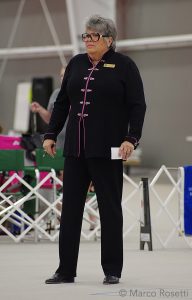 Nannette Newbury, judges education coordinator for United States Australian Shepherd Association, breaks down breed standards.
Newbury’s presentation will help you understand: What are the parts of the standard, what’s a good and bad breed standard, what’s open to interpretation and what isn’t.
Breeders use the standard one way, judges have to use it another way, Newbury noted.
“That judge had to weigh a lot more than soundness,” Newbury said. “What good is it if a dog looks like a coyote and it’s sound. Judges can only go by what’s in the breed standard.”
How to apply the breed standard
Understanding the essence of the breed has to be a priority for judge or breeder, Newbury observed.
When dog shows began, folks had to come up with a way to compare and contrast dogs. The breed standard has to distinguish one breed from another.
“Our breeds came first and then we wrote standards,” Newbury said. “In order to read, interpret and apply a breed standard, you have to have a knowledge of canine anatomy, physiology, structure. It takes time to learn.”
Flaws, faults, implied faults
The breed standard is not a list of negative aspects, Newbury opined, rather it describes ideal.
Hallmarks of a breed are what make it distinct from all others and should be part of a good breed standard.
“If all dogs were perfect, judging would be easy. In the real world, deciding which quality or fault is more or less important and awarding accordingly is the quintessential job of the judge,” Newbury said. “As breeders, you pick your poison. Markings or fronts or whatever, you pick your poison. Judges do the same thing.”
Anything that deviates from the standard is a fault, Newbury noted, while the degree of deviation determines the severity of the fault.
“Go through (your breed) standard and list virtues and ideals. If the virtue affects the original function of the dog, consider those more important,” Newbury said.
“Anybody can find a fault. The hardest thing to do when evaluating a dog is to look at a dog, even one that is of poor quality, and find something good to say about it. It is a gift to be able to find the virtues in a dog.”
There’s always more to learn! Check out the archive!
296 – Pat Trotter, Dorothy Macdonald and Kim Meredith Speak at Forum

Pat Trotter, Dorothy Macdonald and Kim Meredith Speak at Forum
Today’s episode is part one of a Pure Dog Talk Friday Night Forum at Del Monte Kennel Club in 2017. The panel features Pat Trotter, Dorothy Macdonald and Kim Meredith addressing the topic of the “Judge-Exhibitor Relationship.” Learn about the background and priorities of these legends in the sport.
This Forum was originally available as a livestream video. We’re now bringing everyone all of the information in a three-part series on the podcast.
Topics in this section of the forum include background of the judges, what the judges want to see in the ring, how to ask judges about a dog, the judges’ opinions of the National Owner Handled Series and withholding ribbons.
Learn From the Source
In a current moment that features social media commentary pages on which exhibitors “report” on the judges, often with great vitriol, the value of hearing directly from the judges and what matters to them cannot be overstated.
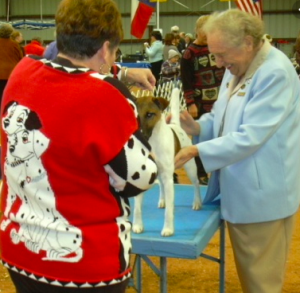 A highlight of the conversation is Dorothy Macdonald’s description of coming to the US with her family in 1941 and bringing the dogs they could with them, including a Kerry Blue Terrier rescued from Dunkirk.
Macdonald is noted as one of a handful of judges who judge both conformation and field trials.
“I judged field trials as many years as dog shows,” Macdonald said. “I put up the first English setter running in the field that was a show champion.”
“As long as you’re more interested in the dogs than the people, there will never be a split (between exhibitors and judges),” Macdonald said. “I want an exhibitor to be happy in the ring. I’m interested in the dog, not the exhibitor’s ability. Just need them to control the dog. It’s the dog I want to see.”
“We all had a first time in the ring,” Trotter said. “I do want them to have a dog that’s somewhat prepared for the event. I want to have a dog we can go through the process … see the bite, see the dog move.”
“I’m always happy to talk about the dogs I’ve judged,” Meredith said. “Attitude and how the question is approached are everything.”
295 — Dogs Just Want to Have Fun: Increasing Focus in Performance

Dogs Just Want to Have Fun: Increasing Focus in Performance Dogs
Dr. Paige Pierce, veterinary behaviorist, speaks to the topic of increasing focus in overly social dogs during performance events. This presentation was sponsored by the Clumber Spaniel Health Foundation at the 2018 Clumber Spaniel Club of America National Specialty.
Owners and exhibitors of the social butterflies in the dog world, understand the frustration of competing in performance events with a dog who wants to visit with the course setter or bird planter instead of continuing their task.
Dr. Pierce provides outstanding insight in to understanding the dog’s mindset in these situations.
“When the dog is overly excited, he literally can’t hear the command,” Pierce said.
Once she rules out a medical condition, she wants to identify a trigger and then use the environment to *benefit* the dog instead of distracting them.
Managing the dog’s environment so it doesn’t “use up” impulse control or so it is well conditioned to the chaos, depends on the dog. This requires the owner to find the “best level of arousal for that individual for that sport.”
PAIGE PIERCE, MS, DVM
Dr. Pierce graduated with a BS in Zoology from Michigan State University, and moved to College Station, TX, to pursue graduate work in animal behavior and genetics. Upon completing her Master’s degree, she moved to Oregon – not because she had a job lined up, but because she knew this was where she wanted to live. She worked for Oregon Fish and Wildlife for a few years, met her future husband there, and then made a slight shift in career path. She attended OSU’s School of Veterinary Medicine, and has been providing medical care for dogs and cats in Portland since 1997.
In general practice, she’s found that her ongoing fascination with animal cognition, communication and emotional health allows her to help clients with pets who have anxieties and/or concerning behaviors. Her particular areas of interest are reducing the stress and fear that so many dogs and cats experience with vet visits, and trouble-shooting issues that crop up for performance dogs. Dr. Pierce joined the Animal Behavior Clinic as a part-time clinician in 2017.
294 – Veterinary Voice: Brachycephalic Breeds’ Health and Legislation
Veterinary Voice: Brachycephalic Breeds’ Health and Legislation
Dr. Marty Greer visits with host Laura Reeves about the health and recent international legislation impacting Brachycephalic breeds.
Pugs In Holland
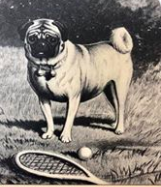
Pug circa 1879. Our thanks to PureDogTalk listener Kelly Schur for making these images available.
Recently the Dutch Pug Club announced, with immediate effect, that the breeding of any pug with a nose less than a third of the length of the skull has been banned.
The following information regarding the breeding of Brachycephalic dogs in Holland is gleaned from several Dutch websites using Google translate:
It has been against the law in Holland since 2014 to breed flat-faced dogs but the government has recently announced they will now be checking dogs, which has triggered this change.
The ban affects popular dog breeds. In the very short term, according to the Dutch legislation, the muzzle of the following dog breeds must be adjusted: French Bulldog, Pug, Boston Terrier, English Bulldog, Shih Tzu and Pekingese. In the longer term, targeted breeds also include the Boxer, Bordeaux Dog, Bullmastiff, Chihuahua, Cavalier King Charles Spaniel and the Yorkshire Terrier .
“It has actually been forbidden since 2014 to keep breeding short snouts, but the ministry has now announced that they will actually check it,” according to Milo Laureij of Dier & Recht. Dier & Recht is a lobbying group that advocates against purebred dogs, insists that wrinkles and flat faces are “harmful” to dogs and “Requires breeders to prevent hereditary disorders.”
Muzzle length
According to the new criteria from the Dutch Pug Club, the muzzle of a dog must be at least a third of the head. That means the end of the pug as it is now being bred in Holland, but also, for example, of the popular English and French Bulldogs and twenty other breeds.
End of breeding
For Commedia, the Dutch association of breeders of Pugs, the new policy is a reason to stop breeding immediately – before enforcement has come into effect. “Since the Ministry believes that breeding dogs with harmful external characteristics has been banned since the entry into force of the Decree on Holders of Animals (2014), we must also conclude that our internal regulations were in part in conflict with and this decision,” the breed club writes on its website.
New breeding program
“Together with the Expertise Center for Genetics Companion Animals, we are now going to put together a breeding program to find out how we can make the pug meet the requirements of the legislator within a number of generations,” said chairman Arjan Sterk. According to him, the breeders reacted differently to Commedia’s decision. “They all understand, but there is always anger and disappointment. But I have not heard that people drop out.”
Traffic light system
The ministry uses a traffic light system with the colors red, orange and green. Red applies to dogs with a snout length shorter than a third of the skull, such as the pug and English and French bulldog. Breeding with these dogs is prohibited immediately. Orange applies to dogs with a muzzle length of a third to half the skull. With this, breeding is only allowed if they meet other criteria that are set for breeding. ‘Green’ dogs have a snout that is at least half the size of the skull. You can breed with this.
Shock waves in U.S.
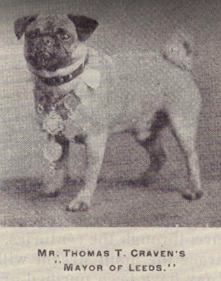
Pug circa 1910. Our thanks to PureDogTalk listener Kelly Schur for making these images available.
Greer noted that National Animal Interest Alliance (NAIA) is actively working to encourage awareness by breeders and purebred dog enthusiasts in the U.S. and elsewhere about this type of animal rights extremism and its looming potential impact here.
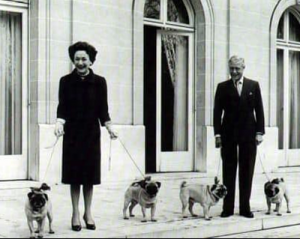
Duchess of Windsor’s Pugs … late 1800s. Our thanks to PureDogTalk listener Kelly Schur for making these images available.
Pugs are an ancient breed from China, the appearance of which has changed little in 150 years.
From the Pug Dog Club of America, “The Pug is of Chinese origin and dates back to the pre-Christian era. They were prized possessions of the emperors of China and lived in a most luxurious atmosphere and at times were even guarded by soldiers. Records show that three types of short-nosed dogs were bred by the Chinese. They were the Lion dog, the Pekingese and the Lo-sze. The Lo-sze or “Foo Dog” was the ancient Pug.”
293 – Coloring the Future: Artist Creates Purebred Dog Designs

Coloring the Future: Artist Creates Purebred Dog Designs
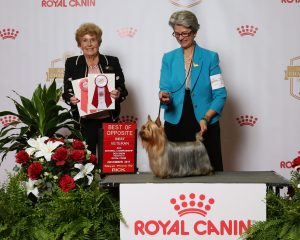
Sandy Mesmer and her Silky Terrier
Sandy Mesmer is an artist, Silky Terrier breeder and purebred dog enthusiast who has designed and published the first of a planned series of coloring books for each group.
“Color Me Canine: a Coloring Book for Dog Lovers of All Ages!” is Mesmer’s debut book in the series, this one covering the toy group.
Mesmer provides great insight about Silky Terriers in addition to her discussion of the coloring book, responsible breeders, taking back the conversation on purebred dogs and so much more.
“This book is a celebration of purebred dogs,” Mesmer said. “This is a viable alternative to the ‘adopt don’t shop’ message for children.”
“I am planning 7 more volumes of Color Me Canine, one for each AKC Group and Miscellaneous,” Mesmer added. “There are two areas that I could use help with:
- Part of the description I do for each breed is a crowd-sourced “In Three Words”. It can be helpful for someone to hear how the breed is very briefly described, it gives a snapshot of the breed’s temperament. You are very welcome to email me at sandy@smesmer.comwith your “In Three Words” for your breed. After all very breed is “great”. But is it independent? Sweet? Elegant? Feisty? All these adjectives can help a prospective buyer. As a matter of fact, as a thank you I’ll put you on our mailing list (if you’d like) so you can get the latest news about my coloring books.
- I have done over 160 headshots so far, these are the detailed drawings I use to model my coloring pages. They can be seen at the store (sandy-bergstrom-mesmer-designs.myshopify.com). I am working on the remaining 40+ as I work my way through each Group and am open to receiving photos of breeds I haven’t done yet. If I have done your breed, please feel free to check out your Headshot — I try hard to be an expert on each one but I know sometimes a detail slips through the cracks. As I can often easily correct such errors, I welcome experienced advice.”
Mesmer includes in the book, amongst a treasure trove of valuable information, this outstanding description.
What Makes a Responsible Pet Owner?
My friend and I got on the subject the other day. She volunteers at an animal shelter. We were having coffee. “I gotta tell you what happened.”
“Right before closing, I had this lady at my counter with a small black dog.
‘It’s not my fault,’ the lady told me. ‘This dog is obviously over-bred. I was promised that he wouldn’t shed, but he does – everywhere. And he pees everywhere too.
‘The kids begged and begged for a dog. I gave in but I told them, you’ll have to take care of him yourselves. And of course, they agreed. But did they? Of course not! It all got dumped on me. As usual. Never wanted the stupid thing in the first place.
‘Last night I got up to get a drink of water and stepped straight into a big pile of dog poop. That was the final straw.
‘I’m sure you understand I did all I could. The dog is obviously over-bred. It’s not my fault!”
My friend gave a deep sigh. “The woman so floored me, I couldn’t think of what to say. I came through the counter, took the dog’s leash and led him away. He’s a sweet little boy and no trouble at all. I took a long walk afterward.
“How can people get it so wrong?”
I shook my head. “No one ever tells people how to be a responsible pet owner. Instead they get their ears and eyeballs filled up with stories of Evil Breeders. Victimhood is so much simpler than to stand up and take responsibility.
“It’s way too easy to put a solitary bulls-eye on all breeders as the blanket cause of shelters full of abandoned animals. A good dog breeder is part of the solution, but so is a responsible pet owner.
“The popular press is curiously silent about this. It is loud about titillatingly horrific videos of stomach-turning breeding facilities, and we hear a lot these days about “over-bred” problem dogs.
“But what about the other side of the coin?”
I thought about our conversation over the next several days. What makes a responsible pet owner? I figured there were ten things to watch out for.
- A responsible pet owner is not in a rush to get a She knows that she is purchasing a companion who will be with her for the next 15 years. She does not try to get a dog for under the Christmas tree or for a birthday.
- A responsible pet owner never gets a dog just “for the kids”. She knows that at least one adult household member must be willing to be fully responsible for the
- Unless she is a responsible breeder, a responsible pet owner does not She never wants to “just have one litter” so the kids can see “the miracle of birth”.
- A responsible pet owner realizes that even with busy modern lifestyles, dogs need This is including regular walks. She knows that many canine behavior problems can be eliminated or at least mitigated with enough exercise.
- Whenever possible, she takes her dog with She knows that a happy dog is one with lots of stimulation and interaction.
- A responsible pet owner microchips her dog and has him registered with one of the lost and found She also has him licensed with her county.
- A responsible pet owner keeps up with her dog’s She checks him weekly for possible health issues and makes sure her dog gets regular wellness exams.
- A responsible pet owner trains her This can be in formal classes or from a book, but dogs love to learn; they become more sociable and excellent companions through training. If her dog has behavior problems, she is persistent in looking for help and answers and keeps going until she finds workable answers. She also realizes that if there is a persistent problem, most likely there is something that she is doing that is perpetuating the problem.
- A responsible pet owner continues to educate She keeps on learning about her breed, possible health issues and the latest in training protocols.
- A responsible pet owner knows that once she has made the original commitment, her dog is her responsibility for Like a child or a marriage, there are no give backs because the dog is no longer convenient or entertaining. It’s in sickness or in health, ’til death do us part.
I gave my friend the list. “What do you think?”
“I’m framing this and putting this on the wall behind the counter.”
“That would be great. If it helps just one dog have a better, more responsible owner, it’ll be worth it.”
I’ve heard about the excellent responsible pet ownership program they have in Calgary, Canada. Maybe that’s why that city has the lowest kill rate (how many pets are put to sleep) in North America.
Maybe this is the missing puzzle piece in the problem of pets in shelters. Just maybe.
292 — Jeff Heim: “Dog Shows Are Not Dying” and Other Punditry

Jeff Heim: “Dog Shows Are Not Dying” and Other Punditry
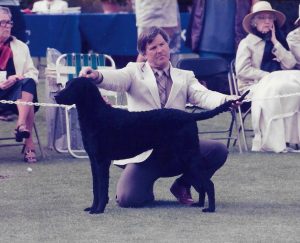
Professional handler Jeff Heim with a Curly Coated Retriever in 1985.
Professional handler, Jeff Heim, reflects on 50 years of learning, from cattle judging in FFA to observing handlers and judges at dog shows.
As someone who is always willing to help, talk to a stranger or answer a question, Heim observed there is a fine line in mentoring.
“You need to offer advice in a way people will hear it,” Heim said. He also encourages new exhibitors to watch other handlers to learn.
“Find the handlers who are above average,” Heim said. “Watch them. See what they are doing, take that move home and try it on your dog… not everything works for every dog. Learn what the handler is doing and why, with that particular dog – they’ve done the trial and error to get to that point.”
Heim repeats, for the umpteenth time in a row, the downfall of “drive through dog shows.”
“You cannot come to the dog show, show your dog and go home,” Heim said. “Spend some time. You spent your money. There’s a whole dog show here. Go watch breeds that are similar to yours. Then go watch breeds that aren’t similar. Watch the judges all day.”
“A judge can only judge what you present to them,” Heim noted. “The judges are not going to make up what they want to see, they are going to judge what you show them. The mediocre dog with a great handler is going to beat the great dog with an average handler most of the time. Because the great handler never lets the judge see the dog’s faults.”
Amongst his myth busting thoughts, Heim blows away the idea of “DNS Lists.”
“There is no judge I will not show a dog to. It’s a waste of time. You pay your money and take your chances. But know the type of dog the judge will like,” Heim added.
In his typical bluff fashion, Heim also opined that dog shows are not dying.
“The sport isn’t going to die,” Heim insisted. “This sport was going during wars. These days we have a lot of shows and entries are down because they’re all spread out. Dog shows are not put on for your entertainment. They are for earning championship points. The entertainment is on you. Put together a potluck with your friends. Sit down, talk, learn about each other. Dog people all have varied backgrounds. Put your phones DOWN! Interact with each other. If you aren’t having fun, maybe you need to change your group.”