

Posts by Laura Reeves
262 — Will Alexander on Grooming, Handling and Heroes

Will Alexander on Grooming, Handling and Heroes
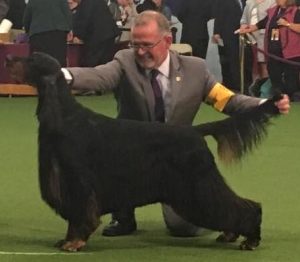
Will Alexander winning BOB in Gordon Setters at Westminster Kennel Club this week.
Canadian dog handling legend, Will Alexander, shares his memories, his handling tips and grooming tools that have brought him significant success in the last 25 years.
“My heroes were people like George Alston,” Alexander said. “He basically taught me to trim Irish Setters over the phone.”
“I always wanted to be a handler, but before embarking on a handling career I worked for Garry MacDonald in Canada, and for Bobby Stebbins in the States,” Alexander said.
Carving the picture
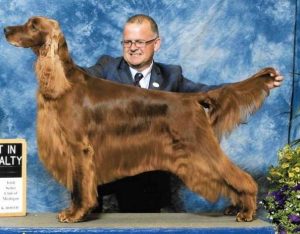
Will Alexander grew up with Irish Setters and learned from George Alston, over the phone, how to trim them.
Grooming is not a recipe, Alexander noted. Every dog is different. Famous for his meticulous grooming of setters particularly, Alexander describes a process to “build a shell around the dog” when trimming the back coat. He works with a stripping knife, his fingers, a grooming stone and, the most important piece, a bristle brush to bring up the oils in the coat.
Attention to detail
“I hate it when I hear “Oh, they won because they are so and so… well, they didn’t just grow up and they were so and so… they had to work hard to become so and so,” Alexander said. “It’s hard work. For every 15 minutes of fame there are 23 hrs 45 minutes working on your dog. It’s not age, it’s mileage.”
Tips of the trade
- Think in slow motion. In real time you’re doing exactly the right speed.
“When Miss P won the group at the Garden, George Alston called and yelled at me that I had gone too fast on the down and back. It was terrifying!”
- Attention to detail.
“I like to sit and watch the ring, pretend I’m in there already, making my mistakes in my head so I don’t make them in the ring.”
- “Old fashioned” isn’t bad
“I have a mind’s eye picture of the dogs. So much of type is in how they move, how they carry themselves,” Alexander said. “We need to be preserving the breeds not ‘improving’ them.”
Dream Best in Show Lineup
- English Springer Spaniel Ch. Salilyn’s Condor
- Borzoi Ch. Kishniga’s Desert Song
- Doberman Pinscher Ch. Brunswig’s Cryptonite
- Wire Fox Terrer ch galsul excellence
- Pekingese Ch. Wendessa Crown Prince
- Standard Poodle Ch. Rimskittle Ruffian
- German Shepherd Dog Ch Altana’s Mystique
BIS to Robert the Springer
For more information, videos, the book and more, visit http://www.doghandlingtips.com/
261 – AKC Doubles Your Cancer Research Dollars with a Matching Grant

AKC Doubles Your Cancer Research Dollars
More than 50 percent of dogs over 10 years old will be diagnosed with cancer. Dr. Diane Brown from AKC Canine Health Foundation wants to change that statistic.
AKC has pledged $250,000 in matching funds this year toward research into prevention, early diagnosis and treatment of all cancers in dogs. This enables individuals and clubs who donate to the matching fund to literally double the impact of every dollar.
Age is not a disease
“Age is not a disease,” Brown said. “There are quality of life issues to consider, but I believe we can get to a point of treating older dogs.”
Since people and dogs are affected by the same types of cancers, much of the research being done can be applied in what Brown describes as comparative oncology.
Prevention and Detection
In the prevention category, some cancer vaccines are a reality today and more are being studied. A melanoma vaccine is on the market now, Brown said.
Early detection of cancer saves lives in dogs and in people. Current research is looking at markers circulating in the dog’s system identified in blood samples that indicate increased risk for a specific disease.
Investing in personalized medicine is the wave of the future, Brown said. Using immunotherapy that is individualized for each dog is a very real possibility. She added that within five years many of these options will be realistically available.
Visit the AKCCHF crew on the west coast at the Beverly Hills Dog Show March 2-3. Brown encouraged visitors to share their stories and their questions.
Visit the AKCCHF website to learn more. And listen to past episodes with Brown to hear details on some of the research studies being conducted, particularly regarding epigenetics and hemangiosarcoma
Allison & Laura Handicap the Line Up at Westminster Kennel Club
Special: Allison & Laura Handicap the Line Up at Westminster Kennel Club
Special edition!! Allison & Laura jam on the Westminster Kennel Club show, the fabulous contenders and who may or may not rise to the top of the pack. Las Vegas oddsmakers have occasionally offered up a “line” on the Garden. But those are not Dog Show Divas! Pure Dog Talk brings you two of the sport’s long-time observers with input on who stands a good chance in the green carpet final seven line up this year.
Whiskey the Whippet and King the Wire Fox Terrier are high on the list of the potential winners. The Havanese, Bono, is peaking at the right time but could be pushed by Treasure, the Papillion. The Border Collie, Slick and the new German Shepherd Dog, Tony, are set to duke it out in the herding group. A surprise appearance from Elsa the Old English Sheepdog could upset that applecart.
Breed judging on Tuesday will make or break a lot of the group judging. Will Bean the Sussex Spaniel who won the group last year come back and play in BIS again? Or will the brand new English Setter, Penny, come on strong? Sporting is in play!
Working group is being judged by Jimmy Moses. Questions about what Doberman will get to the group and what Boxer will win the breed have a lot to do with which dog could win the group. Once again, up in the air. Allison says, “Jimmy Moses will pick a solid dog, but what’s he gonna get to work with?”
Jim Reynolds to Christine Erickson to Peter Green. Is this the fairy tale line up for King and Gabriel?
Allison is going all Ws…. She’s putting her line up as BIS to the Wire Fox Terrier and RBIS to the Whippet. Laura has her heart and her money, long odds, on the Wire Fox Terrier and the Havanese as RBIS.
Check out the Dog Show Divas with the best line on the best in show line up at Westminster Kennel Club on Pure Dog Talk! Vegas got nothin’ on us, baby!
260 – Canine Cognitive Dysfunction is More Than Old Age

Canine Cognitive Dysfunction is More Than Old Age
Dr. Marty Greer, DVM is back with this month’s Veterinary Voice topic, Canine Cognitive Dysfunction.
Canine Cognitive Dysfunction/Cognitive Dysfunction Syndrome: (CDS) is a neurobehavioral disorder affecting geriatric dogs and cats that is characterized by an age-related decline in cognitive abilities sufficient to affect functioning, with behavior changes that are not attributable to other medical conditions.
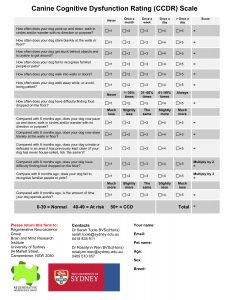 Signs of Dog Dementia
To look out for canine cognitive dysfunction, remember to check your dog’s “DISH”:
- Disorientation
- Paces
- Wanders aimlessly
- Becomes stuck on the wrong side of the door or behind furniture
- Staring at walls or into space
- Seems lost in the yard or forgets the purpose of going outside
- Forgets where the water and food bowls and doors are
- Fails to recognize familiar people or dogs
- Reduced responsiveness to name or verbal commands
- Abnormal response – increased or decreased – to familiar objects
- Difficulty learning new tasks
- Difficulty performing previously learned task
- Loss of interest in food
- Repetitive behaviors
- Interaction with Family Members
- Seeks less attention (petting, belly rubs, play)
- Less enthusiastic to greet people or other pets in the home
- No longer greets family upon arriving home
- Fails to respond to verbal cues
- Increased irritability and/or aggression with family and pets
- Changes in exploratory behavior
- Intolerant of being left alone
- Sleep and Activity
- Sleeps more hours per day, especially during the daytime
- Sleeps less throughout the night
- Reduced daily activity
- Lack of interest in his surroundings
- Restlessness, pacing, wandering or circling at sunset (sundowning)
- Vocalization at night (barking or howling)
- House Training
- Urinates or defecates indoors
- Urinates or defecates indoors soon after having been outside
- Failure to indicate need to go outside
- Accidents occur in front of his owners
- Elimination at uncommon outdoor locations such as on concrete
Cause
The neuroanatomic pathology in dogs and cats shares some characteristics with human Alzheimer’s disease, specifically β-amyloid accumulation, tau phosphorylation and neuronal loss in the frontal cortex, cerebellum, and hippocampus.
Managing Canine Cognitive Dysfunction
- Purina Neurocare/Bright Minds
- Hills B/D
- Royal canin
- Addition of antioxidants (Vitamin C and E) for cellular-level health and medium-chain triglycerides for cognitive improvement. L-Carnitine for muscle mass.
- Phosphatidylserine, Apoaequorin and S-Adenosyl-l-Methionine (SAME)
- Anipryl/selegeline – Is a selective monoamine oxidase -B inhibitor, which could enhance catecholamine neuron activity and increases dopamine levels in dogs.
- DHA
- Avoid unnecessary vaccines
- Skip pharmaceuticals when possible
- Reduce stress including changes in their routine and environment
- Potty pads, confinement, outside more often
- Pet-proof the house
- Social interaction and mental engagement/ environmental enrichment
- Keep the day/night cycles regular with sunlight
- Walking/exercise/stroller if needed
- Situational anti-anxiety drugs – trazodone and gabapentin
259 — LIVE from Canada: “Judges Were Not Hatched From an Egg”
“Judges Were Not Hatched From an Egg”
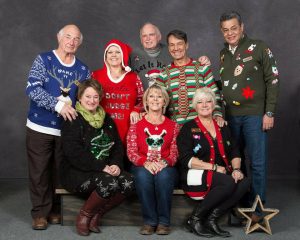
Regina Kennel Club judging panel on Ugly Sweater Day.
Host Laura Reeves moderates an international judges panel discussion at the Regina Kennel Club in Saskatchewan, Canada. The panel includes Lee Anne Bateman, Saskatchewan, Linda Buckley, Australia and Tabatha Buckley-Bettis, United States.
The panel discussed their views on how to “mentor the future” of purebred dogs.
Bateman noted that it’s important for judges to remember “how much fun it is to have dogs in your life” and to be proud of ones dogs, “that’s how everyone feels coming in your ring.”
“Just because I don’t put your dog up today, it doesn’t mean I don’t like YOU,” Buckley said. “On the day, I preferred someone else’s dog, but I’d still like you to come out and have a drink with me.”
Everyone Wins a Prize?
Tabatha Buckley-Bettis observed that “giving everyone a ribbon” isn’t necessarily improving the sport.
“Unlike where most people think everyone should get a prize, how I excel is people telling me what I did wrong, then trying to improve and get better,” Buckley-Bettis said. “When the people who have been in the breeds come and correct you, it’s a good thing.”
The judges all offered important advice for everyone in the sport. These suggestions are consistent and recurring themes.
Watch and Learn
“Stay at the dog show all weekend,” Bateman said. “Go watch. Watch handlers. Watch and learn. It’s hard to get better if you don’t immerse yourself in it. Don’t just watch your own breed. Watch people in grooming area. Video your performance and watch it critically. Give new people in your breed a hand and be NICE to them.”
Buckley reminisced about the old-time English Cocker breeder who helped her when she was new. He groomed one side of the dog and told her “Do the other side to match.” This was a very common learning method and is still employed by many of us today.
“If you want help, come and ask us,” Buckley-Bettis said. “We can’t come and find you because we don’t know what you need. Don’t be intimidated.”
“Seriously people, we’re not curing cancer here,” Buckley-Bettis observed. “This is something we should all be enjoying, but we can’t all win.”
258 — Mari-Beth O’Neill: AKC’s Own Guardian of the Galaxy

Mari-Beth O’Neill: “Guardian of the Galaxy”
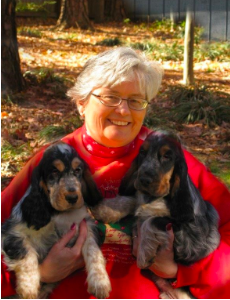 American Kennel Club Vice President of Sport Services, Mari-Beth O’Neill, is the walking, talking institutional memory of the organization. One of the longest serving current staff members, O’Neill is also a second-generation AKC employee. Her father was Executive Vice President of the organization and show chair of the AKC Centennial Show.
“I attended dog shows in utero,” O’Neill said. “My parents had Dobermans, but the rule was I had to have a dog I could pick up and carry out of a situation. That led to Manchester terriers.”
O’Neill owned and showed the top winning Toy Manchester Terrier of the time period, winning the toy group brace at the Garden in 1968 and the toy group in 1969 with Ch. Renreh Lorelei of Charmara.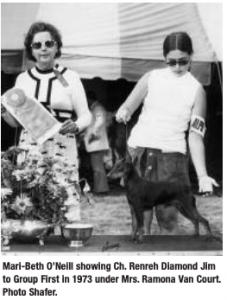
No Gypsy Caravan
Her parents insisted she couldn’t “just be a gypsy,” so she went to college and worked as a classroom teacher, along with working as an assistant for then-handler (Theresa) Terry Hundt.
“It was held over my head when I was growing up, if I didn’t maintain my grades, I didn’t play,” O’Neill said. That upbringing is what shapes the requirements of today’s Junior Showmanship contestants at AKC National Championship presented by Royal Canin.
In December, 160 juniors, the largest entry at the show, competed for Best Junior. All of them had won first place in an open class at least five times and maintained a 3.0 GPA during the year. The winner of the competition, Claire Ctibor, was interviewed on PureDogTalk last year.
Chipping Away at the Iceberg
Juniors have always been a passion for O’Neill. As she moved through the ranks and roles at AKC, she eventually wound up in a position to make a difference. In 1995 she helped establish the national junior organization for AKC. Since then she has continued to work to support the youth and future of the sport.
“Judging juniors is the hardest thing you will ever judge,” O’Neill said. “It’s a subjective sport. And it’s hard for new people to understand how subjective it is.”
An expanded coordination with 4H clubs, Junior showcase events, Junior scholarship programs and more are all the direct result of O’Neill’s passion for the program.
“I have this ice pick and there’s this big iceberg out there… I just keep chipping away at it…”
“We need to wake up and smell the coffee,” O’Neill said. “This ain’t my father’s AKC anymore. We have a lot more events, a whole different society to address. In many cases people love dogs but they’ve never been around them.”
“The greatest joy for me is meeting these young people, seeing how wonderful they are. What great careers they are pursuing, how they are maintaining their passion and involvement with dogs.
257 – The Ancient Breed Believed to Predate all European Hunting Dogs
The Ancient Breed Believed to Predate all European Hunting Dogs
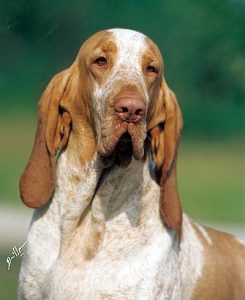
The Bracco Italiano is depicted in the fourth and fifth centuries BC.
Dating back 2500 years, the Bracco Italiano is one of the world’s oldest hunting dogs. Host Laura Reeves is joined by Bracco Italiano Club of America member Marilyn Vinson to learn more.
Braccos are frequently compared to the Spinone Italiano, but Vinson said the similarities are more in country of origin than in appearance.
“The Bracco is a breed of angles,” Vinson said, “the Spinone a breed of curves.”
And while the Bracco may have a very houndy look, Vinson said, they are a versatile hunting dog, designed to hunt, point and retrieve.
Hot Knife Through Butter
Vinson said the breed’s characteristic trot is one of its most identifying features. While the Bracco may sometimes appear to be “put together with rubber bands,” Vinson said the trot “is like a hot knife through butter, so smooth.” The breed’s enormous 10- to 12-foot long stride is designed to keep them working efficiently all day in the hunting field.
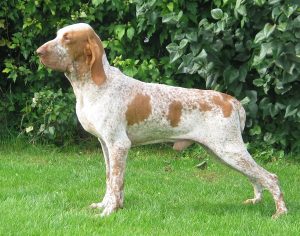
The Bracco Italiano is a “breed of angles,” according to enthusiast Marilyn Vinson.
Braccos came to the attention of enthusiasts in the US in the late 1990s, with the first dog registered with AKC’s Foundation Stock Service in 2001. According to Vinson a teenager in the Midwest formed original club, with help from other fanciers.
Dual Dogs a Must
The priority for the Bracco is to be a dual dog, Vinson said. The standard is the description of dog best able to hunt all day.
“I don’t care how well your dog hunts, if it doesn’t look like a Bracco I don’t want it,” Vinson said. “And I don’t care how pretty my dog is, if it doesn’t hunt I don’t want it.”
Currently working its way from FSS to Miscellaneous, and eventually regular group status, the Bracco has become popular with exhibitors for their easy-going disposition and “Gumby-like” properties, Vinson said. The breed currently competes in AKC pointing breed hunt tests, agility and more, as well as in FSS/Open conformation shows.
Health Considerations
The breed is generally long-lived, but can encounter issues with skin allergies, kidney problems caused by amyloidosis and is affected by bloat.
For more information, visit: https://www.thebraccoclub.org/
256 — Jason Hoke: Just Judge the Dogs & Be Nice to People
Jason Hoke: “Just Judge the Dogs & Be Nice to People”
Second generation dog breeder Jason Hoke grew up with German Shepherd Dogs. His family acquired Great Danes in the mid ‘80s and he now owns Whippets.
“I think when I judge dogs, I’m very much a purist,” Hoke said. “I think handlers revert back to being even harder and more like a breeder judge. Because we were handlers, we know the value of showmanship, but also realize flash and dash doesn’t make a good dog.
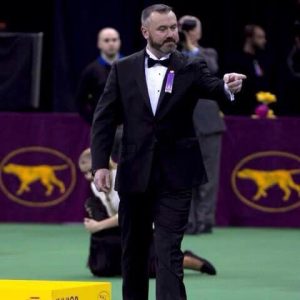
Jason Hoke judging at Westminster Kennel Club
“Just judge the dogs,” Hoke said. “That’s the best thing we can do.”
Breeder judges and handler judges
“As handlers, we have the opportunity to put our hands on so many more breeds,” Hoke said. “To be a successful handler, you have to learn what a good dog is in every breed you show. But at the core, we’re still breeders. We care about the breeds.
“I don’t care if it moves on the table, stands like a statue, comes back and does the pose heard round the world, if it’s not a good dog, just being a good show dog doesn’t make it a good dog,” Hoke said.
Pet peeves
“Running like a maniac around the ring is ridiculous,” Hoke said. “It defeats the purpose. It takes away from the dog’s silhouette and ruins every part of the outline. Showing a dog like a generic dog is incorrect.”
Encourage new people
“We have to be accessible, open to talking to new people,” Hoke said. “Encourage new people. Be members of clubs to volunteer. We have to teach people what our breeds are all about.”
BIO, from Petcha:
“Jason M. Hoke, a resident of Madison, Wis., began his longstanding involvement in the sport of purebred dogs in the late 1970s exhibiting German Shepherd Dogs in Junior Showmanship. In 1984, he and his parents purchased two Great Danes, which became their passion. They bred Great Danes under the Jamara prefix, producing numerous champions and one of the top Great Danes in the breed’s history.
Mr. Hoke continued his involvement by apprenticing as a young adult with noted professional handlers such as Leroy Stage and Wood Wornall. He then went on to become a successful professional handler, winning Best in Shows from many groups, and presented dogs to the highest rankings in their respective breeds.”
Quote of the Day, From Great Dane Review:
What advice would you give owner handlers just getting started in the ring?
Since I started as an owner handler I think the biggest suggestion is first to study the breed. Learn the Trends and Lines. Then while you are in the ring and outside, observe all the dogs. Be objective and try to see where your dog falls in the mix. Be fair when thinking about your own dog. Know it’s strong points and it’s weaknesses as well. Always try to accentuate the positive of your dog. Listen to others for tips as well. Most people will try to give you constructive advice. Mentors in the breed are invaluable from a breeding and a handling standpoint. Practice handing and go to handling classes. I used to go to classes 2 times a week for years. It’s a great training tool for your dog as well as yourself.
255 — Lost Dog Found: Tips for Success in Emergency

Lost dog found…
Today host Laura Reeves visits with Allison Foley of Leading Edge Dog Show Academy about some of the important steps to quickly and successfully find a lost dog.
The following is a partial reprint of Laura’s As the Wheels Turn column originally published in September 2015 for the online magazine Best in Show Daily. Many of us have lived this nightmare. Here are tips on how you can be prepared in case of emergency.
Lost Dog Story
Ours is a story to which every single dog lover can relate. Either you have lost a dog or you live in perpetual fear of the day it happens to you.
TiMI, the light of my life and last year’s #1 GWP, had gone to visit my friend and Spinone client in Carson City, NV in early August to get ready for the fall hunt tests. Since her husband had run TiMI for the first two legs of his JH this spring, it made perfect sense for him to go back there to finish up his title while I was busy running around the country showing dogs.
Stacey took TiMI out every weekend to refresh his training and ran him off the quad four miles a day to get him in condition for the hunt tests and the coming GWP national. I talked to Stacey Friday night and she was pumped. They were ready for the big double-double hunt test the next morning (two tests a day for two days).
Saturday morning, before the crack of dawn, in the excitement and confusion of getting ready for a weeklong elk hunting trip, Stacy’s husband let their young Spinone, Adele, and TiMI out and forgot to put on their invisible fence collars.
What WERE they thinking?
We can only guess from there, but I would assume the doggie conversation went something like this:
Adele: Hey, TiMI, guess what, the Mister spaced our zippy collars…..
TiMI: Dude, how ‘bout we go check out that bad rabbit down at the end of the driveway. I bet we can catch him today…
Adele: Right on big guy… Let’s hustle before they holler at us…
(Trot, trot, trot…. ZING off goes the bunny, but today, instead of jigging right, he jigs left… Two hunting dogs in hot pursuit in the wee dark hours of the pre-dawn, skirting yards and sleeping barns, off to the northeast…)
Pant, pant, pant….
Adele: Whoa, that bunny was sure fast this morning….
TiMI: Wait, what’s that? Hmmm…. <Sniff, sniff> Something smells good up here… Let’s go check it out for a minute.
Adele: Well… OK, but we’re going to get in trouble…
TiMI: Yeah, yeah, this smells like a foxy lady just waiting for some company…
Adele: You are such a BOY…. (doggie sigh)
(Trot, trot, trot… OOOOOOPS! Out of the gloom rise a half-dozen scraggly, doggy looking animals…. Coyotes, including a female ready to breed, and her mate…)
TiMI: Adele, we are in big trouble. You stay behind me and I’ll try to scare them away…
Adele: whimper….
TiMI: (Standing as big and tough as he can) RAWR…
(Coyotes charge.)
TiMI: Discretion is the better part of valor, girl! RUN!!!
(Dogs run, coyotes chase into the mists…)
That sinking feeling
Meanwhile, Stacy steps outside to load the dogs at 5:30 a.m. and finds nothing. She calls and calls. Then comes that sinking feeling in your stomach that leaves your ears ringing and bile at the back of your throat.
Stacey searched for several hours Saturday morning by herself, driving and calling and whistling. She contacted me in Oregon once it became obvious that the dogs were not going to reappear.
Critical first steps
From that point forward, the machine went into overdrive. Since I was a six hour drive away, I was the communication center, media center and public information center. I threw together a lost dog flyer from an existing template in my word processing program and emailed it to Stacey, who had it printed and posted around the neighborhood within an hour. As the deputy emergency manager of her county, Stacey has better than average resources. All of which were put to use with contacts and flyer distribution to all relevant authorities, animal shelters, vet clinics and more.
I shared the flyer on social media, Craigslist, lost dog sites, local television and radio sites and more. I know for a fact a half-dozen other people across the country with no actual connection to the dogs other than seeing the original post on Facebook were also sharing the information everywhere they could.
By Saturday afternoon, a dozen people were searching, in jeeps, on quads, in trucks and on foot in all of the expected places the dogs would normally have gone. Unfortunately, they had gone totally the opposite direction.
Home Again flyers with microchip information were faxed, animal communicators were contacted, tracking dog groups specializing in lost pets were called.
Late Saturday night with zero sightings, zero notifications, the dogs appeared to have disappeared into thin air. I made the decision to drive down to Carson City the next day.
Dog gone…
I didn’t sleep much that night, just kept muttering to myself, checking Craigslist, hunkered down in my chair on the deck.
I left Sunday morning planning to borrow a horse to search areas the vehicles couldn’t go. Within an hour of my asking on Facebook for a horse, I had a friend, who was visiting England, able to use her connections to have a woman call me on my cel offering to drive her horse three hours to give me a mount for the search. I had a text from another friend with the names of every field trial person in town and their phone numbers. I heard later another friend had a horse lined up and ready to go.
Good news?
About three hours into my drive, I received a text that they had a sighting.
“Matt” was a young man out skeet shooting in a deserted area northeast of town. He’d driven past two “good looking” dogs just lying under a big shade tree and wondered where their owners were. When he came back the same way, in search of more fuel and water, he noticed one of the dogs (TiMI) had moved and was lying in the middle of the road, causing him to have to go around off-road.
It is one of mankind’s great endeavors, to anthropomorphize our animals sufficiently to understand their thinking. Did they go toward the sounds of shotguns, and skeet shooting, as safe and familiar and hopeful? Did TiMI watch that truck drive by and intentionally try to “flag down” the human? We can’t know, but I am willing to believe both to be true.
When “Matt” got to town, he happened to glance at the huge poster plastered on a pole at the corner of 5th and Carson River Road. Something must have caught his eye, because he stopped, saw the pictures, remembered the dogs lying in the middle of the road, and called the contact number.
Stacey, frantically trying to understand his information and directions on a bad cel connection, finally arranged that searchers would meet him and follow him back to where he’d seen the dogs.
When she told him the reward noted on the poster was his if the dogs were there, his comment was, “I don’t need a reward for doing the right thing.” Needless to say, he got the reward anyway.
The first searchers to arrive at the site were known to Adele, but not TiMI. She was slowly going toward them when TiMI came up and put his head over her shoulders in a clearly protective stance. Fortunately, the rescuers were calm and quiet and gentle and were able to leash both dogs until Stacey could arrive for a joyous reunion.
By the time I arrived in Carson City Sunday afternoon, the dogs were home safe and remarkably unharmed.
The power of social media is such that we had hundreds, and I mean close to 1,000, shares from people, friends and strangers, all over the country.
What we learned
From Stacey:
- I would call for help earlier. I was by myself so I couldn’t stay at home and be out looking for the dogs.
- I would have moved faster and started searching earlier. I kept thinking they’d walk up, so I wasted 15 minutes.
- I would go in a complete circle, ranging out. I didn’t search the direction they went initially.
From a communications standpoint, my first flyer did not have a good enough picture of TiMI. I wanted non-show photos which still showed face and body markings. Having candid file photos of all dogs is something I’m adding to my list of musts. I learned that Home Again will not fax a flyer which offers a reward, so had to remake the flyer for them. TiMI is microchipped, but in my disjointed thinking, I couldn’t for the life of me remember where the number was. I wound up calling to get it from my vet. Making sure microchip information is centrally located with each dog’s registration and other data is another “must” adjustment.
There are great websites available with outstanding “lost dog” protocols. What we learned is that even experienced, comparatively tough cookies such as ourselves can be reduced to the barest of coherence when a dearly loved companion goes walkabout. Being prepared and organized *before* the dreaded event happens will reduce confusion and response time, increasing the chances for a happy ending to the “adventure.”
254 – Purebred Dogs Get Their Own Super Hero Movie

Purebred Dogs Get Their Own Super Hero Movie
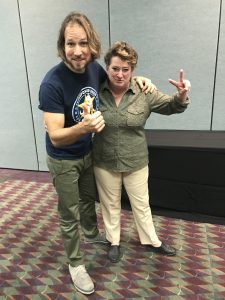
Super Power Dogs producer Daniel Ferguson, with host Laura Reeves.
Host Laura Reeves, live at the AKC National Championship brought to you by Royal Canin, visits with Daniel Ferguson, producer of the new superhero IMAX film — Super Power Dogs.
An exciting joint effort with corporate sponsors including Mars Pet Care and Wisdom Panel, Super Power Dogs is a story about the heroic achievements of dogs, Ferguson said.
“This movie is like the doggie avengers,” Ferguson said. “If features five breeds with different, specific abilities.”
Ferguson said he wanted sort of a “James Bond opening” to the movie. The opening scene of an avalanche shows Henry, the Border Collie, danging from a helicopter on the way to the rescue. Henry is actually the movie’s narrator, Ferguson noted. “It’s the voice of Dog.”
An eclectic background in film gives Ferguson perspective and creativity for the project.
Ferguson has produced, written and directed films for National Geographic Studios, the National Wildlife Federation, History TV, Smithsonian Networks, France Television and Discovery Channel. His IMAX®/giant screen credits include Lost Worlds: Life in the Balance, Wired to Win: Surviving the Tour de France, Journey to Mecca and Jerusalem. His most recent film is the feature documentary, Last of the Elephant Men.
“You’re talking about an IMAX film, the screen is multiple stories tall,” Ferguson said. “The screen holds so much promise, you have to do it right. Getting the science right is important. There are so many stories to tell of dogs involved in helping people.”
Halo, a Dutch Shepherd, handled by Fire Captain ‘Cat’ Labrada of Miami Dade County, Florida is the “star” of the movie. The film crew followed Halo and Cat for three years as they developed the bonds they’d need for the emergency work they do.
Joining Henry and Halo are, Reef, a Newfoundland lifeguard with the Italian coastguard; Ricochet, a Californian surf legend helping people with special needs; and, the Bloodhound brothers, Tipper & Tony, who are leading the fight to save endangered species in Africa.
Super Power Dogs is set to debut at IMAX theaters around the country this spring. Check local listings for more details.